

The Missing Layer in Personal Finance: Seeing Assets, Liabilities and Family Wealth Together
Open a typical household's finances and a strange pattern shows up. One spouse can name their own mutual fund returns down to the last percentage point, yet has only a rough idea of what the other holds. A working son tracks his own stock portfolio closely while barely knowing what his retired parents have set aside. Personal finance apps have gotten very good at showing an individual their own numbers, but almost none of them show a family what it looks like together, which loans overlap, which goals are being funded twice, and which gaps nobody is covering. This is the layer most households are missing, and it is exactly the problem that an asset consolidation app for Indian families is built to address, by pulling separate financial pictures into one shared view without erasing who owns what.
Why Personal Finance Tools Stop at the Individual Level
Built Around One Person, Not a Household
Most budgeting and investment apps are designed with a single user in mind, which makes sense given how the category originally developed. A person logs in, links their own bank account and demat account, and sees their own picture. This works well for tracking one person's spending or portfolio growth, but it was never built to answer household level questions, such as whether the family's combined emergency fund is actually sufficient, or whether two people are unknowingly investing in overlapping mutual fund categories.
The Rise of Two-Income, Two-Portfolio Families
India's female labour force participation rate climbed noticeably through the middle of 2026, part of a broader shift toward more dual income households across both rural and urban areas. As more households move from a single earner to two working partners, financial planning naturally becomes more complex, with two salaries, two sets of investments, and often two separate views of the same shared goals. Reviewing joint financial goals, insurance coverage, and separate emergency funds tends to matter more precisely at this stage, yet most tools still nudge each partner toward managing their own numbers in isolation.
What Gets Lost When Family Finances Stay Separate
Goals That Quietly Get Funded Twice, or Not at All
Without a shared view, it is surprisingly common for two people to both open a recurring investment toward the same long term goal, such as a child's education, without realising the other has done the same. The result is either an unnecessary overlap that could have been redirected toward a different priority, or the opposite problem, where both partners assume the other is handling a particular goal and it ends up unfunded entirely.
Combined Debt That Nobody Sees in Full
A home loan taken jointly, a personal loan one partner took out independently, and a credit card balance the other is quietly paying down rarely get viewed as a single combined liability. This fragmented view can make a household's actual debt exposure look smaller than it really is, since no single person, and no single app, is adding every outstanding balance together at once.
The Growing Case for a Shared Financial View
More Women Managing Independent Portfolios
Women's participation in India's investment markets has grown substantially in recent years. Women investors now hold a significant and rapidly growing share of mutual fund assets nationally, with their combined holdings roughly tripling over five years according to data reported from AMFI and Crisil Intelligence, and they account for close to one in four stock market investors today. This growth is a genuinely positive shift toward financial independence, but it also means more households now have two active, independently managed portfolios rather than one, which makes a combined household view more useful than it would have been a decade ago, not less.
Aging Parents and the Generational Layer
Beyond spouses, many Indian households also carry a generational dimension, where adult children gradually take on more responsibility for aging parents' finances, from insurance renewals to fixed deposits nearing maturity. Without a shared record, this transition tends to happen reactively, with details discovered only when a renewal is missed or a document cannot be located, rather than through a financial picture the whole family already understands. Starting this conversation early, well before it becomes urgent, tends to make the eventual handover of responsibility far smoother for everyone involved.
What a Genuine Household View Should Actually Include
Combining Net Worth Without Erasing Individual Ownership
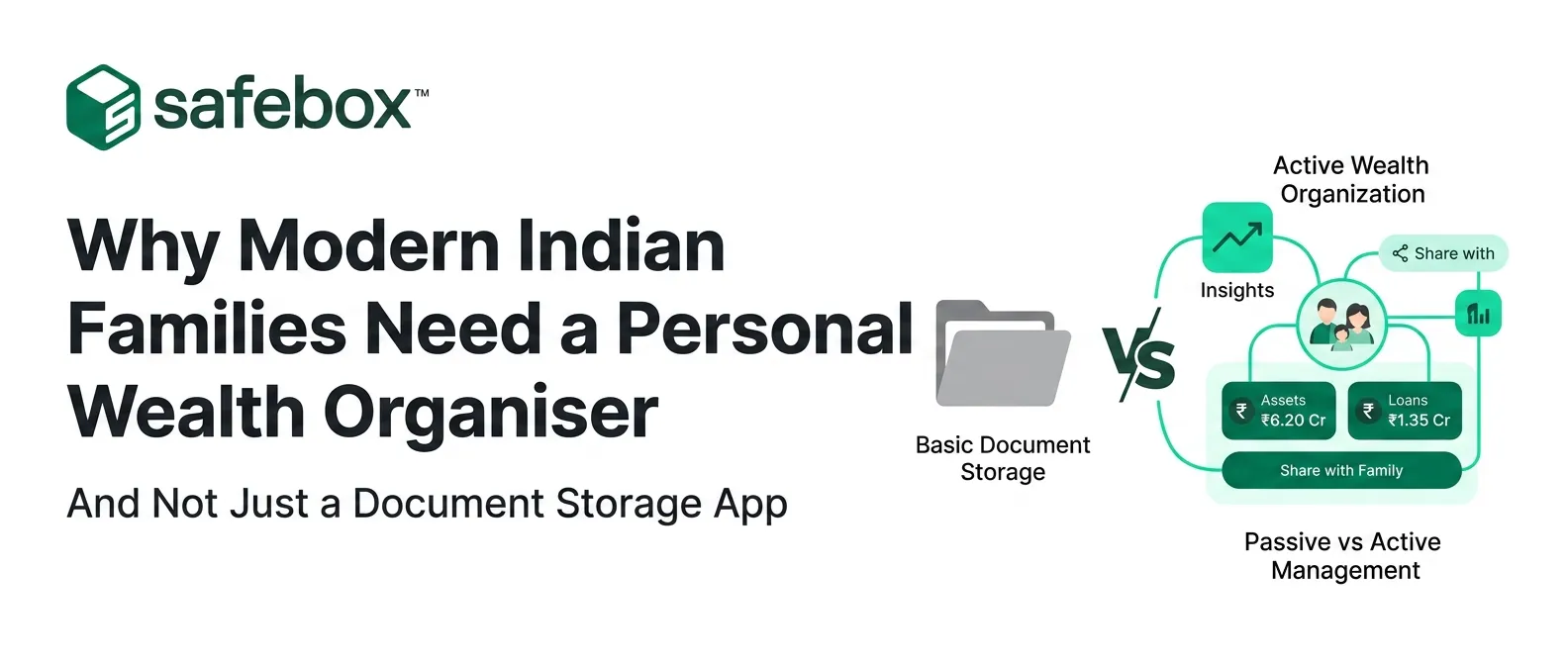
A useful family-level view does not need to merge everyone's finances into one undifferentiated pool. It simply needs to show each person's assets and liabilities clearly labelled, alongside a combined household total, so that individual ownership stays clear while the bigger picture remains visible to those who need to see it. This is the practical middle ground that tools designed to bring family assets and liabilities into one view aim to strike, offering household level clarity without forcing every account into a single shared login.
Shared Visibility Without Shared Passwords
A common concern with combining family finances is privacy, and rightly so. The more practical approach is controlled visibility, where each family member can choose what to share and with whom, rather than everyone needing full access to every account. A spouse might share investment summaries without sharing day to day spending details, while parents might grant a trusted adult child visibility into key policies and accounts without handing over full account access. This kind of selective sharing tends to be far more realistic for most families than an all-or-nothing approach.
Building This Layer Into Everyday Financial Habits
Introducing a shared financial view works best as a gradual habit rather than a one-time event. Starting with a single conversation, listing out major assets, loans, and insurance policies across the household, gives everyone a baseline to work from. From there, revisiting that shared picture every few months, alongside individual reviews each person already does for their own accounts, keeps the household layer current without requiring anyone to give up the personal tracking habits they already rely on.
Common Coordination Mistakes Families Run Into
Assuming a Verbal Update Counts as Shared Knowledge
Many couples believe they are already on the same page simply because they occasionally mention a new investment or a paid off loan in conversation. In practice, these casual updates rarely stick in enough detail to be useful later. A mention that a fixed deposit was renewed last month is not the same as both partners knowing the exact bank, maturity date, and amount, particularly months or years down the line when the detail is actually needed.
Treating Financial Planning as One Person's Responsibility
In many households, one partner naturally becomes the default manager of shared finances, tracking bills, renewing policies, and reviewing investments, while the other partner stays only loosely informed. This arrangement can work smoothly for years, but it leaves the less involved partner with a significant gap in financial literacy specific to their own household, which tends to surface as a stressful learning curve during exactly the moments when clear thinking matters most, such as a medical emergency or a sudden job loss.
How a Shared View Changes Everyday Financial Decisions
Making Big Purchases With the Full Picture in Mind
A major decision, such as buying a car, upgrading a home, or taking on a new loan, looks different when both partners can see the household's complete asset and liability position rather than just their own individual numbers. A purchase that seems comfortably affordable based on one person's savings alone might look considerably tighter once the household's combined existing debt is factored in, and a shared view through an app for consolidating family assets and liabilities surfaces that reality before a decision is made rather than after.
Reducing Financial Friction Between Partners
Money disagreements between partners often stem less from actual financial strain and more from mismatched assumptions about where the household stands. When both partners can see the same numbers, disagreements tend to shift from vague arguments about spending habits toward specific, solvable conversations about actual priorities, since the guesswork that usually fuels financial tension has been removed from the equation.
Conclusion
Individual net worth tracking answers an important question, but it is not the same question a household needs answered. Seeing combined assets, shared liabilities, and overlapping goals together is the layer most families are currently missing, even as more households move toward two incomes and two independently managed portfolios. Building that shared view, carefully and with the right privacy boundaries in place, turns two separate financial pictures into one a family can actually plan around together. The households that get the most benefit from this shift tend to be the ones that treat it as an ongoing habit rather than a one-time project, revisiting the shared picture regularly enough that it stays accurate as incomes, goals, and responsibilities continue to evolve over time.























Sign in to leave a comment.