

Buyers sourcing stainless steel pipe for process or power applications often come across both ASTM A312 and ASTM A358 in technical specifications, and the two are sometimes assumed to be interchangeable. They are not. Each standard covers a different manufacturing scope and is written for a different range of service conditions, and picking the wrong one on a purchase order can lead to a pipe that does not match the design requirement even though both are austenitic stainless steel products.
What Is ASTM A312 Pipe
ASTM A312 is the standard specification for seamless and welded austenitic stainless steel pipe, commonly used across general corrosive and high temperature service. It covers both seamless pipe and welded pipe made without the addition of filler metal, typically in smaller to mid range diameters, and it is one of the most widely specified standards for process piping in chemical, pharmaceutical and general industrial plants. Grades such as 304, 304L, 316 and 316L are all commonly supplied under A312.
What Is ASTM A358 Pipe
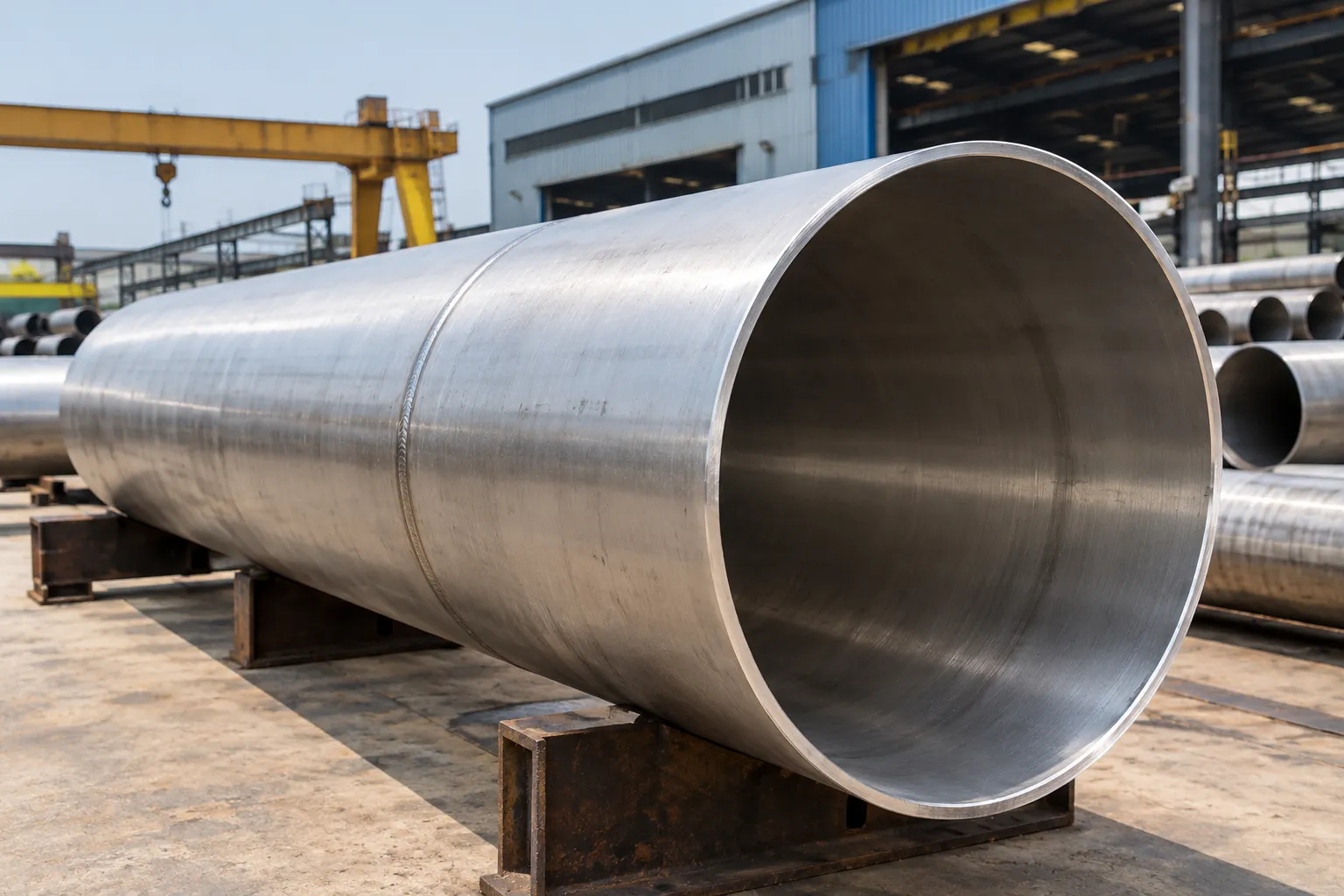
ASTM A358 is the standard specification for electric fusion welded austenitic chromium nickel alloy steel pipe, intended specifically for high temperature and general corrosive service. Unlike A312, it only covers welded pipe, and it is generally used for larger diameters where seamless manufacturing becomes impractical. A358 also introduces different pipe classes based on the extent of radiographic examination performed on the weld seam, which directly affects the allowable design stress of the pipe.
Key Differences Between A312 and A358
The most basic difference is manufacturing scope. A312 covers both seamless and welded pipe, giving buyers flexibility depending on diameter and application, while A358 covers only electric fusion welded pipe and does not include a seamless option. Diameter range is another distinguishing factor, since A358 is typically used for larger diameter pipe where seamless production is not practical or economical, while A312 is commonly specified across a wider range including smaller process piping sizes.
Weld examination and pipe classification set the two standards further apart. A358 defines distinct classes, such as Class 1 and Class 2, based on whether the weld seam is fully radiographed, spot radiographed, or not radiographed, and this classification directly affects the allowable stress value used in design calculations. A312 welded pipe does not carry the same class system, since its scope and typical application are different. Because of this, A358 is frequently selected for large diameter, high temperature piping systems such as those found in power generation and process plants, while A312 remains the general purpose default for general corrosive and high temperature service across a broader diameter range.
Which Standard Should You Choose
The choice generally comes down to diameter, service temperature and the design stress requirement specified by the project engineer. For general process piping in small to mid range diameters, A312 is usually the appropriate reference, available in both seamless and welded form. For larger diameter piping in high temperature service where weld integrity and radiographic classification matter for the design stress calculation, A358 is typically the correct standard. In practice, the governing piping specification or project drawing will state which standard applies, and this should always take precedence over a general assumption based on diameter alone.
Buyers evaluating either standard can review the stainless steel welded pipe range for welded options relevant to both A312 and A358 requirements, and the stainless steel seamless pipe range for seamless A312 pipe in process piping sizes.
Conclusion
ASTM A312 and ASTM A358 are both austenitic stainless steel pipe standards, but they are not interchangeable. A312 covers seamless and welded pipe across a broad diameter range for general corrosive and high temperature service, while A358 is specific to electric fusion welded pipe, typically in larger diameters, with weld classification that affects allowable design stress. Confirming the correct standard against the project specification and Mill Test Certificate remains the only reliable way to ensure the pipe supplied matches the design intent.

















Sign in to leave a comment.