
The Worldwide Star Tracker for Astrophotography Market: Strategic Trends and Commercial Opportunities
Market Overview: Scale, Growth Trajectory, and Structural Challenges
The global market for star trackers dedicated to astrophotography has transitioned from a niche enthusiast segment to a commercially significant hardware ecosystem. Between 2020 and 2025, revenue grew from approximately 102.5 million USD to 163.5 million USD, reflecting sustained adoption among amateur astronomers, landscape photographers, and educational institutions. The trajectory forward indicates continued expansion, with projected revenue reaching 312.59 million USD by 2032, supported by a compound annual growth rate of 9.72 percent across the forecast period through 2032. This growth pattern is not merely incremental; it signals a structural broadening of the addressable market as tracking hardware becomes more accessible, reliable, and integrated with modern imaging workflows.
Despite the positive momentum, the sector faces several interconnected challenges that will shape competitive positioning over the next cycle. First, polar alignment accuracy remains a persistent friction point for consumer-grade trackers. While manufacturers have introduced smartphone-assisted alignment tools, integrated laser pointers, and dedicated alignment scopes, achieving repeatable precision under suboptimal viewing conditions still demands user skill and patience. Second, hardware miniaturization and payload optimization continue to pull in different directions. Photographers increasingly demand compact, travel-friendly rigs capable of supporting heavier mirrorless cameras and fast telephoto lenses, but shrinking mechanical footprints without sacrificing tracking stability or battery endurance requires careful engineering trade-offs. Third, the supply chain environment remains sensitive to component availability, particularly for precision stepper motors, timing controllers, and durable aluminum or carbon fiber housings. Variability in input costs can compress margins or delay product iterations, especially for companies operating with lean inventory models.
A fourth challenge lies in the absence of standardized performance benchmarks tailored specifically to amateur astrophotography tracking mounts. Products are evaluated through manufacturer specifications and community reviews rather than a unified certification framework, which places a premium on brand reputation, real-world validation, and ecosystem compatibility. This dynamic rewards companies that can consistently deliver predictable performance and provide clear guidance on setup, payload limits, and environmental durability. It also creates an opening for newcomers that can simplify alignment workflows and reduce the learning curve for first-time buyers.
Astronomical Telescope Market
Understanding these constraints is essential for interpreting where value is being created and where customer expectations are shifting. The market’s growth is not just a function of more buyers entering the space; it reflects a maturing product category in which usability, reliability, and integration increasingly differentiate winners from followers.
Telescope Market
Key Drivers Shaping Demand and Competitive Dynamics
Several forces are converging to accelerate adoption and redefine product requirements in the astrophotography tracking segment.
Technological Innovation and Workflow Simplification
Advancements in motorized tracking precision, microprocessor-controlled drive mechanisms, and app-based alignment have reduced the operational complexity that historically limited broader adoption. Modern trackers increasingly integrate smartphone control for polar alignment assistance, automated sidereal rate tracking, and remote camera triggering. This shift matters because it lowers the barrier to entry for photographers who want long-exposure nightscape or deep-sky imagery without mastering traditional equatorial mount procedures. At the same time, engineering teams are pushing payload capacities higher within compact form factors, enabling users to mount heavier mirrorless bodies and telephoto lenses with reduced vibration and improved tracking fidelity. The result is a product category that is simultaneously smaller, smarter, and more capable than earlier generations.
Policy and Regulatory Context
While consumer astrophotography trackers generally operate under standard electronics safety and electromagnetic compatibility expectations, broader regulatory developments are influencing manufacturing practices and market confidence. High-reliability certifications such as EN9100 and ISO 9001 have become meaningful signals in adjacent space-oriented tracker production, reinforcing disciplined quality control, traceability, and manufacturing consistency. Although amateur tracking mounts are not subject to the same certification regime, the presence of such standards in the wider star tracker ecosystem raises customer expectations for build quality, documentation, and repeatability. Companies that adopt rigorous internal quality processes and transparent product documentation are better positioned to earn trust in a market where performance claims are closely scrutinized by experienced users and community reviewers.
Demand-Side Shifts and Creative Use Cases
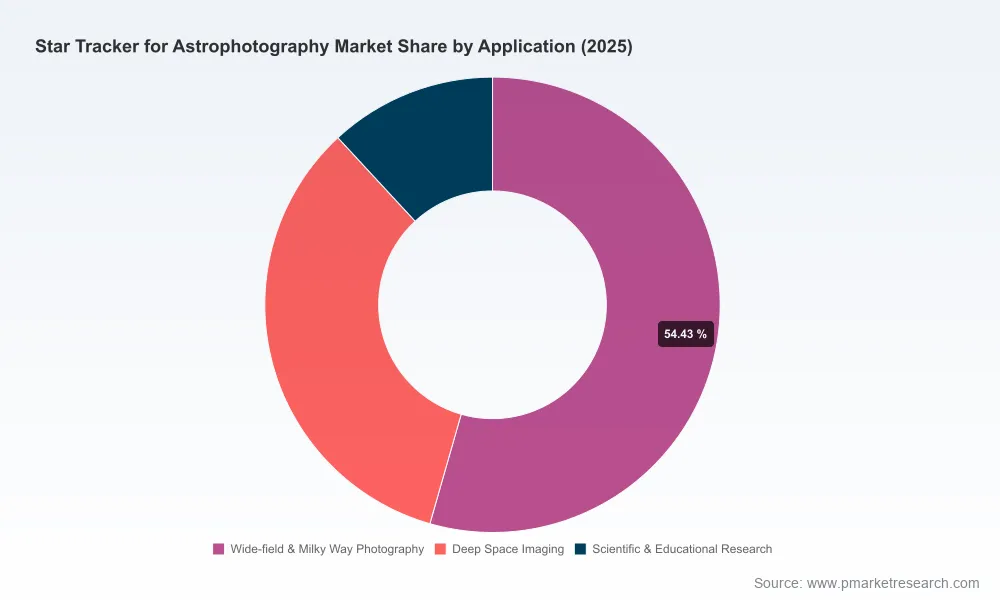
Demand is being reshaped by evolving photographic ambitions and broader accessibility trends. Wide-field and Milky Way photography continues to represent a major application area, driven by travelers, landscape photographers, and content creators seeking striking night-sky imagery for portfolios, social platforms, and commercial assignments. Beyond single-image capture, multi-frame stacking, time-lapse sequences, and hybrid landscape-and-sky compositions are increasing the practical value of precise tracking. On the deep-space side, more advanced hobbyists are investing in longer exposures and finer tracking resolution to capture faint nebulae and galaxies, which places greater emphasis on mechanical smoothness and polar alignment accuracy. Educational and public-outreach programs also contribute to demand, as schools, observatories, and community science groups seek manageable equipment for instructional imaging sessions. These use cases expand the buyer base beyond traditional astronomy enthusiasts and introduce new expectations around portability, app integration, and ease of operation.
Supply Chain and Cost Structure Considerations
Cost structures in this segment are influenced by component sourcing, assembly complexity, and regional manufacturing strategies. Precision motion control elements, durable housing materials, and battery systems all contribute to bill-of-materials variability. At the same time, regional production footprints are gaining importance as companies balance lead times, logistics resilience, and customer proximity. Domestic or near-market assembly can improve responsiveness and reduce exposure to cross-border shipment disruptions, particularly for firms selling into markets where buyers prioritize availability and support. Conversely, manufacturers that can maintain consistent quality across distributed supply chains while controlling costs retain a competitive advantage in price-sensitive segments. The interplay between component availability, build quality, and regional sourcing will continue to shape margin dynamics and product roadmaps.
Competitive Landscape and Strategic Positioning
The competitive field in astrophotography star trackers is relatively concentrated at the top while remaining open to specialized entrants. Market leadership is distributed among established optics and mount manufacturers, compact tracker specialists, and regional brands that differentiate through form factor, alignment technology, or ecosystem support. To interpret how these players compete, it helps to examine the strategic emphasis of the companies shaping the segment.
Differentiation Through Product Architecture and User Experience
iOptron has built recognition around compact motorized camera mounts, including the SkyTracker Pro and SkyGuider Pro series, that emphasize precise sidereal tracking, polar alignment support, and payloads suitable for both wide-field and deeper imaging work. The company’s positioning reflects a balance of portability and capability, appealing to users who want a dedicated tracking solution without moving into full-sized equatorial mounts. Sky-Watcher has taken a broader ecosystem approach with the Star Adventurer series, offering models that span entry-level manual or basic motorized setups to advanced versions with WiFi and app control and GoTo-style capabilities in higher-tier configurations. This tiered structure allows the brand to serve photographers at multiple experience levels while maintaining brand continuity across the lineup. Benro has targeted users looking for higher payload flexibility and smart alignment features, with the Polaris Astro Edition combining a three-axis design, smartphone-assisted alignment, and substantial load capacity. The emphasis here is on enabling more ambitious imaging rigs while reducing setup friction.
Compact, travel-oriented players have carved out a distinct niche by prioritizing weight and packability. Move Shoot Move has focused on ultra-light Nomad series trackers designed for portable nightscape and landscape astrophotography, offering alignment options such as laser or polar scopes to accommodate different workflow preferences. Vixen’s Polarie and Polarie U models similarly emphasize ultra-compact form factors attachable to standard tripods, targeting photographers who value quick deployment and starry-sky imaging without a bulky mount footprint. Fornax Mounts has differentiated through a tangent-arm equatorial tracker design in the Lightrack II, emphasizing reliable long-exposure performance without traditional gear drives, which appeals to users seeking mechanical simplicity and durability. Omegon distributes compact mechanical and motorized tracker series such as the MiniTrack LX lineup, addressing wide-angle and lightweight telephoto applications where minimal bulk and straightforward operation are priorities. NyxTech has approached the segment with an affordable barn-door-style motorized tracker available in kit or assembled form, attracting builders and budget-conscious buyers who value transparency, modularity, and accessible pricing.
PW Consulting
Strategic Positioning and Competitive Evolution
Across these players, several strategic themes emerge. First, alignment assistance and control software are increasingly central to differentiation. Smartphone apps, integrated alignment aids, and app-based tracking control reduce dependence on manual polar scopes and shorten the learning curve. This is not merely a convenience feature; it directly affects whether new buyers remain in the category after initial setup. Second, payload-versus-portability trade-offs are being actively re-engineered. Brands that can maintain tracking stability while reducing weight or increasing usable load capacity create tangible value for photographers upgrading from entry-level cameras to heavier mirrorless and telephoto setups. Third, brand trust and documentation quality matter because performance expectations are often verified through extended user experience, community feedback, and real-world exposure conditions. Companies that provide clear guidance on payload, alignment, battery life, and environmental resilience tend to earn stronger repeat engagement and word-of-mouth referrals.
The market is also seeing a blend of consolidation-minded behavior and fragmentation from specialized entrants. Larger optics and mount brands can leverage existing distribution channels, accessory ecosystems, and customer support infrastructure, which supports scaling across multiple price tiers. At the same time, startups and regional manufacturers continue to enter with focused value propositions: extreme portability, novel alignment methods, modular kits, or niche payload profiles. This dynamic suggests a landscape where established players defend broad relevance through product breadth and ecosystem strength, while newer entrants seek durable positions by solving a specific setup pain point more effectively than the incumbents. The presence of adjacent space-oriented star tracker activity, including manufacturing expansion and new product introductions for satellite attitude determination, further underscores how precision tracking expertise can cross-pollinate between professional and consumer applications, even if the end-use requirements differ materially.
For organizations operating in this space, the strategic question is less about whether the category is growing and more about which positioning can withstand increasing customer scrutiny. Competitive advantage is likely to accrue to companies that can combine dependable tracking performance with simplified setup, transparent specifications, and support structures that match the expectations of both casual buyers and experienced imaging practitioners.
Forward Outlook: Three Trends Shaping the Next Three to Five Years
Looking ahead, several trajectories are likely to define the astrophotography tracker market through the end of the decade.
One major trend is the continued integration of alignment and control intelligence into compact hardware. As smartphone-assisted polar alignment, app-based tracking adjustments, and remote camera control become more refined, the category will likely shift further toward "set up and capture" experiences that reduce setup time and error rates. This creates commercial opportunities for manufacturers that can bundle reliable tracking with intuitive software, clear alignment aids, and accessories that streamline field operation. It also raises the stakes for firms whose products still require steep manual setup, since usability friction becomes a more visible competitive weakness as the category matures.
A second trend is the widening gap between portable wide-field solutions and higher-capability setups aimed at serious deep-sky work. Buyers are increasingly self-selecting by application: travelers and landscape photographers want lightweight, quick-deploying trackers; advanced hobbyists want smoother tracking, higher payload headroom, and accessories that support longer exposures and stacking workflows. This bifurcation rewards product line clarity and targeted marketing. Companies that attempt to serve both ends without clear differentiation may face pricing pressure or brand confusion, while those that define focused use cases can build stronger loyalty and more predictable product roadmaps.
A third trend concerns manufacturing and supply resilience. As demand grows and component sensitivity remains, firms with disciplined sourcing, consistent quality processes, and flexible regional assembly may gain an advantage in availability and lead-time reliability. This is especially relevant for buyers and retailers who prioritize predictable restocking and post-sale support. At the same time, organizations should anticipate ongoing cost variability in precision motion components and durable materials, which will keep margin management and product-tier strategy under active review. A related uncertainty is the pace at which community expectations around performance transparency will accelerate; without standardized amateur tracking benchmarks, customers will continue to rely heavily on real-world validation, making product consistency and documentation increasingly important competitive factors.
Strategic Actions for Decision-Makers
For manufacturers, the priority should be to invest where setup friction and usability most directly affect adoption. Improving alignment assistance, stabilizing tracking performance across payload ranges, and providing clear documentation for practical field use can strengthen both new-customer conversion and repeat engagement. Product planning should also account for distinct use cases rather than treating the market as uniform; a well-defined portable lineup and a separate higher-capability offering can reduce internal competition and make value propositions easier to communicate.
For investors, the opportunity lies in identifying companies with a credible path to differentiated positioning rather than broad but undifferentiated participation. Indicators worth examining include consistent product updates, alignment and control software maturity, supply resilience, and the ability to serve a clear customer segment without dependence on price-only competition. In a market growing at a healthy pace, value capture is likely to favor players that can defend a specific role in the buyer’s workflow, whether that is ultra-portable field imaging, higher-payload deep-sky work, or accessible entry-level tracking.
For procurement and channel teams, attention should be placed on performance consistency, support infrastructure, and product fit to target applications. Evaluating payload limits, alignment methods, battery endurance, and documentation quality can help reduce downstream returns and customer dissatisfaction. It is also prudent to assess the supplier’s ability to maintain availability and provide guidance on practical setup conditions, since these factors often determine whether a tracked product performs well in real use rather than only on paper.
Detailed segmentation figures, regional breakdowns, company-level benchmarking, and scenario-based projections can materially improve planning quality for organizations making product, investment, or sourcing decisions in this space. Access to a full research report enables more precise prioritization, whether the objective is to refine a product roadmap, evaluate competitive exposure, or identify customer segments with the strongest near-term pull.
For detailed analysis of this topic, please visit the official page: Worldwide Star Tracker for Astrophotography Market
Lacy Lee
Senior Marketing Manager
[email protected]
PW Consulting: www.pmarketresearch.com

























Sign in to leave a comment.