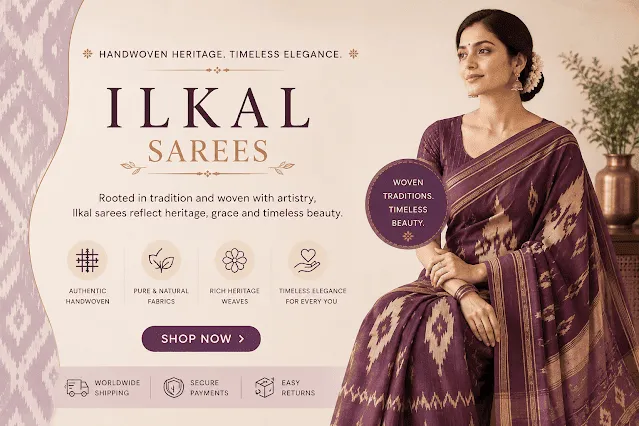

Finding an authentic Ilkal saree online comes down to checking the weave construction, the fabric composition, and how transparently the seller documents the piece's origin — not just going by the price tag or the photos alone. Genuine handloom work leaves identifiable traces: a distinct join where the pallu meets the body, slight natural irregularities in the weave, and border work that holds up to close inspection. Knowing exactly what these markers look like is what separates a confident purchase from a guess.
What Separates an Authentic Ilkal Saree From a Machine-Made Imitation?
The Tope Teni Join as a Quality Marker
Genuine Ilkal sarees use a technique called Tope Teni, where the pallu is woven on a separate warp and then joined to the body using interlocked loops rather than stitching. This creates a visible seam-like join that sits slightly raised compared to the surrounding fabric. In machine-made or power-loom copies, the border is usually printed or sewn on flat, with no such interlocked construction visible at all.
Weave Irregularities That Indicate Handloom Work
Handloom fabric rarely has perfectly uniform tension across its length, so a genuine piece often shows minor, natural variation in thread spacing when examined closely. This isn't a flaw — it's a sign of hand-operated pit-loom weaving. A saree that looks machine-perfect in every inch, with zero variation in weave density, is more likely power-loom made rather than genuinely handwoven.
How Do You Verify Handloom Ilkal Saree Claims Before Buying?
GI Tag and Documented Origin
A handloom Ilkal Saree is tied to a Geographical Indication (GI) recognized by the Government of India, linking the craft to weaving centres in and around Bagalkot district, Karnataka. Government cultural records, including the Indian Culture portal maintained by the Ministry of Culture, document the Tope Teni technique and regional origin, giving you a factual reference point to check seller claims against.
Weaver Cooperative and Regional Sourcing
Many authentic Ilkal weaves are produced through registered weaver cooperatives or societies based in Karnataka's weaving belt. Sellers who can name the sourcing region or cooperative, even briefly, are generally more credible than listings with no origin information at all. This detail won't appear on every listing, but its presence is a meaningful positive signal worth factoring into your decision.
What Fabric Details Confirm Genuine Quality in an Ilkal Silk Saree?
Silk Content and Sheen
An ilkal silk saree should have a natural, slightly uneven sheen rather than the flat, overly glossy finish typical of synthetic silk substitutes. Genuine silk also has a distinct, slightly warm feel against skin, unlike the cooler, slicker touch of polyester blends marketed as "art silk" without disclosure. Checking the listing for whether silk content is pure or blended helps set accurate expectations before buying.
Zari Quality in the Border
Traditional zari work uses metallic or metal-coated thread woven into the border, giving it noticeable weight and texture compared to the body fabric. Lower-quality imitation zari tends to look flat, feel papery, and can flake or dull quickly after just a few washes. A border that feels substantially heavier and more textured than the saree body is a reasonable sign of genuine zari work.
What Visual and Tactile Checks Reveal Handloom Craftsmanship?
Border Texture and Width Consistency
Run a finger along the border's edge — genuine handwoven borders typically maintain a fairly consistent width throughout the saree's length, with the pattern (Gomi, Chikki Paras, Zari, or Gayatri) remaining recognizable and evenly spaced. Noticeable width fluctuation or a blurred, inconsistent pattern often points to a lower-quality reproduction rather than traditional weaving.
Reverse-Side Inspection
Turning the saree over reveals a lot: genuine handwoven motifs and borders often show thread ends or a mirrored construction pattern on the back, since the weaving process physically creates the design rather than printing it. A completely smooth, identical-looking reverse side with no construction detail usually indicates a printed or digitally reproduced pattern instead of handloom work.
How Does Pricing Reflect Authenticity in Handloom Ilkal Sarees?
Why Genuine Handloom Pieces Cost More
Handloom weaving is slow and labor-intensive, often taking several days per piece on a pit loom with multiple people involved in preparation and weaving. This directly affects pricing — a genuine handloom Ilkal Saree generally costs more than a power-loom or printed equivalent, reflecting the time, skill, and material quality that goes into producing it.
Red Flags in Unrealistically Low Pricing
A price that seems unusually low compared to similar listings is worth questioning rather than treating as a bargain. It often indicates synthetic fabric substitution, printed rather than woven motifs, or machine production marketed loosely as "handloom style." Comparing prices across a few listings before buying gives a realistic baseline for what genuine craftsmanship actually costs.
What Should You Check About the Seller When Buying Authentic Ilkal Saree Online?
Product Documentation and Transparency
Reliable sellers specify fabric composition for both body and border, mention the weaving technique by name, and avoid vague descriptions like "traditional design" with no further detail. Labels such as Indeloom include Ilkal weaves within their saree offerings, and checking a brand's specific product page for these documented details remains a dependable way to confirm authenticity before ordering.
Return Policy and Authenticity Guarantees
A seller confident in their product's authenticity typically offers a clear return or exchange window, since genuine handloom pieces are expected to hold up to inspection on arrival. Vague or restrictive return policies, especially on higher-priced pieces marketed as handloom, are worth treating as a caution sign rather than a minor inconvenience.
FAQs
How can I tell if an Ilkal saree is handwoven and not power-loom made?
Check for minor natural weave irregularities, a raised Tope Teni join where the pallu meets the body, and construction detail visible on the reverse side.
Does a genuine Ilkal silk saree cost more than regular silk sarees?
Pricing depends on silk purity and weaving time, but genuine handloom Ilkal silk sarees typically cost more than printed or power-loom equivalents due to labor-intensive production.
Is the GI tag a reliable way to confirm authenticity?
The GI tag confirms the craft's recognized regional origin, and referencing documented government sources alongside seller claims helps build a more reliable picture of authenticity.
What's a red flag when buying a handloom Ilkal saree online?
Unusually low pricing compared to similar listings, vague fabric descriptions, and a lack of origin or weaving-technique details are common red flags.
Final Thoughts
Identifying a genuine authentic Ilkal saree online comes down to checking the weave construction, fabric quality, border craftsmanship, and how transparently the seller documents the piece. Whether you're evaluating a cotton-body handloom Ilkal Saree or a richer ilkal silk saree, applying these weave, fabric, and seller checks before ordering gives you a far more reliable way to confirm you're buying real handloom craftsmanship rather than a reproduction.




























Sign in to leave a comment.