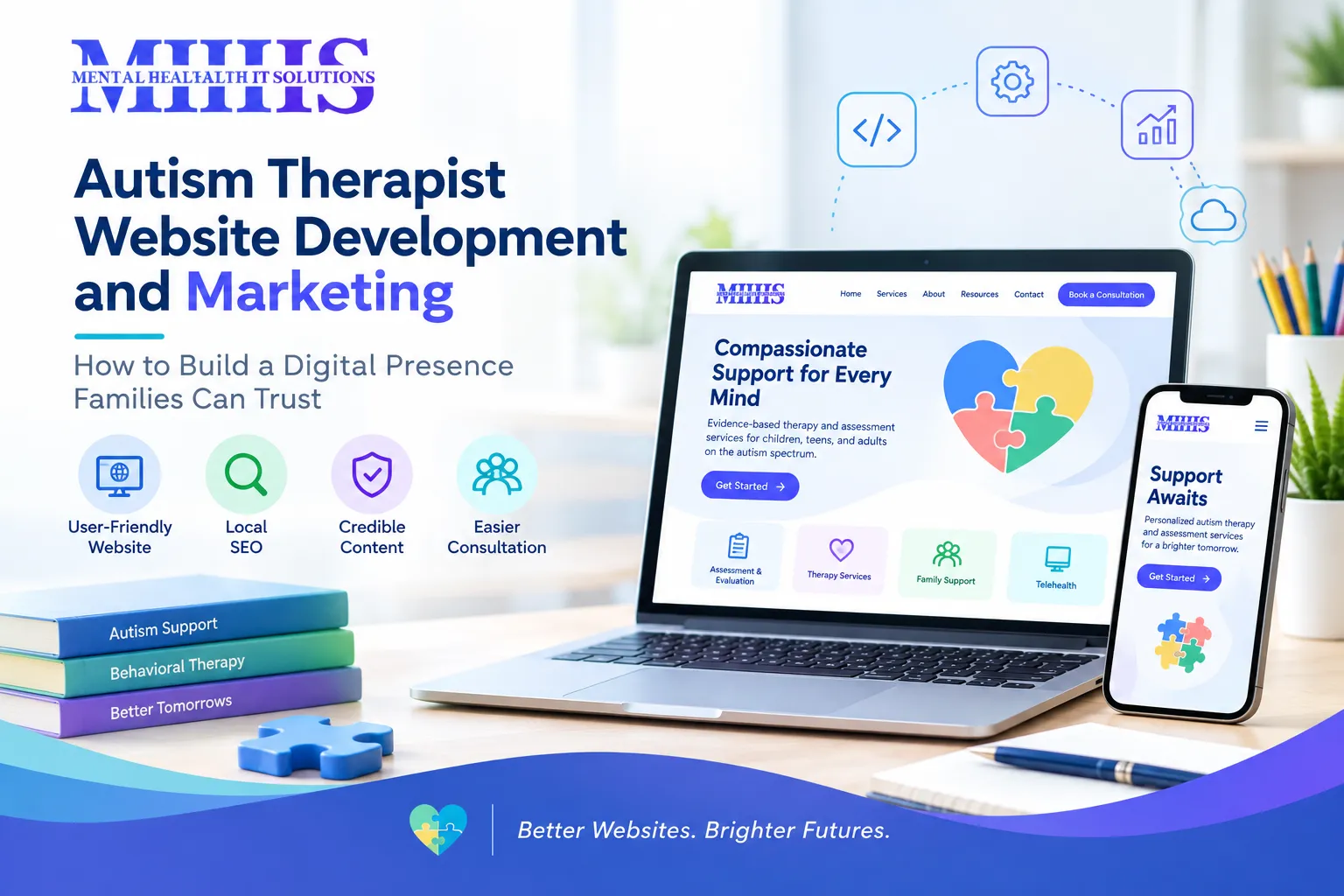

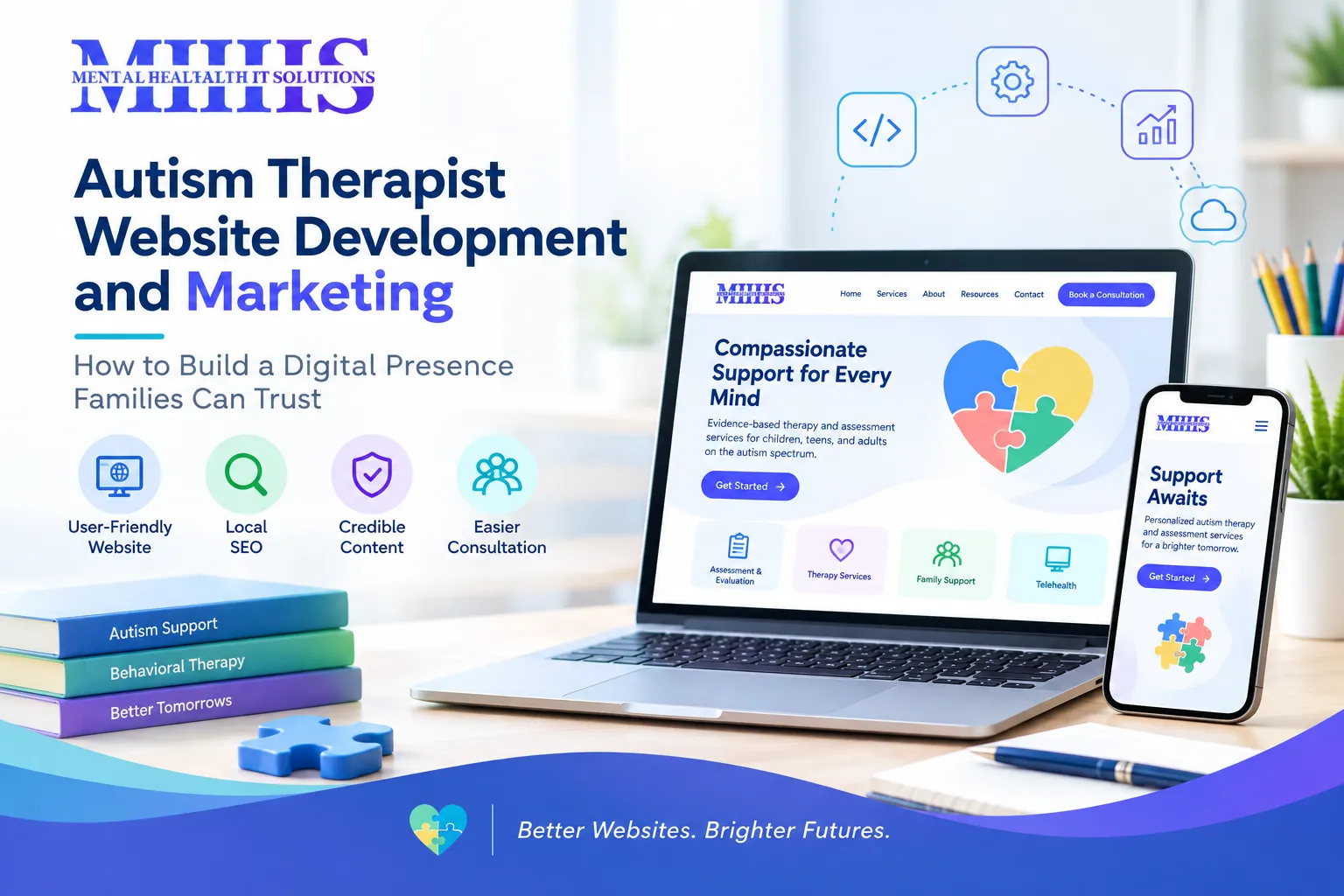
Autism therapist website development and marketing should do more than make a practice look professional online. A strong website needs to explain who the practice serves, what services it provides, how its clinicians work, where care is available, and how someone can take the next step.
That matters because autism-related searches can come from parents seeking support for a child, adults exploring an assessment or therapy for themselves, or professionals looking for an appropriate referral. Each audience may have different questions and concerns.
The best website strategy combines accessible design, useful information, local SEO, credible clinical content, and a straightforward consultation path.
What Makes an Autism Therapy Website Different?
Autism care is not a single type of service. Depending on the provider, services may include psychological assessment, psychotherapy, behavioral services, occupational therapy, speech-language therapy, family support, or other interventions.
A website should never imply that these services are interchangeable. Instead, it should clearly explain what the practice actually provides.
Website Information
This starts with straightforward information about the ages and populations served, the services offered, available locations or telehealth options, clinician credentials, treatment philosophy, assessment options, insurance and payment information, and the referral or consultation process. Providing these details clearly helps visitors understand whether the practice is appropriate for their needs before they decide to get in touch.
Autism terminology also deserves care. Some people prefer identity-first language such as “autistic person,” while others prefer person-first language such as “person with autism.” There is no universal preference, so practices should understand their audience and communicate their language approach respectfully.
Build the Website Around the Questions People Actually Ask
A website becomes more useful when its structure follows real search intent.
For example, someone looking for an autism assessment may want to know what the evaluation involves, who conducts it, how long it takes, whether insurance is accepted, and what happens afterward.
Someone looking for therapy may instead want to understand the therapist's approach, whether adults or children are served, what concerns can be addressed, and whether family participation is part of treatment.
A well-structured website gives these questions their own clear answers rather than placing everything on one long services page.
Essential Website Pages
An autism-focused practice will often benefit from:
Homepage: Quickly identifies the population served, services, location, and next step.
Assessment or Evaluation Page: Explains who can be assessed, what the process involves, expected timelines, fees, insurance, and how to begin.
Specialty Service Pages: Provides detailed information about genuine services offered by the practice.
Approach or Philosophy Page: Explains the clinical perspective and how the provider works with autistic clients and families.
About Page: Establishes professional credentials, training, experience, and areas of expertise.
Fees and Insurance Page: Answers practical financial questions before someone contacts the practice.
Contact or Consultation Page: Makes the next step simple without asking visitors to navigate unnecessary steps.
A dedicated assessment page can be particularly useful when a provider offers autism evaluations. The CDC notes that autism diagnosis relies on developmental history and professional observation rather than a single medical test, making it especially important for practices to explain the evaluation process accurately.
Accessibility Should Be Part of the Design
Accessibility should not be treated as an optional feature added after a website is finished.
For an autism practice, design choices can influence whether visitors feel comfortable using the site. Excessive animation, autoplay video, flashing elements, complicated navigation, poor contrast, and dense blocks of text can create unnecessary barriers.
Accessible Website Design
A calmer interface can include predictable navigation, readable typography, strong color contrast, descriptive headings, clear buttons, meaningful alt text, keyboard-friendly navigation, reduced-motion options, straightforward language, and mobile-friendly layouts. These design choices can make the website easier to understand and use while creating a more comfortable experience for a wider range of visitors. Research on web accessibility for autistic users also supports clear, consistent navigation and reduced complexity as useful design considerations.
The W3C's WCAG 2.2 provides an international accessibility standard covering perceivable, operable, understandable, and robust web content.
Accessibility is therefore both a usability consideration and a meaningful reflection of how seriously a practice takes its audience.
How SEO Helps Autism Therapists Get Found
SEO for autism therapists should begin with search intent, not a long list of disconnected keywords.
Consider three levels of searches.
Local Searches
Local Search Keywords
Local searches can include phrases such as “autism therapist near me,” “autism assessment in [city],” “autism psychologist [city],” and “autism therapy [city].” These location-based phrases can help a practice create service and location pages that reflect the areas it genuinely serves, making it easier for potential clients to find relevant information when searching locally.
These searches often have strong local intent and should connect with appropriately optimized service and location pages.
Service-Focused Searches
People may search for autism therapy for adults, therapy for autistic children, adult autism assessment, autism and anxiety therapy, or a neurodiversity-affirming therapist. Creating useful content around these specific services and populations allows a practice to address different needs instead of relying on one general services page.
Each service page should answer the specific question instead of forcing every topic onto the homepage.
Educational Searches
Informational Content
Informational content can address topics such as how an autism assessment works, common signs of autism in adults, what happens during an autism evaluation, what neurodiversity-affirming therapy means, and whether autistic adults can receive an autism diagnosis later in life. Answering these questions clearly can help visitors understand their options while also creating useful opportunities for search visibility.
The purpose is not to turn every blog post into an advertisement. Useful educational content can establish expertise while naturally guiding readers toward relevant service pages.
For practices looking to build this structure, this detailed resource on autism therapist website development and marketing provides additional information on website architecture, SEO, accessibility, local search, and AI search optimization.
Local SEO Matters for Autism Practices
Many people searching for therapy want care they can realistically access. That makes local SEO especially important for practices serving defined geographic areas.
Start by keeping the practice's name, address, phone number, services, credentials, and location information consistent across its website and professional profiles.
A well-maintained Google Business Profile can also help establish local visibility. Service descriptions, accurate categories, current photographs, appropriate updates, and genuine reviews can contribute to a clearer online presence.
Location pages can be useful when a practice genuinely serves multiple communities. However, creating dozens of nearly identical city pages simply by replacing the city name can produce weak content. Each location page should provide genuinely useful local information.
Content Should Reflect Clinical Expertise
Healthcare content needs a higher standard than generic marketing copy.
An autism therapist's website should avoid promising specific outcomes or suggesting that one therapy works for everyone. Autism is heterogeneous, and support needs vary considerably between individuals.
The National Institute of Mental Health notes that there is no single best intervention for every person with autism and that services can include behavioral, psychological, educational, occupational, physical, and speech-language approaches depending on individual needs.
That principle should influence marketing content too.
Instead of writing, “Our therapy solves autism-related challenges,” a responsible website might explain the concerns the clinician works with, the treatment approach used, and what clients can reasonably expect from the process.
What About AI Overviews and ChatGPT?
Search behavior is changing. People increasingly ask complete questions instead of typing short keyword phrases.
A practice can make its information easier for search engines and AI systems to interpret by clearly connecting:
Provider → credentials → services → population → approach → location → contact process
FAQ sections can also answer specific questions directly.
For example:
Who provides autism assessments?
Explain which licensed professionals at the practice conduct assessments.
Do you work with autistic adults?
State the actual age range served.
What happens during an autism evaluation?
Provide a concise overview of the real process.
Do you offer telehealth?
Clearly explain where and under what circumstances telehealth is available.
No website can guarantee placement in Google AI Overviews or an AI-generated recommendation. The stronger goal is to publish accurate, attributable, well-structured information that both people and search systems can understand.
Protect Privacy During Digital Marketing
A healthcare website should also consider privacy before adding forms, analytics, pixels, chat tools, appointment systems, or other third-party technologies.
If a form collects information about someone's health, diagnosis, treatment, or reason for seeking care, the practice needs to understand how that information is handled.
HHS has specifically addressed HIPAA considerations involving online tracking technologies and warns that regulated entities need to consider whether information transmitted to third-party tracking vendors constitutes protected health information and whether disclosures are permitted.
That means “add every marketing pixel” is not an appropriate healthcare strategy. Marketing technology should be selected and configured with privacy requirements in mind.
Treatment Information Should Stay Accurate
A good autism therapy website can discuss symptoms, assessment, therapy approaches, co-occurring concerns, and support options, but it should not diagnose visitors through marketing content.
Autism can involve differences in social communication and interaction as well as restricted or repetitive behaviors or interests, but similar characteristics can occur in people who are not autistic.
Likewise, autism should not be presented as something a website or therapy can “prevent.” Prevention language can be misleading and stigmatizing. A more appropriate focus is early identification when appropriate, individualized support, skill development, quality of life, communication, emotional well-being, and respect for the individual's goals.
Measure More Than Website Traffic
An autism practice should consider tracking meaningful actions such as consultation requests, assessment inquiries, phone calls, appointment requests, referral inquiries, location-specific conversions, organic search growth, and visibility for high-intent keywords. These measures provide a clearer picture of whether the website and marketing strategy are attracting relevant visitors and encouraging appropriate next steps.
This makes it easier to determine whether SEO and website improvements are attracting the right audience rather than simply generating more page views.
A strong website is not finished when it launches. Search behavior changes, services evolve, competitors publish new content, and accessibility requirements develop. Regular reviews help keep the website accurate and useful.
Conclusion
An effective autism therapist website should make it easier for the right people to understand a practice, evaluate whether it fits their needs, and take an informed next step.
That requires more than attractive design. Accessible UX, respectful language, clinically responsible content, local SEO, clear service pages, privacy-conscious technology, and useful educational resources all work together.
Practices should also remember that autism support is highly individual. Marketing should reflect that reality rather than promising universal outcomes or presenting one treatment approach as appropriate for everyone.
For therapists and practices planning a stronger digital presence, this in-depth autism therapist website development and marketing guide offers a useful next step for reviewing website structure, SEO, accessibility, local search, and AI-search considerations.
Frequently Asked Questions
1. What should an autism therapist website include?
At minimum, it should clearly explain who the practice serves, available services, clinician credentials, locations, treatment philosophy, fees or insurance information, and how visitors can begin.
2. How do I improve SEO for an autism therapy practice?
Start with search intent. Build useful service and assessment pages, optimize local search signals, publish genuinely helpful educational content, improve technical SEO, and maintain consistent practice information.
3. Should an autism therapist have a separate assessment page?
If the practice provides autism assessments, a dedicated page can make the evaluation process easier to understand and give search engines a clear page to associate with assessment-related queries.
4. How can an autism therapy website be more accessible?
Use predictable navigation, readable typography, strong contrast, descriptive headings, meaningful alt text, keyboard accessibility, limited motion, and other practices aligned with WCAG.
5. Should autism therapists use identity-first language?
Language preferences vary. Many autistic people prefer identity-first language, while others prefer person-first language. Practices should make a thoughtful choice and use terminology consistently and respectfully.
6. Can SEO help an autism therapist attract local clients?
Yes. Local SEO can help a practice appear for geographically relevant searches when its website, Google Business Profile, professional listings, and location information are accurately aligned.
7. Is blogging useful for autism therapists?
Educational blogging can help answer questions that potential clients and families search for. The strongest articles provide useful information and naturally connect readers to relevant services.
8. Should an autism therapy website include information for adults?
If the practice serves autistic adults, absolutely. Adult and late-diagnosis audiences should not be hidden behind child-focused messaging.
9. How long does it take to build an autism therapist website?
The timeline depends on page count, content, integrations, accessibility requirements, revisions, and SEO scope. A strategic project should allow enough time for research, content, design, development, testing, and launch.
10. Can autism therapy websites appear in AI search results?
They can potentially be surfaced by AI-powered search systems, but no provider can guarantee inclusion. Clear answers, strong professional credentials, useful content, consistent entity information, and trustworthy sources give search systems better information to interpret.
























Sign in to leave a comment.