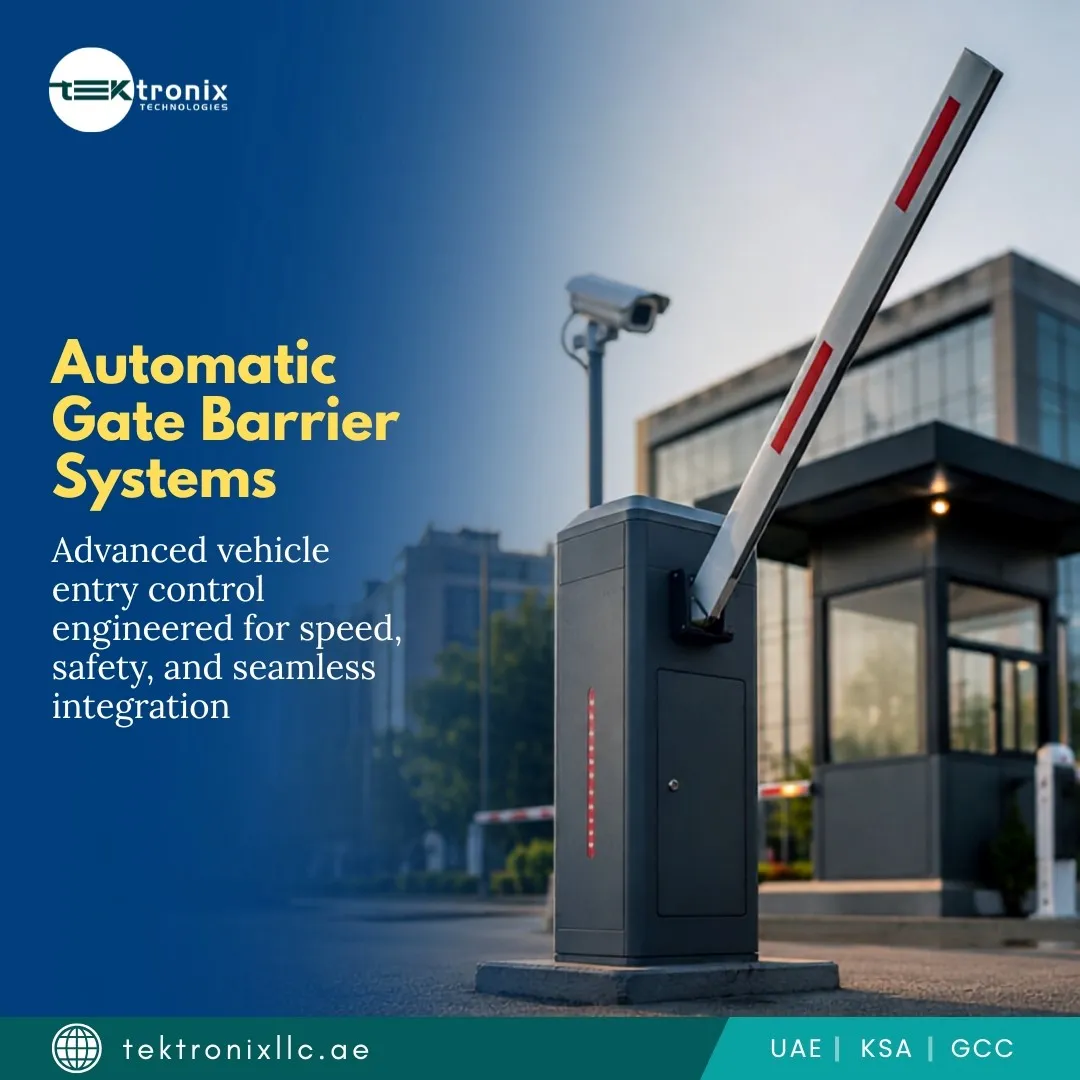

As the UAE's cities, free zones, and critical infrastructure sites continue to expand, controlling who — and what — enters a facility has become a core pillar of operational security. An automatic gate barrier is no longer a discretionary add-on for premium developments; it is a baseline requirement for any site that needs to regulate, monitor, and audit vehicular movement. From sprawling industrial free zones to high-density residential communities, hospitals, government compounds, and logistics hubs, the right gate barrier system determines a facility's security posture, traffic flow efficiency, and liability exposure. 
In the UAE's demanding operating environment — defined by extreme heat, high-volume traffic corridors, and strict regulatory oversight — choosing and integrating a purpose-engineered vehicle access control solution carries long-term operational and financial consequences. This guide walks through the full landscape of gate barrier technologies, their real-world applications across the Emirates, and the criteria that separate a dependable installation from an underperforming one.
What Is a Gate Barrier System and Why Does It Matter in the UAE?
A Gate Barrier System is an electromechanical or hydraulic vehicle access control mechanism that permits or denies entry to a secured area. Operated through RFID readers, loop detectors, licence plate recognition (LPR) cameras, intercom systems, or remote management software, today's gate barriers function as intelligent platforms that log every vehicle transaction, enforce access policies in real time, and connect into wider security and parking management ecosystems.
Within the UAE, these systems serve two purposes at once: physical deterrence against unauthorised vehicle entry, and operational data capture for fleet management, billing, and compliance reporting. As Smart City frameworks mature across Dubai, Abu Dhabi, and Sharjah, an intelligent automatic gate barrier with cloud connectivity and API integration has shifted from a premium feature to a baseline expectation.
Types of Gate Barriers: A Complete Technical Breakdown
Choosing the correct category of gate barriers is the single most important step in accurate specification and successful project delivery. Each barrier type is engineered for a distinct traffic profile, threat level, and integration requirement.
1. Boom Barrier System
The Boom Barrier System is the most widely deployed automatic road barrier across the UAE. It consists of a motorised arm that raises and lowers to control a single traffic lane. Available in arm lengths from 3 to 9 metres, boom barriers are built for high-cycle-rate environments where speed and reliability matter most. Modern units achieve opening times as fast as 0.9 seconds and are rated for 5,000 to 10,000 operations a day, making them the default choice for shopping mall car parks, office basement entrances, gated communities, hotel driveways, and airport ground-level access points.
Key specification factors include motor type (AC versus DC brushless), arm material (fibreglass-reinforced for high-wind sites), loop detector integration, anti-crush safety sensors, and weather-sealed electronics rated IP54 or above — a non-negotiable requirement in the UAE's dusty, high-humidity coastal climate.
2. Toll Gate Barriers
Toll Gate Barriers are heavy-duty variants engineered for revenue-collection lanes, expressway access points, and monitored entry zones where transaction accuracy and mechanical endurance are critical. These units typically feature reinforced aluminium or steel arms, integrated payment-terminal interfaces, queue-management sensors, and tamper-resistant enclosures. In the UAE, toll gate barriers form the backbone of the Salik and Darb road-pricing networks and are widely used in paid parking structures across Dubai's DIFC, Downtown, and Business Bay districts.
For operators who need seamless integration with payment gateways, ERP systems, or smart-mobility platforms, toll gate barriers support Wiegand, OSDP, and REST API communication protocols — enabling end-to-end automated revenue management with a full audit trail.
3. Parking Gate Barrier Systems
Parking Gate Barrier solutions are purpose-built for structured parking environments — multi-storey car parks, surface lots, basement facilities, and valet operations. These systems typically pair entry and exit barriers with ticket dispensers or cashless payment terminals, occupancy sensors, digital signage, and centralised parking management software. In the UAE's competitive retail and hospitality sectors, a high-functioning parking gate barrier is directly tied to customer experience, revenue-leakage prevention, and operational efficiency.
Modern smart parking platforms add real-time bay-availability displays, pre-booking APIs, EV charging-station management, and white-list/black-list vehicle databases — turning the parking facility into a data-generating asset that informs broader property management decisions.
4. Vehicle Access Control Barriers
Vehicle Access Control barriers cover a broad category — sliding gates, swing gates, bi-folding speed gates, and barrier-arm combinations — designed for controlled-access environments where identity verification is required before entry. These systems sit at the centre of corporate campuses, government ministries, and critical infrastructure sites across the UAE. Pairing them with biometric readers, ANPR cameras, visitor management software, and guard intercom systems creates a layered, multi-factor vehicle authentication approach that significantly reduces tailgating and cloned-credential risk.
5. Automatic Road Barrier & Automated Boom Gate Access
An Automatic Road Barrier extends the same access-control logic to public and semi-public roadways — checkpoints, restricted zones, event perimeters, and free-zone entry roads. Paired with Automated Boom Gate Access software, these installations allow facility operators to schedule access windows, issue time-limited passes, and remotely open or close a lane without dispatching security personnel to the barrier itself. This remote-management capability has become especially valuable for multi-entrance industrial estates and university campuses that need centralised control over dozens of access points.
6. RFID Barrier System Integration
An RFID Barrier System uses radio-frequency identification tags — mounted on a vehicle windshield or carried as a card — to trigger automatic barrier opening the moment an authorised vehicle approaches. RFID-based automatic gate barriers are prized for their speed (near-instant recognition), low false-rejection rates, and ability to log entry/exit timestamps without manual intervention. In residential communities, staff parking areas, and logistics yards across the UAE, RFID barrier systems have largely replaced manual card-swipe or keypad entry because they reduce queuing at peak hours and remove the friction of stopping to present a credential.
7. Security Gate Barrier Systems: Bollards
Bollards occupy a distinct position in the vehicle security hierarchy. Unlike arm barriers, which rely primarily on deterrence and transaction control, security-rated bollards provide certified physical protection against vehicle-borne threats, including ram-raid attacks and hostile vehicle intrusion (HVI). Classified under PAS 68, IWA 14-1, and ASTM F2656 international standards, crash-rated bollards are mandatory on UAE government and critical national infrastructure projects governed by Abu Dhabi's Critical Infrastructure and Coastal Protection Authority (CICPA) and equivalent bodies.
Available in fixed, removable, and automatic retractable configurations, bollards serve two roles at once: operational access control for authorised vehicles, and passive physical security for pedestrian zones, building facades, and utility infrastructure. Automatic rising bollards, integrated with access-card readers or ANPR, are increasingly specified at the entrances to Emirati government buildings, financial institutions, luxury hotels, and major public attractions in Dubai, Abu Dhabi, and Sharjah.
Gate Barrier System UAE: The National Security Infrastructure Context
Deployment of the Gate Barrier System UAE-wide has accelerated over the past five years, driven by urban densification, smart-mobility initiatives, and post-pandemic security reassessments. Free zone authorities — including JAFZA (Jebel Ali Free Zone Authority), KIZAD, and ADAFSA — now mandate certified barrier systems at every operational entry and exit point, reflecting a national commitment to standardising perimeter security across commercial and industrial estates.
The Security Industry Regulatory Agency (SIRA) in Dubai and the Abu Dhabi Police security framework set prescriptive requirements for system performance, installer certification, and maintenance documentation, creating a compliance-driven procurement environment that favours technically capable, licensed integrators over unqualified suppliers.
Gate Barrier System Dubai
As the UAE's most densely developed commercial centre, Dubai's gate barrier market is defined by volume, sophistication, and regulatory rigour. Gate Barrier System Dubai projects span the full spectrum of the city's built environment: SIRA-regulated commercial towers and mixed-use developments in Business Bay and JLT; high-throughput boom barriers at Dubai International Airport's staff and cargo access zones; revenue-grade toll gate barriers within Salik-network infrastructure; and crash-rated bollards protecting sensitive government assets in Deira and the Dubai World Trade Centre precinct. SIRA certification, for both the system and the installing contractor, is a mandatory pre-condition for most Dubai Municipality-registered projects.
Gate Barrier System Abu Dhabi
The capital's security demands are shaped by its concentration of federal government institutions, energy infrastructure, and diplomatic missions. Gate Barrier System Abu Dhabi installations reflect this elevated risk profile — ADNOC headquarters, Masdar City, the Abu Dhabi corniche government complex, and Yas Island's mega-venues all deploy multi-layered vehicle access strategies that combine boom barriers, rising bollards, and ANPR-integrated vehicle access control barriers. The Abu Dhabi Department of Digital Economy's smart-infrastructure mandate further drives demand for IoT-enabled, remotely managed automatic gate barrier systems with real-time event reporting and predictive maintenance.
Gate Barrier System Sharjah
Sharjah's industrial, academic, and cultural landscape creates its own distinct vehicle security requirements. Gate Barrier System Sharjah deployments concentrate in Hamriyah Free Zone, Sharjah Airport International Free Zone (SAIF Zone), the emirate's network of industrial areas, and its network of public university and college campuses. Cost-efficient, high-cycle boom barriers and robust parking gate barrier systems dominate these environments, while the emirate's expanding waterfront and cultural-district developments are increasingly adopting sleek bollard arrays and vehicle access control barriers aligned with the Sharjah Urban Area master plan.
Smart Integration: From Automatic Gate Barrier to Intelligent Security Asset
The true value of a modern automatic gate barrier is realised through its integration ecosystem. Leading UAE deployments connect barrier hardware to:
•ANPR / LPR cameras — automatic number-plate recognition for white-list/black-list enforcement and visitor pre-registration
•Access control platforms — Lenel S2, Genetec, Honeywell Pro-Watch, and Gallagher, enabling unified vehicle and pedestrian identity management
•Parking management software — real-time occupancy, dynamic pricing, pre-booking, and EV-charging integration
•Guard management systems — intercom, CCTV, and incident logging for security operations centres
•Building management systems (BMS) — unified control of barriers, lighting, HVAC, and fire safety on one converged platform
•Cloud analytics dashboards — traffic-flow analysis, peak-utilisation reporting, and anomaly detection for facility managers
This convergence is what security professionals now call integrated perimeter security infrastructure — an approach where every vehicle transaction feeds a living security-intelligence picture rather than existing as an isolated mechanical event.
Why Tektronix LLC Is the UAE's Trusted Security Gate Barrier Systems Partner
Tektronix LLC brings over a decade of specialist experience designing, supplying, installing, and maintaining vehicle access control systems across every major UAE emirate. Our engineering team is SIRA-certified and ISO-qualified, with a proven delivery record spanning government, healthcare, education, hospitality, retail, logistics, and critical infrastructure sectors. We are an authorised distributor for globally recognised barrier, bollard, and parking-management brands, so clients receive manufacturer-warranted equipment backed by a robust UAE supply chain.
•SIRA-licensed engineers qualified to design and commission gate barrier systems compliant with Dubai's security industry regulations
•ISO 9001-aligned project delivery, from site survey through commissioning and handover documentation
•Authorised OEM partnerships with leading barrier, bollard, and parking-technology manufacturers
•Nationwide UAE coverage, with active project teams in Dubai, Abu Dhabi, Sharjah, Ras Al Khaimah, Fujairah, and Ajman
•Preventive maintenance contracts with a 24/7 helpdesk and scheduled servicing to maximise system uptime and warranty compliance
Explore our full range of solutions at , or contact our team for a complimentary site assessment and system specification.
How to Choose the Right Automatic Gate Barrier System
Selecting the optimal gate barrier solution means weighing several interdependent factors:
•Traffic volume and cycle rate — high-throughput sites such as shopping centres and airports need heavy-duty motors rated for 5,000+ daily cycles
•Vehicle type and weight — HGV and tanker access routes require reinforced arms and heavy-duty foundations; standard passenger-car lanes can use lighter aluminium arm units
•Security classification — critical infrastructure and government sites need crash-rated bollards meeting PAS 68 or IWA 14-1; commercial sites can typically be served by standard boom barrier deterrence
•Integration requirements — confirm communication protocols (Wiegand, OSDP, TCP/IP, REST API, or RFID barrier system compatibility) before equipment selection, to ensure compatibility with existing access control and parking platforms
•Environmental rating — UAE coastal and desert environments demand IP54 minimum for electronic enclosures, and IP65 or IP66 for fully exposed outdoor installations
•Total cost of ownership — factor in energy consumption (solar-powered options are available), preventive maintenance cycles, and spare-parts availability when comparing competing systems
Conclusion
Unauthorised vehicle entry is not merely an inconvenience — it is a measurable operational risk that exposes UAE facilities to liability, financial loss, reputational damage, and regulatory non-compliance. A properly specified and integrated Gate Barrier System turns a facility's perimeter from a passive boundary into an active, intelligent security and management tool. Whether the requirement is the high-speed convenience of a Boom Barrier System at a commercial car park, the revenue precision of Toll Gate Barriers at a paid facility, the layered protection of Vehicle Access Control barriers at a government compound, the smart efficiency of a Parking Gate Barrier at a mixed-use development, the speed of an RFID Barrier System at a residential community, or the certified impact resistance of Security Gate Barrier Systems at a critical asset, the technology, expertise, and regulatory knowledge to deliver it exist in the UAE today.
FAQS
Q1. What is the difference between a Boom Barrier System and a Parking Gate Barrier?
A Boom Barrier System is a general-purpose lane-control solution used at any vehicle entry or exit point — residential gates, office basements, industrial access roads, and more. It works as a standalone deterrent or integrates with access control readers. A Parking Gate Barrier, by contrast, is purpose-built for paid or managed parking environments, incorporating ticket dispensers, payment terminals, occupancy sensors, and parking management software. The parking gate barrier is a subsystem within a broader parking management ecosystem, while the boom barrier is a versatile single-point access control device.
Q2. Are gate barrier systems in the UAE required to comply with SIRA regulations?
Yes. In Dubai, the Security Industry Regulatory Agency (SIRA) mandates that Gate Barrier System Dubai installations at commercial, industrial, and government facilities be designed, supplied, and commissioned by SIRA-licensed security companies, covering system performance standards, documentation, and ongoing maintenance obligations. In Abu Dhabi and Sharjah, corresponding regulatory bodies enforce similar requirements under the Abu Dhabi Police security framework and Sharjah Police directives, respectively. Non-compliance can lead to project rejection, fines, or mandatory decommissioning of unapproved systems.
Q3. When are bollards required instead of a standard automatic gate barrier?
A standard Boom Barrier System provides operational access control and visual deterrence, but no certified physical resistance to vehicle impact. Bollards rated to PAS 68, IWA 14-1, or ASTM F2656 are required wherever there is a credible risk of hostile vehicle intrusion (HVI) or ram-raid attack — including government buildings, financial institutions, critical utilities, crowded public spaces, and any site classified under the UAE's critical national infrastructure (CNI) designation. For most commercial and residential sites, a combination of boom barriers for access control and decorative or light-duty bollards for perimeter definition is sufficient.
Q4. How long does it take to install a Gate Barrier System in a UAE facility?
Timelines for a Gate Barrier System UAE project depend on site preparation, lane count, integration complexity, and civil works. A standard single-lane Boom Barrier System installation with loop detectors and a standalone controller typically takes 1–3 business days. A multi-lane Parking Gate Barrier deployment with payment terminals and parking management software integration may take 2–4 weeks. Projects incorporating crash-rated bollards with foundation works and civil engineering can extend to 4–8 weeks. Tektronix LLC provides a detailed project schedule at the tendering stage, covering every milestone from site survey to SIRA commissioning sign-off.
Q5. Can toll gate barriers and vehicle access control barriers integrate with existing CCTV and access control systems?
Yes. Modern Toll Gate Barriers and Vehicle Access Control barriers are built for open-protocol integration with leading security platforms. Using standard interfaces — Wiegand, OSDP, TCP/IP, and REST API — these systems connect with ANPR cameras, CCTV platforms (Milestone, Genetec, Axis), access control software (Lenel, Honeywell, Gallagher), guard management systems, and building management platforms. This interoperability means a Gate Barrier System Abu Dhabi or Gate Barrier System Sharjah installation extends and strengthens existing security infrastructure, delivering unified situational awareness without a full system replacement.






























Sign in to leave a comment.