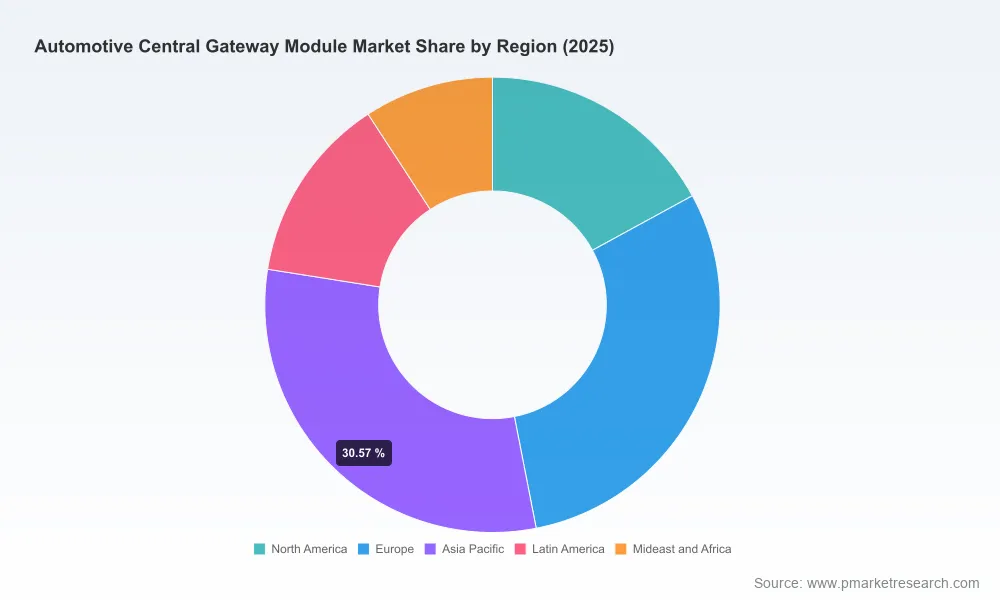

The Automotive Central Gateway Module Market: Strategic Trends and Commercial Opportunities
The automotive central gateway module has evolved from a simple communication hub into a critical architectural component that determines vehicle connectivity, cybersecurity posture, and software-defined functionality. As vehicles transition toward domain-centralized and zonal architectures, the gateway module sits at the intersection of powertrain control, body electronics, infotainment, and advanced driver assistance systems. The market has demonstrated steady expansion, with global revenue climbing from approximately 2.85 billion USD in 2020 to around 3.93 billion USD in 2025, reflecting a compound annual growth rate of 6.7 percent through the forecast horizon extending to 2032. By the end of that period, the market is projected to surpass 6.1 billion USD, underscoring the strategic importance of gateway infrastructure in next-generation vehicle platforms.
This growth trajectory is not merely a function of vehicle volume expansion. It reflects a fundamental redesign of in-vehicle networks, where legacy distributed ECUs are being consolidated into fewer, more capable computing nodes. The central gateway module now serves as the secure bridge between high-bandwidth Ethernet domains and legacy CAN, LIN, or FlexRay subsystems, while simultaneously enforcing security policies, routing diagnostic data, and enabling over-the-air software updates. For executives and investors, the question is no longer whether gateway modules will grow, but how the competitive landscape, regulatory pressure, and architectural shifts will reshape value capture across the supply chain.
Market Snapshot and Core Challenges
The current market structure is characterized by moderate concentration, with the top three players capturing roughly 48.5 percent of revenue and the top five accounting for approximately 65 percent. This concentration reflects the capital-intensive nature of automotive-grade validation, long development cycles, and the trust requirements between OEMs and tier-one suppliers. However, concentration does not equate to stagnation. The market is undergoing a structural transition as Ethernet-based gateways gain share over legacy CAN and LIN variants, and as software integration becomes a more decisive competitive factor than hardware specifications alone.
Several interconnected challenges are shaping the near-term trajectory. First, the migration from domain-specific networks to zonal and centralized architectures is forcing suppliers to rethink gateway design. Legacy modules optimized for isolated CAN traffic must now handle multi-gigabit Ethernet streams, secure partitioning between safety-critical and infotainment functions, and dynamic routing that adapts to software-defined vehicle configurations. Suppliers that cannot deliver scalable, software-managed gateway platforms risk being relegated to commoditized components with shrinking margins.
Vehicle Camera Module Market
Second, cybersecurity and functional safety compliance have moved from optional enhancements to baseline requirements. Regulatory frameworks and industry standards now mandate hardware security modules, encrypted communication pathways, secure boot mechanisms, and intrusion detection capabilities within gateway modules. Compliance is no longer a checkbox exercise; it is a design constraint that affects component selection, firmware architecture, validation timelines, and cost structures. Suppliers that treat security as an afterthought face integration delays, while those that embed security-by-design can differentiate on trust and reduce time-to-certification.
Third, supply chain complexity is introducing new cost and availability risks. Gateway modules depend on a layered network of semiconductor processors, microcontrollers, memory, connectivity transceivers, and passive components. Fluctuations in raw material availability, semiconductor lead times, and geopolitical trade dynamics can disrupt development schedules and inflate bill-of-materials costs. This environment rewards suppliers that maintain multi-source strategies, engage early with component manufacturers, and design for component flexibility without compromising performance or compliance.
Key Drivers of Market Change
The expansion and transformation of the central gateway module market are being driven by a combination of technological, regulatory, and demand-side forces. Understanding these drivers is essential for mapping where value will accrue and which capabilities will separate leading suppliers from followers.
- Technological innovation and architectural shift
The most significant driver is the ongoing shift toward Ethernet-centric in-vehicle networking and domain/zonal controller consolidation. Ethernet gateways enable higher bandwidth, deterministic communication, and scalable service-oriented architectures that align with software-defined vehicle platforms. This transition is not simply a wire replacement; it requires new physical layers, interoperability testing, and middleware that can translate between high-speed Ethernet domains and legacy buses. Suppliers investing in Ethernet-native gateway designs, combined with robust software stacks for routing, service discovery, and diagnostic interfaces, are positioned to capture premium segments as OEMs accelerate architectural modernization.
- Regulatory and cybersecurity mandates
Compliance requirements are reshaping both product design and procurement behavior. Standards such as UNECE R155 and ISO/SAE 21434 require automotive cybersecurity management systems that extend into hardware and communication pathways. Gateway modules must incorporate hardware security modules, encrypted data exchange, secure boot sequences, and intrusion detection to meet certification expectations. These mandates create a dual effect: they raise the baseline for all entrants, and they reward suppliers that can provide integrated security solutions, validated documentation, and lifecycle management support. For OEMs, selecting a gateway supplier with demonstrated compliance capability reduces integration risk and accelerates vehicle certification.
PW Consulting
- Demand-side evolution and feature enrichment
Consumer and commercial vehicle buyers increasingly expect seamless connectivity, advanced driver assistance features, and continuous software updates. These expectations place new demands on gateway modules, which must support ADAS data routing, infotainment integration, body and chassis communication, and telematics aggregation without becoming bottlenecks. The gateway is no longer a passive relay; it is an active participant in feature delivery, influencing latency, reliability, and updateability. As vehicles add more sensors, cameras, and connected services, the gateway's role in managing cross-domain traffic and securing communication pathways becomes more critical, driving demand for higher-performance and more secure modules.
- Supply chain and cost structure dynamics
Cost structures are being redefined by the interaction between semiconductor availability, integration complexity, and scale. Gateway modules that combine multiple functions into integrated platforms can reduce wiring, connector count, and assembly complexity, but they also concentrate risk in fewer components. Suppliers are responding by collaborating earlier with semiconductor and raw material partners to align roadmaps, secure allocation, and design for substitution where appropriate. This collaborative approach helps stabilize development timelines and supports more predictable cost planning, which is increasingly important as OEMs pressure suppliers to balance performance gains with cost discipline.
Competitive Landscape and Leading Strategies
The competitive field is led by a mix of established tier-one suppliers, semiconductor specialists, and regional innovators, each pursuing distinct strategic positions. The market's moderate concentration suggests room for differentiation through architecture expertise, security integration, and software-defined capabilities, rather than through price competition alone.
Robert Bosch GmbH continues to emphasize integrated central gateway modules and vehicle computer systems that combine cross-domain connectivity with cybersecurity features. Its strategy reflects a broader push toward vehicle computer platforms that can serve as scalable compute and communication hubs, appealing to OEMs seeking to reduce complexity while maintaining robust security and diagnostic capabilities.
Continental AG focuses on gateway modules that support automotive networking and ADAS integration, aligning its product portfolio with the growing need to manage high-bandwidth sensor and control traffic securely. By positioning gateway solutions as enablers of advanced connectivity and automation, Continental targets segments where functional integration and safety-related communication are decisive.
DENSO Corporation supplies gateway modules and telematics solutions tailored for hybrid and electric vehicle platforms. Its emphasis on electrified powertrain ecosystems reflects the reality that EV and hybrid architectures often require distinct communication patterns, energy management coordination, and telematics integration, creating differentiated demand for gateway designs optimized to those platforms.
Aptiv PLC develops gateway modules for vehicle communication and automation, leveraging its broader portfolio in electrical architecture and vehicle networking. Its approach highlights the importance of end-to-end system thinking, where gateway modules are designed not in isolation but as part of an integrated architecture that supports automation-related data flows and secure interoperability.
ZF Friedrichshafen AG provides gateway modules with advanced connectivity and automation capabilities for both passenger and commercial vehicles. By extending gateway functionality toward automation and commercial vehicle use cases, ZF addresses segments where robustness, scalability, and cross-domain communication are particularly valuable.
NXP Semiconductors and Infineon Technologies AG occupy critical positions lower in the value chain, supplying foundational processors, microcontrollers, and integrated cybersecurity solutions that underpin gateway module design. Their strategic relevance lies in enabling secure, high-performance compute and connectivity foundations. Suppliers of gateway modules that pair robust silicon selection with strong security integration can accelerate compliance and reduce development risk, making semiconductor partnerships a strategic lever rather than a commodity decision.
HiRain Technologies Co., Ltd. represents the emergence of regional innovators developing Ethernet-enabled gateway modules for advanced automotive applications. Its growth illustrates how regional expertise, local OEM relationships, and focused connectivity capabilities can create competitive niches, particularly where customization, rapid iteration, and cost-competitive engineering matter.
The competitive landscape is evolving along several axes. Integration is increasing as suppliers seek to offer gateway platforms that combine hardware, firmware, security, and service-oriented software stacks, reducing integration burden for OEMs. At the same time, differentiation is becoming more pronounced between suppliers that lead in Ethernet-native architecture and cybersecurity-by-design, and those that remain tied to legacy bus-centric designs with limited software scalability. New entrants and regional specialists are gaining traction by targeting specific architectures, platforms, or geographic demand, while established players are consolidating capabilities to manage the broader system complexity that modern vehicles demand. The result is a market where architectural competence, security maturity, and software integration are becoming the primary sources of advantage.
Future Trends and Commercial Implications (2026–2032)
Looking ahead, three trends are likely to shape the central gateway module market over the next three to five years, each carrying distinct commercial implications.
- Ethernet-centric gateways will become the default for new architectures
As OEMs accelerate the adoption of software-defined vehicles and zonal electronics, Ethernet-based gateway modules will increasingly dominate new platform designs. This shift creates opportunities for suppliers that can deliver scalable Ethernet routing, deterministic communication, and secure service-oriented interfaces. Commercial value will move toward platforms that support modular scaling across vehicle trims and model years, enabling OEMs to standardize architectures while varying feature sets through software. Suppliers that cannot support Ethernet-native designs at scale risk being confined to legacy refresh programs with limited growth potential.
- Security and compliance will become core product attributes, not add-ons
Cybersecurity and functional safety requirements will continue to deepen, making hardware security modules, encrypted pathways, secure boot, and intrusion detection standard expectations. This trend rewards suppliers that embed security into architecture and validation processes, rather than treating it as a late-stage integration task. Commercially, security maturity can shorten certification cycles, reduce rework, and create differentiation in procurement evaluations where trust and compliance assurance carry increasing weight. It also raises the barrier to entry for low-cost competitors that cannot meet the same compliance rigor.
- Software-defined configuration will reshape value capture
Gateway modules will be expected to support dynamic reconfiguration, over-the-air updates, and service management that adapt to vehicle software states. This shift moves some value from one-time hardware sales toward lifecycle enablement, including firmware management, diagnostic services, and security patching. Suppliers that can offer modular software stacks, validated update pathways, and lifecycle support will be better positioned to participate in recurring value pools and long-term OEM relationships. The risk is that suppliers lacking software integration capabilities may face margin pressure as hardware features become table stakes.
These trends also introduce uncertainty. Architectural decisions vary by OEM, and not all manufacturers will migrate at the same pace. Supply chain disruptions can affect semiconductor availability and component pricing, influencing both cost and timing. Regulatory expectations may evolve beyond current standards, requiring additional security or safety capabilities that alter design assumptions. Finally, the balance between integration and specialization will continue to shift, as some OEMs prefer consolidated platform providers while others seek best-in-class components from multiple partners.
Actionable Recommendations for Decision-Makers
For manufacturers, the priority is to align gateway strategy with architectural roadmaps and compliance timelines. Evaluate gateway partners not only on current bandwidth and pin-count specifications, but on their ability to support Ethernet-native routing, secure boot and intrusion detection, and software-managed service architectures. Prefer platforms that can scale across vehicle lines and software configurations, and validate that suppliers have documented processes for cybersecurity management and functional safety alignment. Early engagement with suppliers on architecture definition can reduce integration rework and shorten certification cycles.
Automotive Antenna Module Market
For investors, the market signals a preference for suppliers with demonstrated security integration, Ethernet capability, and software-defined platform readiness. Monitor how companies are positioning relative to architecture migration, whether they are expanding beyond legacy bus-centric designs, and how they manage semiconductor and supply chain risk through multi-source strategies and early collaboration. Pay attention to regional innovators that are gaining traction in specific platforms or geographies, as they may represent either partnership opportunities or competitive disruption depending on the segment. Value capture will increasingly favor those that can combine hardware competence with software and security differentiation.
For procurement and supply chain leaders, the focus should be on reducing integration and compliance risk while preserving flexibility. Establish clear requirements for security features, updateability, and diagnostic support before sourcing decisions, and verify that suppliers can provide lifecycle support beyond initial delivery. Where possible, design for component flexibility to mitigate semiconductor allocation risk, and require suppliers to demonstrate traceability, validation rigor, and documented compliance processes. Procurement strategies that emphasize total integration cost, certification readiness, and long-term software support will be better positioned than those focused solely on unit price.
Given the pace of architectural change, regulatory evolution, and competitive repositioning, timely access to detailed segment-level data and customized scenario analysis can materially improve planning quality. Detailed breakdowns of regional demand patterns, type-level transitions, application-specific adoption curves, and company-level strategy tracking help decision-makers move from broad market awareness to precise execution choices. For teams evaluating gateway platform investments, supplier selection, or market entry timing, a structured intelligence resource can connect high-level trends to the granular data needed for internal alignment and risk assessment.
The central gateway module market is entering a phase where architecture, security, and software integration define competitive advantage more than incremental hardware improvements. Suppliers and OEMs that anticipate these shifts, embed compliance and scalability into design choices, and build flexible partnerships across the semiconductor and software ecosystem will be best positioned to capture value as the market expands toward the forecast horizon. For executives navigating these decisions, the strategic imperative is clear: treat the gateway not as a passive connector, but as a foundational enabler of vehicle architecture, cybersecurity, and software-defined growth.
For detailed analysis of this topic, please visit the official page: Automotive Central Gateway Module Market
Lacy Lee
Senior Marketing Manager
[email protected]
PW Consulting: www.pmarketresearch.com



























Sign in to leave a comment.