
Bacillus Thuringiensis Market: Strategic Trends and Commercial Opportunities Through 2032
The global Bacillus thuringiensis market has crossed a structural threshold, transitioning from a niche biopesticide segment to a mainstream crop protection category with sustained momentum. Revenue expanded from approximately 177.0 million USD in 2020 to an estimated 245.0 million USD in 2025, and the trajectory points toward 435.0 million USD by 2032. A compound annual growth rate of 8.62 percent across the forecast period underscores a market undergoing consistent, broad-based expansion rather than episodic spikes. This growth is not merely a function of agricultural demand but reflects deeper shifts in resistance management strategies, regulatory recalibration around biological inputs, and evolving supply chain economics for microbial formulations.
For executives, investors, and procurement leaders, the most consequential takeaway is that Bacillus thuringiensis is increasingly embedded in integrated pest management protocols across multiple crop verticals and non-agricultural applications. The market is large enough to support operational scale, diversified enough to absorb regional and application-specific variability, and dynamic enough that incumbents and new entrants are competing on formulation efficacy, regulatory positioning, and value-added deployment models rather than commodity pricing alone.
Yet this expansion is not frictionless. Three structural challenges frame the commercial landscape and require deliberate strategic responses.
First, resistance management remains a persistent operational risk. Lepidopteran pests develop reduced susceptibility when Bt-based products are deployed without rotation, refuge strategies, or complementary biological controls. The commercial implication is that product efficacy cannot be assumed in isolation; it depends on how formulations are positioned within broader crop protection programs and how clearly manufacturers communicate stewardship protocols to end users.
Second, the regulatory environment is simultaneously enabling and complicating market growth. Authorities are increasingly recognizing the favorable safety profile of Bt strains, prompting tolerance exemptions and streamlined pathways for certain registrations. At the same time, risk assessment frameworks are evolving to address strain-specific characteristics, concentration behavior on treated surfaces, and long-term exposure considerations. Companies that treat regulatory engagement as a one-time compliance step rather than an ongoing competitive lever are ceding advantage to organizations that actively shape the evaluation conversation.
Third, formulation economics and application consistency introduce margin and adoption variability. Powder formats continue to represent the larger share of revenue, reflecting their cost efficiency and broad compatibility, but liquid formulations are gaining relevance where ease of integration, tank-mix behavior, and application precision matter. The commercial tension lies in balancing manufacturing scale with the need to preserve biological potency, shelf stability, and performance under diverse field conditions.
The market structure also suggests room for strategic repositioning. Concentration metrics indicate that no single provider dominates overwhelmingly, and even the leading group of companies holds a collective share below half. This implies a competitive field where differentiation comes from product architecture, segment specialization, regional execution, and regulatory agility rather than from scale alone.
Key Drivers Behind Market Momentum
The market's expansion is being pulled by several reinforcing forces. Understanding how these drivers interact is more valuable than tracking any single indicator in isolation, because commercial advantage typically emerges at the intersection of technology, regulation, demand behavior, and cost dynamics.
Technology Innovation and Strain-Level Differentiation
A central driver is the maturation of strain selection, protein characterization, and formulation engineering. Bacillus thuringiensis relies on Cry proteins and related mechanisms to disrupt target pests, and incremental innovation in strain performance, particle size distribution, solubility behavior, and compatibility with application equipment is improving real-world reliability. The strategic relevance extends beyond biocontrol efficacy alone. Strain-level differentiation is increasingly tied to regulatory distinctiveness, since exemptions or approvals for specific strains can create barriers and portfolio advantages that are not easily replicated by generic copycats.
Recent regulatory activity illustrates this dynamic. In February 2025, BASF Corporation filed a pesticide petition with the EPA seeking exemption from tolerance for Bacillus thuringiensis strain EX 297512 in pesticide formulations, followed by a related filing notice for that petition. Separately, as of February 2026, multiple Bacillus thuringiensis Cry proteins remained active in plant-incorporated protectant registrations with EPA approvals dated in 2025. These developments signal a market in which regulatory specificity is becoming part of the value proposition. Companies that align R&D pipelines with strain registration opportunities can convert scientific differentiation into commercial defensibility.
Regulatory and Policy Evolution Toward Biologicals
Policy momentum is reshaping the market's operating context. The broad direction favors biopesticides, but the pace and shape of that support varies across jurisdictions, product categories, and usage scenarios. Regulatory bodies are increasingly engaging with biopesticides through dedicated expert forums and structured risk assessment approaches rather than treating them as afterthoughts in conventional pesticide frameworks.
The OECD Expert Group on Biopesticides Seminar held in November 2025 provides a useful reference point. Discussions included case studies on Bacillus thuringiensis biopesticides, emerging risk assessment approaches, and QPS assessment outcomes. The same OECD report noted concentration trends of Bacillus thuringiensis on treated vegetables ranging from 10 to 10 cfu/g just after application, highlighting the kind of technical detail that regulatory dialogue is beginning to scrutinize more closely. This is not a slowdown signal in itself; rather, it suggests that future market growth will reward companies that can generate and organize technical evidence efficiently and speak the language of regulatory risk assessment with credibility.
For commercial strategy, the implication is that regulatory progress is a dual-edged growth enabler. Faster pathways can expand addressable use cases, while evolving assessment norms can raise the evidence bar. Companies that invest early in strain documentation, residue behavior data, and application-profile evidence will be better positioned to benefit from favorable policy shifts without being disrupted by tighter scrutiny later.
Demand-Side Shifts in Agriculture and Beyond
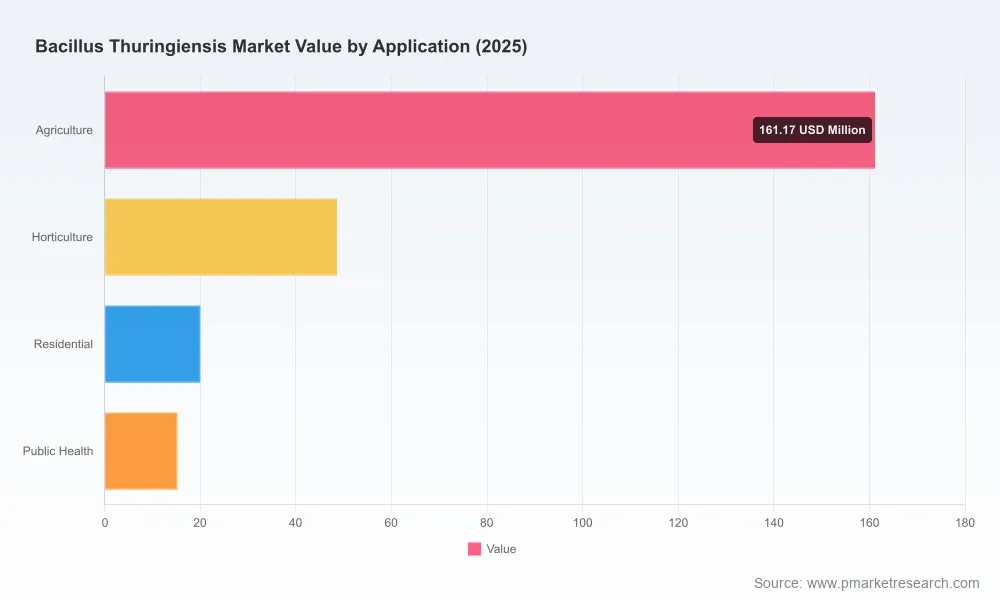
Demand behavior is changing along multiple axes. In agriculture, the push toward resistance management, residue-conscious crop programs, and integrated pest management is increasing the role of biological options within rotation strategies. In horticulture, more specialized crop profiles and higher willingness to pay for tailored pest control solutions create room for differentiated Bt offerings. Outside of field and protected cropping, residential and public health applications add demand streams that respond to different purchasing logic, often emphasizing formulation convenience, perceived safety, and ease of handling.
An important strategic nuance is that demand growth is not uniform across customer types. Commercial growers tend to evaluate Bt products through the lens of efficacy consistency, program compatibility, and total cost of pest control. Residential and public health buyers often weigh convenience, label clarity, and trust signals more heavily. This divergence means that companies pursuing broad markets must either build distinct product architectures for different end-use scenarios or deliberately concentrate on the segments where their formulation strengths and distribution relationships create the strongest fit.
Supply Chain and Cost Structure Dynamics
Cost structure is a third driver shaping competitive outcomes. Microbial biopesticide manufacturing depends on fermentation scalability, strain stability, downstream processing, and formulation stability over time and under transport conditions. These factors influence both unit economics and the reliability of supply across seasons and geographies. Companies that can standardize production while maintaining biological consistency can achieve more resilient margins and more predictable availability, which in turn strengthens relationships with distributors and end users who depend on timely application windows.
At the same time, the market is sensitive to the relative cost positioning of biologicals versus conventional chemical alternatives. Bt products compete most effectively where they solve a clear resistance or program-compatibility problem, where regulatory or market pressures constrain certain chemical options, or where their safety profile creates value in residue-sensitive channels. When the price gap widens without offsetting performance or program advantages, adoption can slow. This makes supply efficiency and formulation optimization strategically important, not just operationally desirable.
Competitive Landscape and Leading Strategies
The competitive field is populated by organizations with different strategic center of gravity. Several players have built recognizable positions by combining product portfolios with segment focus, regulatory engagement, and distribution strength. The market is large enough to accommodate regional specialists and global platforms simultaneously, but the most durable positions tend to come from clarity of strategic intent rather than breadth alone.
Valent BioSciences, based in Libertyville, Illinois, has established a strong identity around Bt kurstaki biopesticides such as DiPel and Foray for caterpillar control across agriculture, forestry, and home gardens. Its commercial logic appears anchored in brand recognition within lepidopteran control and in serving multiple use environments through a coherent product lineage. That breadth across settings can create cross-segment demand resilience, provided the company continues to invest in formulation consistency and application guidance.
Certis Biologicals, headquartered in Chicago, is focused on Bt-based lepidopteran pest control in crops through products such as Crymax, Deliver, Agree, and Javelin. The company's profile suggests a crop-oriented commercial strategy centered on multiple named Bt offerings that can be positioned for different pest control scenarios. In a market where end-user confidence depends heavily on performance predictability, a diversified Bt portfolio can be a practical way to address variation in pest pressure, crop type, and application timing.
Beauveria Bassiana Market
Marrone Bio Innovations, based in Davis, California, has positioned around Bt-based integrated pest management kits for commercial crops, including ProFarm. This productization approach signals a broader strategic emphasis: Bt is not treated solely as a standalone active but as part of a structured pest management system. That orientation can be especially valuable where growers are seeking simplified procurement, clearer program design, and stronger support for resistance management.
Bacillus Coagulans Market
BASF, headquartered in Ludwigshafen, offers Bt strains and proteins within its BioSolutions portfolio for sustainable crop protection against lepidopteran pests. Its scale, regulatory infrastructure, and integration within a larger crop protection ecosystem give it a different competitive posture. The recent EPA petition activity around strain EX 297512 reinforces the idea that BASF is using regulatory pathway strategies as part of its broader positioning. In effect, the company is leveraging the same organizational strengths that support conventional crop protection to accelerate biologicals credibility and pipeline development.
Koppert, based in Berkel en Rodenrijs, provides Bt biopesticides through its biocontrol portfolio for integrated pest management. Its standing reflects the value of an ecosystem-based biocontrol reputation, where Bt products benefit from association with broader biological program expertise and distribution relationships built around sustainable crop management.
Neudorff, in Buxtehude, manufactures and distributes Bt-based biopesticides for organic and conventional farming, a dual positioning that matters in markets where growers move between production systems or where retail channels overlap. Andermatt Group, based in Regensdorf, specializes in microbial biocontrol including Bt products for agriculture, suggesting a focus on microbial competence as a core differentiator rather than as one item among many. Novonesis, headquartered in Bagsværd, develops Bacillus-based biosolutions including Bt biopesticides for plant health and pest control, fitting into a broader trend where Bacillus platforms are extended beyond single-function pest control toward multiple plant health outcomes.
Differentiation Patterns Among Leading Players
Across these companies, several differentiation patterns recur. One is strain and product architecture. Providers that can articulate clear distinctions in target use, formulation behavior, or regulatory status create more defensible market positions than those competing primarily on generic biological active equivalence. Another is application framing. Some leaders emphasize Bt as a crop protection input, while others position it as part of an integrated program, a kit, or a biosolutions platform. These framing choices influence customer perception, sales motion, and the range of use cases a company can credibly support.
A third pattern is the balance between organic crop channels and conventional farming. Some organizations lean into organic or low-input markets where Bt's safety profile is especially valued, while others pursue broader conventional adoption where performance, compatibility, and resistance management are the primary selling points. The commercial logic is not inherently superior in either direction; what matters is whether the company's evidence base, distribution, and messaging are aligned with the chosen audience.
Structural Evolution in the Competitive Field
Looking forward, the competitive landscape is likely to evolve through a combination of consolidation, specialization, and platform-based entry. There is sufficient market size for mid-tier players to grow meaningfully without immediate pressure to merge, especially where they serve distinct regional or application niches. At the same time, larger crop protection platforms can use biologicals as a way to broaden their portfolios and capture demand from growers seeking mixed program strategies. New entrants may focus on strain-level innovation, novel formulation formats, or region-specific registration pathways that create narrow but valuable footholds.
The most interesting strategic question is not whether the market will consolidate, but where value will concentrate. If strain registration, regulatory evidence, and application specificity become more important, advantage will shift toward companies that can generate and defend those assets efficiently. If distribution intensity and end-user support become the dominant constraints, advantage will shift toward players with strong regional execution and trusted adviser relationships. The current concentration levels suggest the market is still open enough for strategic choices to matter more than scale alone.
Future Trends to Watch Over the Next Three to Five Years
Based on current market dynamics and recent regulatory and industry developments, several trends are likely to shape commercial outcomes through the early 2030s.
One likely trend is greater strain-level competition and regulatory stratification. As more petitions, exemptions, and registrations mature, the market may become increasingly segmented by strain-specific approvals and use-case authorizations. This creates opportunities for companies that can move quickly on registration strategy and for customers who benefit from a broader evidence base supporting specific strains. It also raises the stakes for organizations that rely on undifferentiated biological claims without a clear regulatory or formulation narrative.
A second trend is the continued blending of Bt into integrated pest management programs rather than its treatment as a standalone substitute. In practice, this means Bt products will be evaluated for compatibility with other biological controls, application timing, and program economics. Manufacturers and distributors that invest in program-level guidance, tank-mix compatibility knowledge, and resistance management education will strengthen adoption in commercial settings where pest control decisions are increasingly systemic.
A third trend is broader application expansion with uneven regional pace. Growth in residential and public health contexts may accelerate where formulation convenience and safety perception align with consumer and municipal preferences. In agriculture and horticulture, adoption will depend on pest pressure, resistance concerns, and the relative cost and performance of alternatives. The commercial implication is that growth will remain robust overall but will require segment-specific go-to-market logic rather than a single narrative applied across all channels.
These trends carry risks. Regulatory frameworks may tighten in ways that increase evidence requirements or slow certain registrations. Resistance pressure could reduce efficacy assumptions in key pest complexes if stewardship is neglected. Supply disruptions, strain stability issues, or formulation inconsistencies could undermine confidence in specific products. And pricing pressure from conventional alternatives could compress margins in segments where Bt's relative advantages are less obvious. The strategic response is not to avoid these risks but to build portfolios and operating models that can absorb them without losing market position.
Strategic Implications for Decision Makers
Different stakeholder groups will extract value from the Bacillus thuringiensis market in different ways. The following implications are intended to translate market dynamics into practical decision priorities.
For manufacturers and product developers, the priority is to align strain strategy with regulatory opportunity and application specificity. Companies should evaluate whether their pipelines are positioned to capture strain-level differentiation, whether their formulation evidence supports the use cases they intend to serve, and whether their commercial messaging matches the actual strengths of their products. Where a firm has a clear Bt strength, expanding into adjacent program support or compatible product lines can improve stickiness and reduce pure price competition. Where a firm lacks that clarity, focusing on a narrower segment with superior execution may be more effective than attempting broad coverage.
For investors, the most relevant question is whether a target company has defensible differentiation that can survive a more competitive and more regulated market environment. Indicators worth scrutinizing include registration strategy and pipeline specificity, formulation consistency and stability, evidence generation capability, segment focus, and the quality of distribution relationships. Businesses that depend primarily on generic biological positioning may face greater margin and share risk over time, while those with credible strain, regulatory, or program-level advantages are better placed to capture value as the market matures.
For procurement teams and end-user organizations, the priority is to evaluate Bt products as part of a pest control strategy rather than as interchangeable inputs. Decision criteria should include strain appropriateness for the target pest complex, compatibility with existing program elements, expected consistency under local application conditions, supplier support for resistance management, and the reliability of supply through critical treatment windows. In markets where Bt is expanding into residential or public health use, label clarity, handling convenience, and trust signals become additional purchasing factors that should be weighed alongside efficacy expectations.
PW Consulting Health Care Research Center
Across all these roles, one underlying need is consistent: timely, granular intelligence about strain activity, regulatory progression, formulation shifts, and competitive moves. Market-level revenue trends provide a useful map, but operational advantage depends on knowing which strains are gaining regulatory traction, which application segments are shifting faster, where formulation differentiation is creating pricing power, and how leading companies are aligning evidence generation with commercial goals. That level of detail is typically found in deeper research assets that track segment dynamics, corporate moves, and regulatory developments with greater precision than a market overview can provide.
The Bacillus thuringiensis market is on a clear growth path, but its most valuable opportunities will not go to the slowest or least differentiated player. They will go to organizations that treat regulatory specificity, strain-level performance, program compatibility, and segment execution as strategic levers rather than operational details. For executives and investors navigating this space, the practical next step is to connect the broad market trajectory with the specific data and scenarios needed to shape portfolio choices, entry timing, and commercial positioning.
For detailed analysis of this topic, please visit the official page: Bacillus Thuringiensis Market
Lacy Lee
Senior Marketing Manager
[email protected]
PW Consulting: www.pmarketresearch.com




























Sign in to leave a comment.