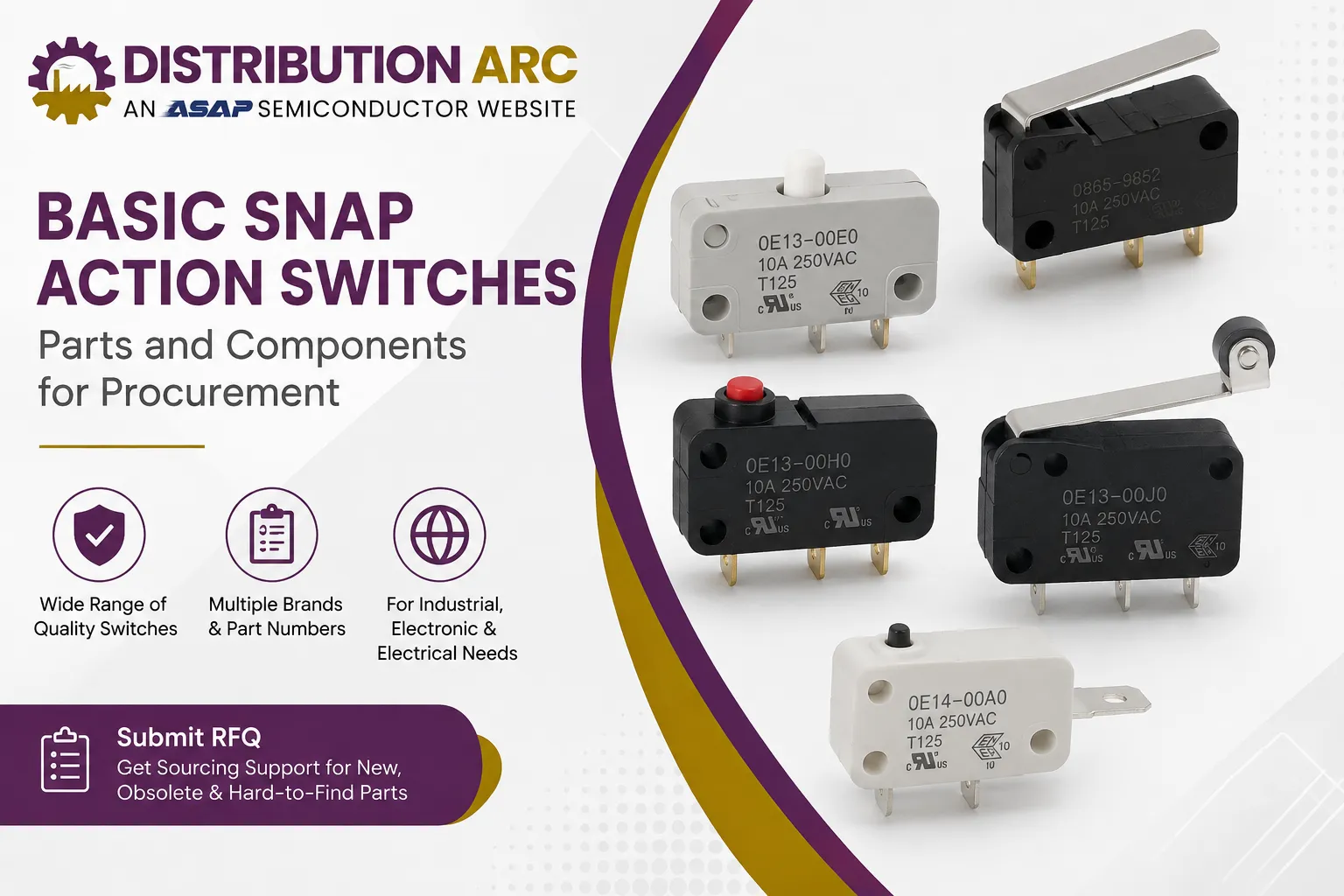

Industrial equipment depends on many small electrical components to operate safely and consistently, and switches are among the most important. They provide a simple way to control electrical circuits, detect movement, and signal when a mechanical action has occurred. Among the different switch designs available, Basic Snap Action Switches are widely used because they offer quick, repeatable switching performance in a compact form.
A snap action switch is designed to change its electrical state rapidly when its actuator reaches a specific operating point. Unlike a switch that gradually moves between contacts, the internal mechanism produces a quick transition from one position to another. This characteristic helps reduce contact hesitation and makes these switches useful in equipment where dependable circuit control is important. Depending on the design, they may be operated through plungers, rollers, levers, or other actuator styles.
Understanding the Construction of Snap Action Switches
Most snap action switches contain a set of electrical contacts, an actuator, terminals, and a spring-loaded internal mechanism. When external pressure is applied to the actuator, the mechanism moves until it reaches its operating point. The contacts then change position rapidly. Releasing the actuator allows the mechanism to return to its original state, depending on whether the switch is normally open, normally closed, or configured with changeover contacts.
The physical design of the switch can vary considerably according to its intended application. Some versions are extremely compact for use in control panels and electronic equipment, while others are designed with stronger housings and terminals for demanding industrial environments. Specifications such as current rating, voltage rating, actuator travel, operating force, terminal configuration, and environmental resistance should always be considered before selecting a component.
Common Industrial Applications
These switches are found in a broad range of industrial and commercial equipment. They can be used to detect whether a machine component has reached a particular position, determine whether a cover or door is closed, or activate and deactivate a circuit when mechanical movement occurs.
Manufacturing machinery frequently uses small mechanical switches as position or limit-sensing devices. They may also appear in control systems, material-handling equipment, appliances, automation assemblies, and various types of electrical equipment. Their relatively simple construction makes them practical for applications where a physical movement needs to produce a reliable electrical response.
Another advantage is the variety of actuator configurations available. A roller lever, for example, can make it easier for moving machinery to operate the switch, while a plunger may be better suited to direct mechanical contact. Choosing the right actuator can have a significant effect on switch life and overall equipment performance.
Selecting the Right Component
When sourcing replacement or new switch components, matching the part number is often the most straightforward approach. However, part number alone should not be the only consideration. Buyers should review the manufacturer's specifications and confirm that the electrical and mechanical characteristics meet the requirements of the application.
Important details can include contact arrangement, operating force, actuator type, mounting dimensions, terminal style, electrical ratings, and expected operating cycles. Environmental conditions should also be considered. Equipment exposed to dust, moisture, vibration, temperature changes, or chemicals may require a switch with appropriate protection and construction.
For larger procurement requirements, organizing parts by manufacturer, part number, availability, and technical specifications can make the sourcing process easier. This is particularly useful when dealing with obsolete components or equipment that has been in service for many years.
Related Switch Technologies
Not every industrial switching requirement calls for the same type of component. Applications involving emergency stopping, conveyor systems, or long-distance mechanical actuation may require a different design. Cable Pull Switches, for instance, are commonly associated with machinery where a cable can be pulled to initiate a switching action along a particular section of equipment.
Other switch categories include limit switches, toggle switches, push-button switches, rotary switches, proximity switches, and pressure switches. Each has different operating principles and advantages. Understanding the application first makes it easier to identify the appropriate component rather than selecting a switch solely based on appearance.
Sourcing Industrial Switch Components
Industrial replacement projects can become challenging when the original component is discontinued, difficult to locate, or required in a specific configuration. A comprehensive parts catalog can help procurement teams compare available part numbers and manufacturers while reducing the time spent searching through multiple sources.
For each requirement, it is useful to have the exact part number, manufacturer preference, quantity, required delivery schedule, and any applicable technical specifications available before requesting a quotation. This information allows suppliers to better understand the requirement and identify suitable sourcing options.
Ultimately, the right switch is determined by the equipment's electrical requirements, mechanical movement, environmental conditions, and expected service life. Taking time to verify these factors can help prevent compatibility problems and unnecessary replacements. Whether the requirement involves a commonly available component or a hard-to-find industrial part, careful identification and specification matching remain essential to dependable procurement.



























Sign in to leave a comment.