
Beacon Technology Market: Navigating Growth, Innovation, and Strategic Shifts in Proximity Intelligence
The beacon technology landscape is entering a decisive inflection point. What began as a niche tool for proximity marketing has matured into a foundational layer for indoor positioning, asset tracking, healthcare workflow optimization, and industrial IoT deployments. Market valuations now exceed $4.5 billion at the base year, with consistent compound annual growth projected at 10.52 percent through the forecast horizon. This trajectory reflects more than incremental adoption; it signals a structural shift in how organizations leverage low-power wireless signals to bridge physical spaces and digital decision-making. For executives, investors, and technology procurement teams, the critical question is no longer whether beacon ecosystems will scale, but how to navigate the technological standardization, regulatory complexity, and competitive fragmentation that are reshaping the value chain.
The market has demonstrated steady expansion over the past half-decade, moving from early pilot deployments to enterprise-grade rollouts with measurable operational impact. Revenue concentration among the top three players remains modest at 28.4 percent, while the top five collectively account for 36.2 percent of total market share. This relatively dispersed structure indicates a sector still in consolidation mode, where specialized vendors compete on vertical expertise, integration capabilities, and software-layer differentiation rather than hardware commoditization alone. The broader trajectory suggests that beacon technology is shedding its standalone hardware identity and evolving into an integrated proximity intelligence layer embedded within larger enterprise architecture.
Three structural challenges are defining the current transition. First, the absence of a unified beaconing standard creates interoperability friction. While Bluetooth Low Energy dominates the technology mix, implementations rely on pseudo-standards such as iBeacon and Eddystone, leading to vendor lock-in risks and uneven cross-platform performance. Second, privacy and data governance requirements are tightening, particularly in regions with stringent consent frameworks. Proximity data collection now demands explicit user consent, transparent usage policies, and architectural choices that separate location analytics from personally identifiable information. Third, the shift from hardware-centric deployment to software-driven value extraction is raising the bar for competitive differentiation. Organizations that treat beacons as mere signal emitters are finding limited ROI, while those that layer analytics, AI-driven workflow integration, and operational dashboards are capturing measurable efficiency gains.
Key Drivers Shaping Market Trajectory
Several interconnected forces are accelerating adoption and redefining where value is created. The first is technological maturation, particularly the recent evolution of Bluetooth specifications. The release of Bluetooth Core 6.3 introduces architectural improvements that enhance ranging precision and interface capabilities, directly addressing historical limitations in distance measurement and signal reliability. Combined with Channel Sounding features introduced across newer Bluetooth generations, beacon-based indoor positioning is moving toward centimeter-level accuracy. This technical leap transforms beacons from proximity indicators into precision location instruments, unlocking use cases in healthcare patient flow, warehouse asset routing, and large-venue navigation that were previously constrained by distance ambiguity.
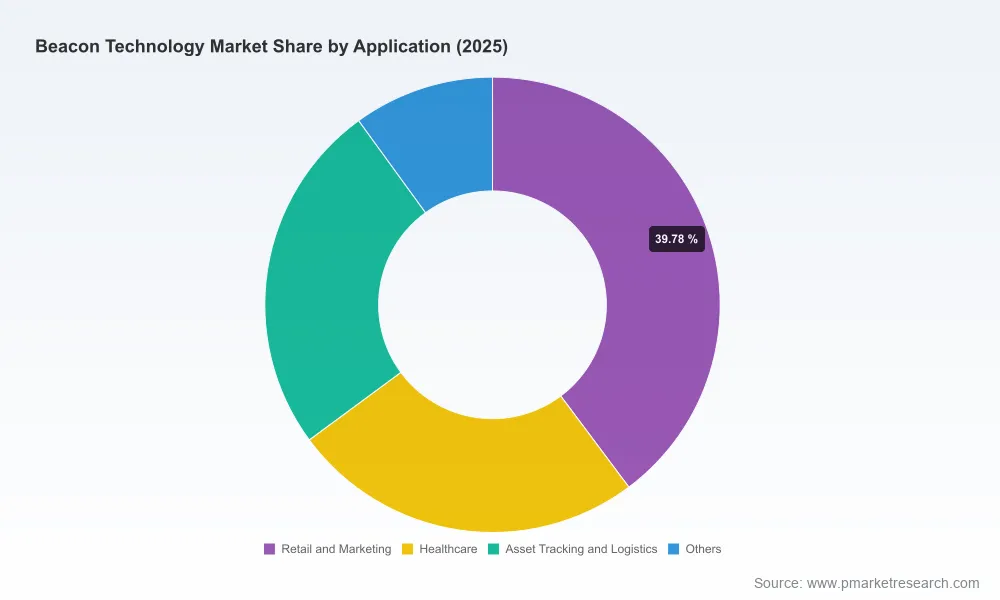
The second driver is demand-side behavior shifting toward operational efficiency and omnichannel integration. Retail and marketing ecosystems continue to represent a substantial application share, but the growth story is increasingly anchored in healthcare and logistics. In healthcare settings, beacon data is being repurposed from simple location tracking to operational analytics, including hand hygiene compliance monitoring and patient flow optimization. In logistics and asset tracking, organizations are deploying beacons to reduce search times, improve inventory visibility, and integrate proximity signals with broader workflow systems. The common thread is a move away from campaign-driven proximity triggers toward persistent, low-friction visibility that supports continuous operational improvement.
Regulatory and standardization dynamics are acting as both constraint and catalyst. Because beacon deployments operate under Bluetooth SIG specifications rather than a formal beaconing standard, implementation consistency varies across vendors and regions. This pseudo-standard environment creates flexibility for innovators but also introduces integration complexity for enterprise buyers. Simultaneously, data protection requirements are reshaping deployment architectures. In markets with strong privacy frameworks, proximity data collection requires explicit consent mechanisms and transparent disclosure of how location signals are used, stored, and shared. Vendors and end users alike are responding by embedding consent management into deployment planning and by designing analytics pipelines that minimize personal data exposure while preserving operational utility.
Supply chain and cost structures are also evolving. The maturation of Bluetooth Low Energy chipset ecosystems, combined with broader IoT manufacturing scale, has improved component availability and reduced per-unit hardware costs for certain form factors. This cost compression is particularly evident in asset tracking and industrial applications, where long battery life, ruggedized designs, and waterproof configurations are becoming standard rather than premium features. At the same time, the economic emphasis is shifting from unit price to total cost of ownership, including integration effort, cloud platform licensing, analytics capability, and ongoing maintenance. Vendors that can offer bundled hardware-software solutions with clear deployment pathways are gaining traction over those competing solely on hardware pricing.
Competitive Positioning and Market Evolution
The competitive landscape reflects a blend of specialized beacon vendors, platform-oriented players, and infrastructure incumbents extending into proximity services. Market participants are increasingly differentiated by their ability to connect hardware signals to actionable software layers, rather than by beacon specifications alone. Several strategic positioning patterns are emerging.
One cluster focuses on vertical-specific solutions, particularly in healthcare and operational analytics. Companies in this space are moving beyond proximity detection to embed AI-powered tools that interpret beacon data for workflow optimization, compliance monitoring, and resource allocation. The launch of AI-driven operational analytics platforms for healthcare environments illustrates how beacon data is being converted into decision-support intelligence. This verticalization strategy allows vendors to command stronger positioning in regulated or workflow-intensive sectors where generic proximity tools struggle to demonstrate measurable return.
A second cluster emphasizes developer ecosystems, SDK maturity, and sensor integration. Durable hardware combined with advanced software development kits enables retail, logistics, and indoor navigation use cases to scale across multiple deployment environments. By prioritizing sensor fusion, AI-driven feature sets, and flexible integration pathways, these players reduce the engineering burden on end customers and accelerate time-to-value for omnichannel and analytics-driven deployments.
Digital Scent Technology Market
A third competitive axis involves infrastructure and enterprise IT vendors integrating beacon capabilities with existing network architectures. When proximity services are embedded into enterprise Wi-Fi and location services ecosystems, organizations gain a more unified deployment model, simplified management, and broader scale potential for large venues and campus environments. This integration path reduces friction for enterprises already invested in specific network vendors and creates a natural expansion lane for location-aware services.
PW Consulting Information & Electronics Research Center
Manufacturing-focused players continue to compete on cost efficiency, form factor variety, and durability. Long battery life, waterproof construction, and flexible hardware options remain important for warehouses, industrial sites, and event environments. However, hardware competition alone is increasingly insufficient as end users demand cloud analytics, deployment support, and integration readiness. The market is gradually shifting toward bundled value propositions where hardware serves as an entry point to software-driven outcomes.
These dynamics point to a market in transition rather than one nearing consolidation. Fragmentation persists because vertical expertise, integration models, and software capabilities vary widely across vendors. At the same time, regulatory pressures, standardization progress, and enterprise demand for unified platforms are creating conditions for selective consolidation, partnership formation, and ecosystem alignment. New entrants are likely to succeed not by replicating commodity beacon hardware, but by targeting underserved verticals, delivering stronger analytics stacks, or offering tighter integration with existing operational systems.
Strategic Trajectories for the Next Three to Five Years
The next phase of beacon market evolution will be shaped by the convergence of precision location, software-led value creation, and regulatory adaptation. Three trends are particularly consequential.
The first is the shift from proximity signaling to precision indoor positioning. As Bluetooth specifications continue to improve ranging accuracy and interface consistency, beacon ecosystems will support more reliable distance estimation and spatial awareness. This will expand deployment confidence in environments where coarse proximity was previously insufficient, such as complex healthcare workflows, dense warehouse layouts, and large public venues. The commercial opportunity lies in applications that require dependable spatial context for automation, routing, and service delivery, rather than simple presence detection.
The second trend is the elevation of beacon data into operational analytics and AI-supported decision-making. Hardware deployment will increasingly be treated as the data collection layer for broader software platforms. Organizations will look for tools that translate beacon signals into workflow insights, compliance indicators, asset utilization metrics, and customer experience optimization. Vendors that can provide actionable dashboards, integration pathways with enterprise systems, and domain-specific analytics will capture more sustained value than those offering standalone beacon hardware.
The third trend is regulatory adaptation becoming a competitive differentiator. Privacy requirements are moving from compliance checkboxes to architectural design principles. Deployments that embed consent management, minimize personal data exposure, and provide transparent usage policies will face fewer friction points in enterprise and regulated environments. Over time, privacy-aware design and clear data governance will influence procurement decisions, particularly in healthcare, retail, and public-facing deployments where user trust and regulatory exposure are material factors.
Beacon Buoys Market
These trends create clear commercial opportunities, but also introduce uncertainty. Precision positioning depends on continued specification refinement and consistent vendor implementation, meaning interoperability risks remain during the transition period. Analytics-driven models raise expectations for software reliability, data integration, and ongoing platform support, which can strain vendors that lack mature engineering and service capabilities. Regulatory environments may diverge across regions, complicating global deployment strategies and requiring localized consent and data handling approaches. Organizations that treat these uncertainties as planning variables rather than external noise will be better positioned to capture the upside while managing exposure.
Actionable Guidance for Decision-Makers
For manufacturers and hardware-centric vendors, the strategic imperative is to strengthen the software and integration layer that surrounds beacon deployments. Competing on hardware specifications alone leaves little room for sustained differentiation as component availability improves and cost structures compress. Investment in developer tooling, cloud analytics, verticalized solutions, and deployment support will determine whether a hardware portfolio becomes a commodity input or a gateway to higher-value services. Vendors should also monitor specification evolution closely and align product roadmaps with precision positioning and interface improvements that reduce integration friction for enterprise customers.
For investors, the most compelling opportunities lie at the intersection of vertical expertise and software-led value creation. beacon technology is increasingly evaluated through the lens of operational outcomes rather than signal emission, which favors companies that can demonstrate measurable efficiency gains in healthcare workflow, asset visibility, logistics routing, or omnichannel engagement. Due diligence should weigh platform maturity, integration readiness, data governance capabilities, and the ability to adapt to evolving privacy requirements. Pure hardware plays face margin pressure and substitution risk, while analytics-enabled and vertically integrated offerings are better positioned to capture recurring value and defend against commoditization.
For procurement teams and enterprise buyers, the priority is to define use cases around operational outcomes before evaluating hardware specifications. Beacon deployments that succeed typically align signal collection with clear workflow objectives, such as reducing search time, improving compliance visibility, enhancing patient or customer flow, or integrating proximity data with existing enterprise systems. Procurement criteria should extend beyond beacon durability and battery life to include platform analytics, consent and privacy architecture, integration effort, vendor support, and long-term scalability. Treating beacon selection as a platform and workflow decision rather than a hardware purchase reduces the risk of underutilization and improves the likelihood of measurable return.
Across all roles, the pace of change in specifications, privacy expectations, and software capabilities means that point-in-time assessments quickly lose relevance. Detailed segmentation data, deployment cost structures, vendor benchmarking, and regional regulatory nuances are essential for sequencing investment and avoiding integration pitfalls. Access to comprehensive market intelligence allows decision-makers to compare strategic options with greater confidence, identify where precision positioning and analytics investments will yield the strongest returns, and anticipate regulatory and interoperability shifts before they affect deployment timelines.
The beacon technology market is moving from a phase of hardware exploration to one of precision location, software-driven analytics, and privacy-aware deployment. Growth is sustained, but value capture is increasingly determined by how well organizations align beacon infrastructure with operational goals, integrate data into decision workflows, and adapt to evolving standards and regulations. For executives, investors, and procurement leaders, the path forward depends on treating beacon technology as a proximity intelligence layer within a broader enterprise strategy, and on securing the detailed market context needed to choose vendors, prioritize vertical opportunities, and time investments with confidence.
For detailed analysis of this topic, please visit the official page: Beacon Technology Market
Lacy Lee
Senior Marketing Manager
[email protected]
PW Consulting: www.pmarketresearch.com





























Sign in to leave a comment.