Before Hiring a Marketing Automation Consultant, Define These Deliverables

Before Hiring a Marketing Automation Consultant, Define These Deliverables
subtitle:A buying guide for teams that need clear acceptance criteria, usable documentation, and someone to run the system afterward.

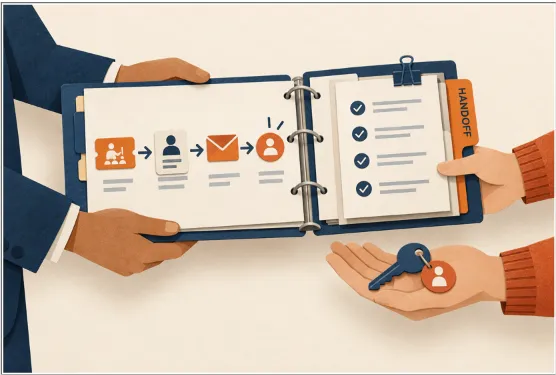
Marketing automation workflow handoff
I would pause on a proposal that promises “CRM integration” without naming what the team will receive. Does that mean a recommendation, a configured connection, or a working process somebody inside the business can maintain?
Those are different purchases. The difference becomes especially clear when a record fails to move, a campaign needs pausing, or the consultant’s engagement ends.
Before hiring, I would turn the proposal into a list of deliverables with an internal recipient and a way to accept each one. That makes marketing automation consulting easier to compare and gives the project a practical definition of finished.
Agree on the job before counting workflows
Start with one business process and its boundaries: for example, webinar follow-up from attendance data to a sales handoff. Identify the systems involved, the decision the process supports, and the team that will operate it.
Then separate advice from implementation. An advisory engagement might deliver requirements and a prioritized design. An implementation engagement should also specify who configures the systems, who tests them, and who handles launch problems. Ongoing campaign management is another scope again.
If nobody internally can maintain a custom integration, I would raise that before approving the build. The available options might be a simpler design, staff training, or ongoing support. Each changes what you are buying.
Put these deliverables in the proposal
Use this as a starting point, then remove anything outside the agreed scope. The internal recipient is the person or role who checks and takes responsibility for the delivered work.
| Deliverable | Internal recipient | Evidence needed to accept it |
| Current-state findings | Business process owner | A traced record shows the problem; affected systems and unresolved questions are named. |
| Approved workflow specification | Marketing and sales leads | Both teams agree on entry, exit, exclusions, timing, and the next human action. |
| Field and integration mapping | CRM administrator | Each transferred field has a source, destination, update rule, and handling for missing or conflicting values. |
| Configured workflow, if included | Internal operator | The configuration can be located in the agreed account and matches the approved specification. |
| Acceptance test record | Business process owner | Expected and actual behavior are recorded, with evidence and unresolved defects. |
| Operating instructions and access register | Operator and system administrator | The team can find the pause, recovery, monitoring, and access-removal instructions. |
| Handoff and support plan | Operator and backup | A practical walkthrough is completed; open issues, support boundaries, and the next review are assigned. |
For broader context on the scope behind this checklist, SpringBrand’s marketing automation consulting guide covers audits, workflow definitions, testing, and handoff documentation. It is further reading on the work to specify.
Keep the list specific enough that two providers can price the same job. “Documentation included” leaves plenty of room for disagreement. “Editable field map, workflow specification, and operator instructions stored in our shared workspace” tells you much more.
Ask for a redacted sample of the promised documents before choosing a provider. Look for details an operator could act on, rather than the polish of the presentation.
Write one acceptance example before signing
A list of files still needs a behavioral test. I would draft one example with the consultant while the scope is being agreed.
Here is a fictional acceptance design for webinar follow-up, not a result from a live system.
Assume the agreed rule is that an attendee can enter a follow-up sequence only when the attendance record has a stable contact identity, an affirmative marketing-permission value, and an active sales owner. The business must approve those conditions before anyone implements them.
The specification could say:
| For one eligible contact and one webinar, enroll the contact once. Reprocessing the same attendance event must not create another enrollment. A record with unknown permission remains outside the sequence. A record without an active owner goes to the named review queue. |
That is deliberately narrower than “automate webinar follow-up.” It gives the buyer something observable to check.
Use controlled test records for four conditions:
- Eligible attendee: one enrollment, with the record linked to the correct contact and webinar.
- Unknown permission: no enrollment, with the exclusion reason recorded.
- Repeated attendance event: no second enrollment for the same contact and webinar.
- No active owner: no enrollment, with a review item assigned to the agreed queue.

Webinar follow-up acceptance logic
The duplicate condition needs careful wording. Deduplicating by contact alone could block that person from a later webinar. The proposed uniqueness rule here uses the contact and webinar together. Ask the implementer to document how that rule works in the chosen platform, including what happens after a failed attempt.
For each case, require the test input, expected behavior, actual behavior, and a link or identifier for the evidence. Specify the account and environment used. A screenshot saying “workflow active” cannot show whether the repeated event created a second enrollment.
Agree who fixes a failed acceptance case and who checks the correction. If a test cannot run because required data or access is missing, record that dependency and its owner. It remains an open acceptance item.
These four cases illustrate how to make scope testable; they are not a complete test suite. Delayed permission changes, integration failures, and platform limits may require additional cases for the actual design.
Make ownership visible in the files and accounts
I would check where the delivered configuration and documents will live while comparing proposals. Your operator needs access to the working materials, and somebody needs authority to approve changes.
Agree which documents and custom configurations you can retain and edit, which components are licensed, and what depends on the provider’s accounts. A third-party platform may limit exports or transferability; those limitations belong in the scope.
NIST’s Small Business Quick-Start Guide provides a useful example of ownership discipline. Its asset inventory places the administrator or owner beside the asset’s purpose, sensitive-data access, and the risk of losing access. I would apply that same discipline to the project inventory.

NIST asset inventory ownership template
The guide is cybersecurity guidance, not a marketing-consulting procurement standard. Its relevance here is concrete: identifying a system without identifying who controls it leaves an operational question unanswered.
For consultant access, ask the system administrator to define the permissions required for the work and the removal date or review point. Include service accounts and integration credentials in that review. Removing a consultant’s user login does not establish that the team controls every connection they configured.
If AI is included, name what it may decide. Drafting a message for review and changing a lead’s qualification are different actions. Define the approval step and the fallback behavior when its output is unsuitable.
End with a handoff the operator can perform
I would make the final handoff a working session led by the internal operator. Give them the documents and ask them to pause the bounded workflow, find a failed record, identify the responsible owner, and explain how a corrected record would be processed.
The consultant can guide the session. The useful evidence is whether the operator can locate and perform the agreed actions. Record anything that still requires the consultant’s private notes or personal account.
Before closing, settle the support window: start and end dates, covered defects, response expectations, escalation contact, and treatment of requests for new functionality. Assign the first maintenance review to an internal role, with a backup.
That review should revisit queue ownership, failures, permission handling, and changes to the systems the workflow depends on. It does not need to become another large project.
My final question would be simple: can the named operator stop this process safely and explain what happens next? If they still need the consultant to answer that, there is useful handoff work left to do.



Sign in to leave a comment.