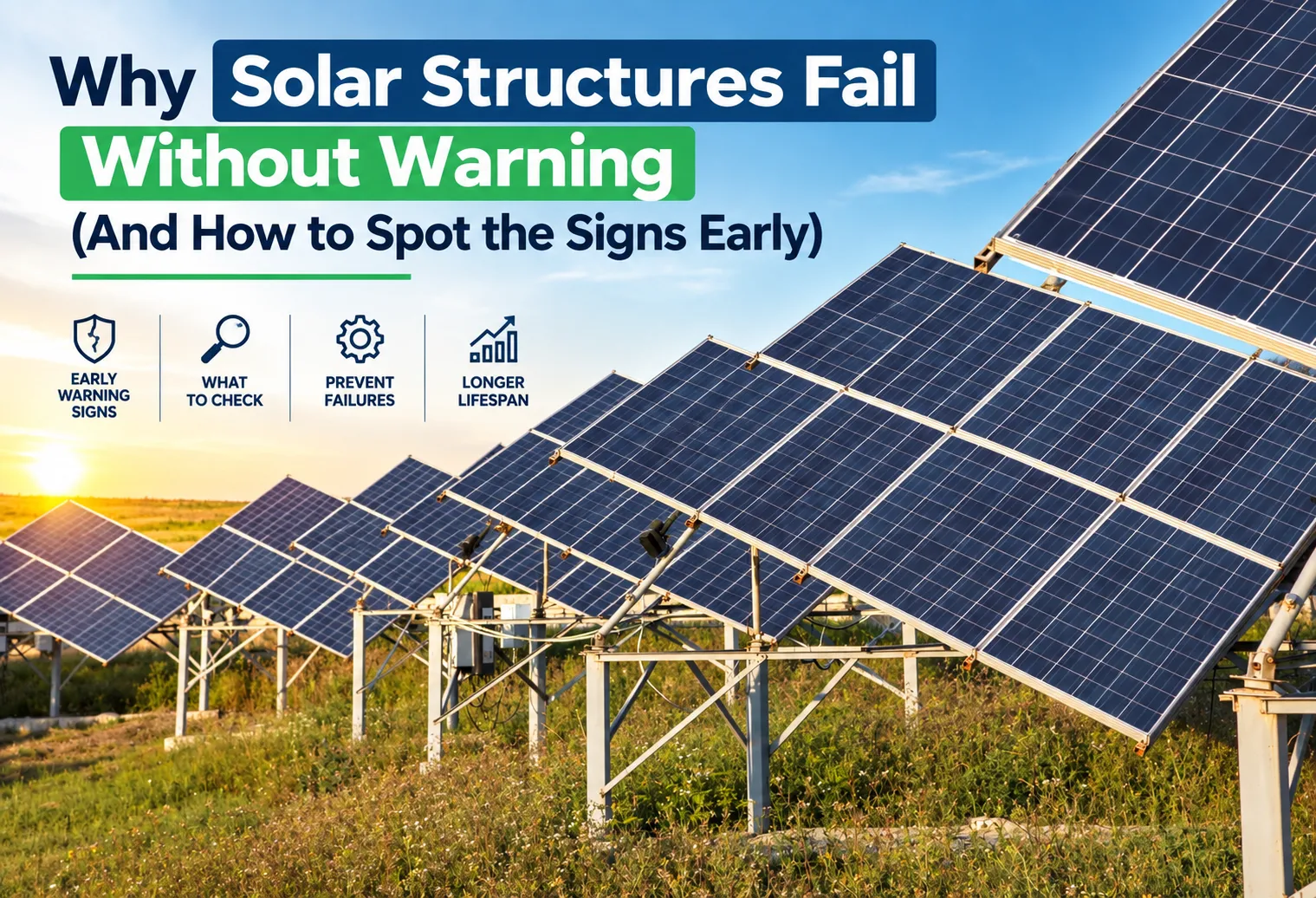

Many professionals are familiar with the unsettling realization that arises when a project nears completion, only to discover an unexpected structural deviation that was not present at the outset. This scenario occurred during a 2 MW ground-mounted solar project for which we supplied mounting structures. The experience provided deeper insights into the essential deliverables for solar ground mounting structure manufacturers than any specification sheet could offer. This account outlines the key lessons learned from that project. The Project Setup The project site covered approximately 5 acres in a semi-arid region characterized by rapidly changing wind conditions and unpredictable subsurface soil. The developer, a mid-sized solar EPC company with a skilled and experienced team, approached us with a strict timeline, detailed load calculations, and a highly annotated drawing set. Their requirements were explicit: ground-mounted solar mounting structures capable of withstanding wind zone IV loads, providing corrosion resistance for over 25 years, and enabling rapid installation without unforeseen complications on site. While these requirements appeared straightforward in theory, a detailed analysis of the project specifications revealed a more complex reality. What the Numbers Actually Said Here’s what the structural loads looked like on paper before fabrication even started. Parameter Specification Wind Zone IV (as per IS 875 Part 3) Basic Wind Speed 47 m/s Panel Tilt Angle 20 degrees Purlin Span 2.1 meters Post Embedment Depth 1.2 meters Steel Grade GI with 120 GSM zinc coating Section Type C-Purlins and custom bracings Tolerances Required ±0.5 mm dimensional accuracy Each parameter carried significant implications. For example, the 47 m/s wind speed required C-Purlins to be manufactured with precise flange widths and web depths, rather than relying on standard catalogue sizes. The ±0.5 mm tolerance specification highlighted any discrepancies between machine-controlled roll forming and manual fabrication immediately. Based on extensive project experience, such discrepancies are often the primary source of procurement challenges. Where Other Manufacturers Struggled (And Why It Matters) Prior to engaging with us, the EPC team had worked with two local fabricators. The issue was not the competence of these fabricators, but rather that the project requirements exceeded the capabilities of general-purpose workshops to deliver at scale. What went wrong with the earlier vendors: There was dimensional inconsistency between batches; the first batch of C-Purlins exhibited flange variations of up to 2 mm between pieces. In a project involving over 1,800 panels, such variation results in significant alignment errors across multiple rows. Punching accuracy was inadequate; pre-punched holes for module clamps deviated from the specified pitch. This necessitated on-site re-drilling, which delayed installation and introduced stress points in the structural sections. The corrosion-resistant coating was inconsistent, with some sections displaying patchy galvanization and visible bare spots. For a structure intended to last 25 years outdoors, this represents a significant durability concern. Fragmented delivery, with rafters, purlins, and bracings sourced from different vendors, resulted in substantial coordination challenges on site. By the time the EPC team reached out to us, they’d already lost about three weeks. Recommendation: For ground-mounted solar projects rated wind zone III or higher, request a section property sheet from the manufacturer in addition to a physical sample. It is essential to verify moment of inertia, section modulus, and wall thickness uniformity before proceeding with large-scale production. A single sample may not reveal inconsistencies that become apparent in bulk orders. What Changed When Manufacturing Was Actually Controlled It is important to recognize that Cold Roll Forming serves not only as a production method but also as a means of quality control. When steel strip is processed through precisely calibrated forming rollers, the resulting shape is determined by the machine rather than individual judgment. Regular quality checks are conducted every five pieces, including during night shifts, ensuring minimal variation between initial and subsequent batches. For this specific project, here’s what that looked like in practice: Step 1: We started with a full review of the drawing set and load specifications. The purlin depth, flange width, and web thickness were calculated to match the actual wind load, not just rounded to a nearby standard size. First, material procurement was done based on the GSM and steel grade specified, not substituted with whatever stock was available that week. Step 2: Decoiling and punching came next. Punching jigs were set to the exact module clamp pitch specified in the drawing, verified with first-piece inspection before the full run started. Then roll forming and cutting brought each section to length with dimensional tolerances within ±0.5 mm, consistently, across the full order volume. Step 3: Final quality inspection before dispatch. Every section checked. Not a sample. Every section. As a result, the EPC team’s installation crew reported that row alignment was completed more efficiently than in previous projects, with no need for on-site re-drilling or re-ordering. Professional Insight: Corrosion resistance in ground-mounted solar structures depends not only on GSM specification but also on coating uniformity across the entire section profile, including internal surfaces. A controlled manufacturing process applies the GI coating to the coil prior to forming, ensuring comprehensive protection for all surfaces. The Installation Reality Most Specs Don’t Talk About There is an aspect of the installation process that is not captured in structural calculations. The installation crew on this project was working in 38-degree heat. The site foreman told us later that the single biggest factor affecting their daily progress wasn’t panel availability or inverter delivery. It was how quickly they could assemble the mounting structure rows. Accurately aligned pre-punched holes, bracings that fit without adjustment, and purlins that remain level without shimming may appear minor. However, in a 2 MW project with hundreds of structure rows, these factors can save days rather than hours during installation. And when structure components come from a single manufacturer with a controlled process, everything fits like it was made together. Because it was. From Our Experience: In ground-mounted projects above 1 MW, coordinating structure components from multiple suppliers almost always creates on-site fit-up issues. A single-source manufacturing partner who can handle C-Purlins, bracings, rafters, and custom profiles together reduces coordination time and almost always improves installation speed. What This Project Confirmed for Solar Ground Mounting Structure Manufacturers So what did the numbers actually teach us? Precision isn’t a premium feature. It’s the baseline that makes everything else work on site. A 0.5 mm tolerance requirement isn’t the customer being overly demanding. It’s them telling you what the project actually needs to succeed. Corrosion specs aren’t just for audits. They’re for the 20th year of that structure’s life, when nobody from the original project team is on site anymore. And batch-to-batch consistency? That’s probably the most underrated specification in the whole procurement conversation. Anyone can make one good piece. The real question is whether piece number 847 looks exactly like piece number 1. From what we’ve seen over 8 years and 500-plus MW delivered, the projects that run smoothly are almost always the ones where the manufacturer was brought in early, given the actual drawings, and asked real questions before production started. What Solar EPC Companies and Developers Should Actually Ask Their Manufacturer Before you commit to a supplier for your next ground-mounted project, here’s a short list of questions worth asking: Can you manufacture to my specific drawing, or only to your standard catalogue sizes? What is your dimensional tolerance, and how do you verify it during production? How do you handle GSM and steel grade consistency across a large order? What’s your daily production capacity, and can you scale if the project timeline moves? Can you supply C-Purlins, bracings, rafters, and custom sections from one facility? How are quality checks carried out, and do they happen at night shifts too? These aren’t trick questions. A manufacturer with a real controlled process will have direct, specific answers to all of them. Working With a Manufacturer Who Understands the Numbers Rudran Infra Metals manufactures cold-rolled-formed steel sections and customised solar mounting structures for ground-mounted, rooftop, and agrovoltaic solar applications. The manufacturing process is built around your drawings, your load specs, your GSM requirements, and your project timeline. With 8-plus years of experience, 500-plus trusted clients, 45-plus tonnes of daily production capacity, and 24x7 operations, the team is set up to handle projects at scale without cutting corners on dimensional accuracy or coating quality. For projects with specific structural requirements, stringent tolerances, or limited timelines, early consultation prior to production is recommended. Reach out to the Rudran Infra Metals team at rudraninframetals.com to share your drawings and get a manufacturing consultation for your solar ground mounting structure requirements. Because the numbers matter. And so does the manufacturer who actually understands them.

























Sign in to leave a comment.