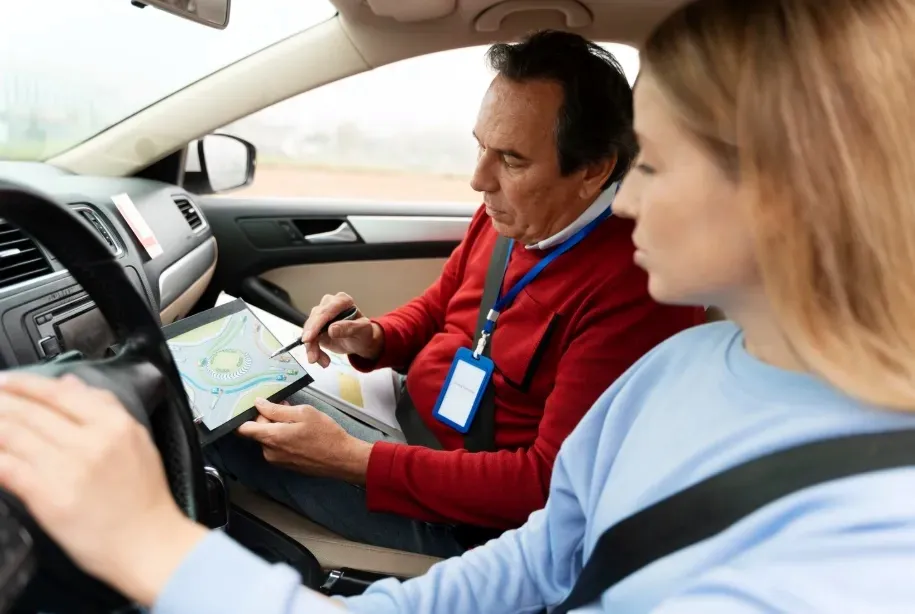

Observe an expert instructor while you’re having a first lesson and not much seems to be going on. The car rolls ahead, the learner holds the wheel, and a placid voice suggests a thing or two. However, there’s a lot going on beneath the gentle surface: assessing the learner’s mood, watching traffic for them, and making a snap judgment again on whether a word is to be spoken or silence is needed. Knowing what a composition driving lesson teacher does helps you make a better decision about who will guide you through your teenage years.
Two Sets of Eyes on the Road
A learner stalls over the basics: speed, steering, mirrors, and signals. An instructor, meanwhile, is watching the rest. The cyclist coming from behind, the pedestrian hesitating in a crosswalk, and the transport truck swerving into the next lane.
This vigilance is why riding in dual-control vehicles in the early stages is safe. While dual control gives an instructor a safety net, a good teacher is rarely required to use it. They foresee problems and steer the lesson away from a scare before a mistake even happens.
Teaching Is a Separate Skill From Driving
Being a good driver does not automatically mean being a good teacher. To help a person who has never performed a shoulder check effectively, explaining how to do one takes clarity and patience and an ability to reduce a hard habit into a series of small, learnable bits.
Good teachers read their learners. A nervous teen, a newcomer to Canada, or a retiree back on the road needs very different instruction and can sense the difference. It's a skill.
What a Quality Driving Teacher Course Looks Like
A well-structured driving teacher course runs its own arc rather than a haphazard roundabout. In most such courses, students progress through:
- The Basics: seat, mirrors, wheel, not braking in quiet streets.
- Typical traffic: lane changing, upgrading, junctions, entering.
- More complex traffic: highways, roundabouts, and left turns.
- The weather: rain, snow, glare, low visibility.
- Practical exam replications: examiners require these maneuvers.
Progression through these stages means competence occurs as well as confidence.
Feedback That Helps Instead of Overwhelms
Most of the time, learners become disheartened because of lousy feedback. Learning is hard, especially in a tense moment when constant correction leaves no time to think. Comments like "just be smoother" are not useful at all. That is why good teachers are careful to pick their moments. A short, specific instruction is given on the way. They wait until they have arrived at a quiet stretch or until the end of the lesson and then give the full explanation. Praise is not vague, but everything is stated clearly so that the learner knows what to repeat.
Preparing for Canadian Roads
Driving here involves adjusting to rapidly changing conditions. In the winter, a familiar route can become treacherous overnight, and on rural roads, you have to expect wildlife, gravel shoulders, and long gaps between services.
A good instructor will gradually impart this knowledge, describing how stopping distances expand on ice and how smooth inputs become crucial when there's little traction. Learners who practice with a skilled instructor are much better equipped to deal with their first snowy street than those who face that intersection on their own.
Questions Worth Asking Before You Enrol
Not every program is the same, so a few questions can save time and frustration:
- Are the instructors certified and experienced?
- Is there a clear curriculum, or are lessons improvised?
- How flexible is scheduling around school and work?
- Are the vehicles dual-controlled and well-maintained?
- What do past students say about the teaching style?
Honest answers reveal a lot about the quality of instruction on offer.
Patience Is the Real Teaching Tool
Well, the common characteristic of great teachers is that they remain calm when the student is not. They are very infectious. After several classes, the stressed-out beginner starts to relax, look in the mirror automatically, and trust himself.
Ready to Learn From the Right Guide?
The quality of the first teacher plays a very important role in forming the habits that will remain with a person for many years. It is always good to invest wisely.
So, are you ready to begin? Contact Jim's Insync Driving School at https://jimsdriving.ca/ for your first lesson and start enjoying the world of safe driving.























Sign in to leave a comment.