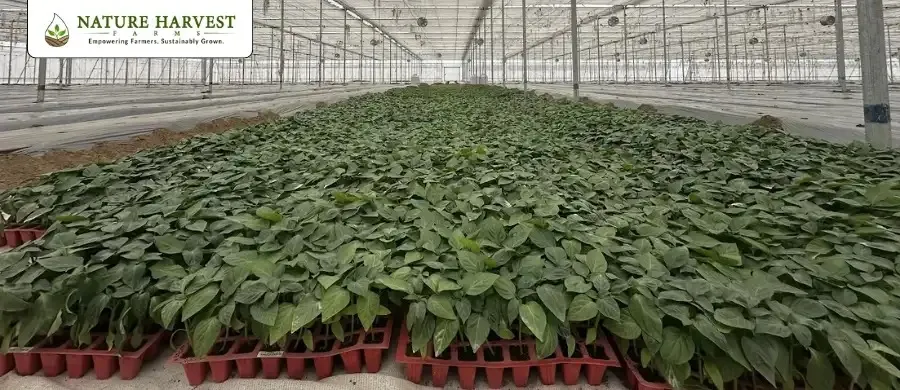

Bell pepper farming is becoming increasingly important in India as demand for fresh, premium-quality capsicum grows across hotels, restaurants, catering companies, retailers, wholesalers, food processors, and modern vegetable markets.
However, growing commercially acceptable bell peppers requires much more than simply planting a crop and waiting for harvest. Fruit size, colour, firmness, appearance, freshness, and consistency can all influence its market value.
This is where Controlled Environment Agriculture for bell peppers provides an important advantage.
At Nature Harvest Farms, bell pepper cultivation is developed around controlled growing conditions, systematic crop management, quality-focused harvesting, and organised B2B supply. By managing important environmental and crop factors more carefully, controlled farming can create a more predictable path from plantation to market-ready produce.

How Are Bell Peppers Grown in Controlled Environments?
Bell peppers are grown in controlled environments by carefully managing temperature, humidity, irrigation, nutrients, airflow, plant health, pest exposure, and other growing conditions. Healthy plants are established first, followed by vegetative growth, flowering, fruit setting, fruit development, harvesting, grading, and supply. Under suitable crop conditions, the first harvest may begin approximately three months after plantation, although timing varies according to variety, environment, management practices, and required maturity.
What Is a Controlled Environment Bell Pepper Farming?
Controlled environment bell pepper farming is a cultivation method in which important growing conditions are monitored and managed rather than leaving the crop completely exposed to changing outdoor conditions.
Depending on the farm and crop requirements, growers may manage factors including:
- Temperature
- Humidity
- Irrigation
- Nutrient availability
- Root-zone conditions
- Air circulation
- Plant spacing
- Pest and disease exposure
- Crop health
- Light and growing environment
Nature Harvest Farms follows a broader Controlled Environment Agriculture (CEA) model incorporating cultivation methods according to crop requirements. The company highlights consistent quality, predictable supply and resource-efficient production as important elements of its farming approach.
Why Bell Pepper Is Suitable for Controlled Environment Farming
Bell pepper, also commonly called capsicum or sweet pepper, is a commercially valuable crop whose quality can be strongly influenced by growing conditions.
Open-field bell pepper cultivation can be affected by variables such as unexpected temperature changes, heavy rainfall, water stress, pest pressure and changes in humidity.
For premium and commercial markets, buyers may be looking for more than basic availability. They may require:
- Consistent fruit size
- Attractive colour
- Firm texture
- Good shelf performance
- Minimal physical damage
- Consistent batches
- Reliable quantities
- Predictable harvest schedules
Controlled cultivation helps growers manage many of the factors that influence these requirements.
For Nature Harvest Farms, the objective is therefore not simply to grow bell peppers, but to develop a crop that can support the requirements of commercial buyers.
Bell Pepper Plantation to Harvest: The Complete Growing Journey
1. Planning the Crop Around Market Demand
Commercial bell pepper farming should ideally begin with understanding what the market needs.
Different buyers may require different types of produce.
For example:
- Hotels may require coloured capsicum with good visual uniformity.
- Restaurants may prioritise freshness and regular availability.
- Caterers may require larger quantities for specific events or contracts.
- Wholesalers may require standard grades and bulk volumes.
- Retailers may focus strongly on appearance and shelf life.
- Food processors may have specific size, colour or maturity requirements.
Common commercial varieties include:
Green bell pepper
Typically harvested before complete colour development and commonly used across restaurants, households and commercial kitchens.
Red bell pepper
Usually sweeter in flavour and popular in premium culinary preparations.
Yellow bell pepper
Widely used by restaurants, hotels and food-service businesses because of its bright colour and presentation value.
Understanding the expected market before plantation can help the grower make better decisions regarding crop selection, harvesting and grading.
2. Selecting Healthy Bell Pepper Plants
A productive plantation starts with good-quality planting material.
Plants should have sufficient vigour to establish a healthy root system and support subsequent vegetative growth, flowering and fruit development.
Weak or unhealthy planting material can affect the crop even when environmental conditions are well managed.
The early establishment stage therefore plays an important role in determining the performance of the plantation later in the crop cycle.
3. Preparing the Controlled Growing Environment
Before plantation begins, the growing environment needs to be prepared carefully.
The goal is to create suitable conditions for:
- Root establishment
- Vegetative growth
- Flowering
- Pollination and fruit setting
- Fruit development
- Crop health
Unlike conventional open-field cultivation, controlled environment farming allows growers to monitor key conditions more closely.
This is particularly valuable for premium vegetables such as capsicum, where variations during flowering or fruit formation can affect crop uniformity and market quality.
4. Plant Establishment and Early Growth
Once planted, bell pepper plants enter an important establishment phase.
During this period, growers generally focus on:
- Root development
- Balanced irrigation
- Nutrient availability
- Plant health
- Appropriate plant spacing
- Vegetative growth
The objective is to establish strong plants before significant flowering begins.
Healthy vegetative development provides the foundation required for the plant to carry multiple fruits later in the cycle.
5. Irrigation and Nutrient Management
Water management is one of the most important elements of bell pepper farming in controlled environments.
Both excessive and insufficient irrigation can negatively affect plant performance.
Controlled farming systems allow irrigation to be managed more precisely according to plant requirements and growing conditions.
Nutrient management is equally important because the nutritional needs of a bell pepper plant change as it progresses from vegetative growth to flowering and fruit development.
The aim is therefore not simply to provide more water or nutrients, but to provide them appropriately according to crop requirements.
6. Supporting Flowering and Fruit Setting
Flowering represents a major transition in the bell pepper crop cycle.
A healthy plant must move from producing leaves and stems to supporting flowers and developing fruits.
Environmental stress during this period can potentially affect flower retention and fruit formation.
This is another reason controlled cultivation can be particularly useful for capsicum production. By maintaining more favourable conditions, growers can reduce some of the environmental variability experienced in traditional farming.
7. Monitoring Fruit Development
After successful fruit setting, bell peppers begin developing toward their required commercial size and maturity.
This stage requires ongoing crop monitoring.
Growers may evaluate:
- Fruit size
- Shape
- Colour
- Firmness
- Surface condition
- Plant health
- Pest or disease symptoms
- Maturity
The required harvesting stage can vary depending on the intended market.
Green capsicum is normally harvested while still green, whereas coloured bell peppers remain on the plant longer to develop their characteristic red, yellow or other mature colour.
8. Harvesting Bell Peppers at the Right Stage
Harvest timing has a direct impact on marketability.
Bell peppers harvested too early may not meet expected size or maturity requirements, while delayed harvesting can potentially affect firmness or logistics.
Nature Harvest Farms’ plantation-focused material indicates that the first market-ready harvest can be expected at roughly three months after plantation under suitable growing conditions, although the exact timing depends on the variety, growing environment, crop management and required maturity.
Harvesting is therefore better viewed as a crop- and market-dependent window rather than a fixed date.
What Happens After Bell Pepper Harvest?
Growing premium capsicum is only part of the commercial supply process.
Post-harvest handling plays an equally important role in protecting quality.
Sorting
Bell peppers can be separated according to factors such as:
- Colour
- Size
- Shape
- Maturity
- Surface quality
- Physical condition
Grading
Commercial grading helps create more uniform batches.
This can be particularly important for hotels, restaurants, retailers and distributors that require predictable product specifications.
Packing
Appropriate packing helps protect peppers during handling and transportation.
Poor handling can cause bruising or physical damage, reducing the value of otherwise high-quality produce.
Dispatch and Distribution
Fresh produce should ideally move efficiently from the farm to the buyer.
Shorter and better-organised supply chains can help maintain freshness, texture and overall product quality.
Why Controlled Environment Farming Matters for Commercial Bell Pepper Production
More Consistent Produce
One of the biggest advantages of controlled environment agriculture is greater control over growing conditions.
This can support improved consistency in:
- Size
- Shape
- Appearance
- Texture
- Harvest quality
Nature Harvest Farms highlights consistent batch quality as part of its CEA-based B2B supply model.
Reduced Dependence on Unpredictable Weather
Heavy rainfall, temperature fluctuations, extreme weather and other environmental changes can influence open-field crop performance.
Protected and controlled cultivation reduces direct exposure to some of these conditions.
Better Resource Management
Controlled agriculture can allow resources such as irrigation and crop nutrition to be managed more carefully.
Nature Harvest Farms positions resource-efficient cultivation as one of the core advantages of its farming model.
Improved Crop Planning
A more predictable growing environment can make production and harvest planning easier.
For B2B buyers, this matters because procurement often requires advance coordination regarding:
- Quantity
- Harvest dates
- Delivery frequency
- Product grades
- Packaging
- Recurring supply
Bell Pepper Demand in the HoReCa and B2B Market
Bell peppers have become an important ingredient across India's growing food-service ecosystem.
Demand comes from several commercial segments.
Hotels
Hotels use coloured capsicum extensively in:
- Buffets
- Salads
- Continental dishes
- Asian cuisine
- Pizza
- Pasta
- Grilled dishes
- Garnishing
Restaurants
Restaurants generally require fresh vegetables regularly and may value suppliers capable of maintaining consistent quality across repeated orders.
Caterers
Catering companies may require large quantities within specific timeframes, making harvest planning and bulk availability particularly important.
Vegetable Wholesalers
Wholesalers connect farms with retailers, restaurants, vendors and regional vegetable markets and therefore often purchase produce in larger quantities.
Modern Retail and Grocery Businesses
Retail buyers may place particular importance on colour, visual appearance, firmness, freshness and shelf performance.
Food Processing Businesses
Processors may require specific capsicum grades depending on whether the peppers are intended for sauces, frozen vegetables, ready-to-cook products or other applications.
What Should B2B Buyers Look for in a Bell Pepper Supplier?
Choosing the right bulk bell pepper supplier should involve more than comparing prices.
Commercial buyers should consider:
Consistent quality:
Can the supplier maintain similar product standards across repeated orders?
Harvest visibility:
Can the supplier communicate upcoming availability and crop schedules?
Bulk capability:
Can production support the quantity your business requires?
Proper grading:
Can produce be sorted according to relevant commercial requirements?
Freshness:
How quickly does harvested produce move through the supply chain?
Farm practices:
Does the grower follow a structured production and crop-management system?
Communication:
Can procurement teams coordinate requirements before harvest?
For businesses with recurring vegetable requirements, establishing a direct relationship with the grower can improve supply planning.
Nature Harvest Farms: Building a Smarter Bell Pepper Supply Chain
At Nature Harvest Farms, bell pepper plantation forms part of a broader approach to modern fresh-produce cultivation.
The company uses Controlled Environment Agriculture to support more consistent growing conditions and focuses on supplying premium vegetables to commercial buyers.
Its wider produce portfolio includes crops such as capsicum, lettuce, English cucumber and cherry tomatoes, while its B2B positioning focuses on hotels, restaurants, caterers, wholesalers and other businesses requiring reliable fresh produce.
The objective is to connect three important parts of agriculture more effectively:
Better crop management → Quality-focused harvesting → Organised market supply
This creates value not only for the grower but also for businesses that depend on predictable vegetable procurement.
Why Buyers Should Plan Bell Pepper Procurement Before Harvest
Fresh-produce buying is often reactive.
A buyer needs vegetables, contacts several suppliers and selects whatever quantity is available at that moment.
A more organised procurement model works differently.
By communicating requirements before harvest, B2B buyers can discuss:
- Approximate required quantities
- Preferred capsicum colours
- Size or grading expectations
- Frequency of orders
- Harvest availability
- Packaging
- Delivery planning
For farms, advance demand visibility can help connect production more closely with actual market requirements.
For buyers, it can provide better visibility into upcoming supply.
This farm-to-business coordination is particularly valuable for HoReCa operations, wholesalers and institutions purchasing vegetables regularly.
Bell Pepper Farming and the Future of Controlled Agriculture
Demand for premium and exotic vegetables is expanding as Indian food habits, hospitality businesses and retail markets evolve.
At the same time, growers continue to face challenges related to weather variability, resource management and quality consistency.
Controlled Environment Agriculture offers a practical way of addressing many of these issues by providing greater oversight of crop conditions.
Nature Harvest Farms' broader farming model focuses on combining controlled cultivation with consistent quality, resource efficiency and organised B2B supply.
For crops such as bell pepper, this approach can help create a more reliable journey from plantation to harvest and from farm to commercial buyer.
FAQs
How long does bell pepper take from plantation to harvest?
Under suitable controlled growing conditions, bell peppers may begin reaching a harvestable stage at approximately three months after plantation. However, exact harvesting time depends on variety, growing conditions, crop management and desired fruit maturity.
Is bell pepper the same as capsicum?
Yes. In India, bell pepper is widely known as capsicum or sweet pepper. Green, red and yellow capsicum are different maturity or varietal forms commonly sold in fresh-produce markets.
What is controlled environment bell pepper farming?
Controlled environment bell pepper farming involves growing capsicum while closely managing important factors such as temperature, humidity, irrigation, nutrients, airflow and crop health to provide favourable growing conditions.
Why are bell peppers suitable for controlled farming?
Bell pepper quality and fruit development can be influenced by environmental conditions. Controlled cultivation provides greater ability to manage the growing environment and reduce exposure to unpredictable weather.

Who buys bell peppers in bulk?
Bulk buyers can include:
- Hotels
- Restaurants
- Caterers
- Vegetable wholesalers
- Supermarkets
- Institutional kitchens
- Food processors
- Distributors
- Modern vegetable retailers
What should businesses consider when buying capsicum in bulk?
Businesses should evaluate freshness, batch consistency, grading, expected harvest schedules, production capacity, post-harvest handling and the supplier's ability to fulfil recurring orders.
Can restaurants buy bell peppers directly from farms?
Depending on the farm's distribution model, restaurants and other HoReCa businesses can establish direct commercial relationships with growers for planned bulk procurement.
Which colours of bell pepper are commercially available?
The most commonly traded varieties include green, red and yellow bell peppers, although other coloured capsicum varieties are also cultivated.
Conclusion
Successful bell pepper farming requires much more than plantation alone. Every stage - from healthy plant establishment and environmental management to flowering, fruit development, harvesting, grading and distribution - can influence the final quality of the produce.
Controlled Environment Agriculture gives growers a more structured method for managing these stages while reducing dependence on unpredictable outdoor conditions.
At Nature Harvest Farms, this approach is being used to build a more dependable connection between modern farming and commercial fresh-produce demand. With a focus on quality cultivation, controlled growing conditions, organised harvesting and B2B supply, Nature Harvest Farms aims to deliver fresh bell peppers for HoReCa buyers, wholesalers, distributors, retailers and other bulk vegetable buyers.
For businesses searching for a bulk bell pepper supplier, fresh capsicum supplier, coloured capsicum supplier in Gujarat, controlled environment farm, or reliable exotic vegetable supplier, connecting before harvest can make procurement more predictable and efficient.
Grow Better. Harvest Fresh. Supply Smarter.


























Sign in to leave a comment.