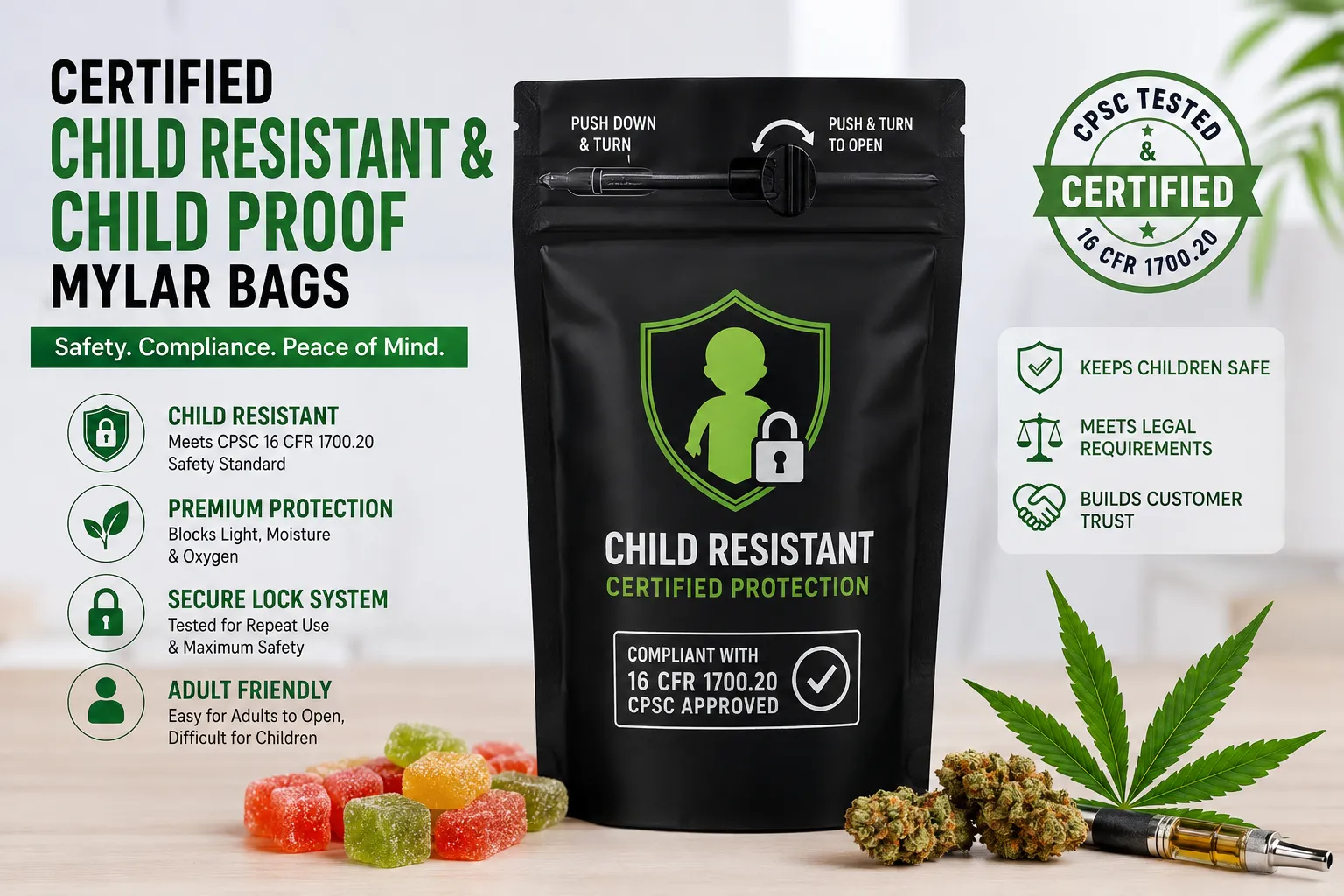

If you sell edibles, vape products, or anything a child should never open, your packaging has one job above all others: keep little hands out. That's where certified child resistant & child proof mylar bags come in. These bags are not just a marketing label. They go through real lab tests before they ever reach a shelf.
At Packagly, we build bags that meet these standards from day one, not as an afterthought. If you want to see how our certified child resistant & child proof mylar bags work and why they matter for your brand, keep reading. We'll walk through the testing rules, show you what to look for, and answer the questions we hear most from new customers.
Why Child Resistant Packaging Matters So Much
Ask any parent what scares them most about a curious toddler, and "getting into something they shouldn't" is near the top of the list. It's a fair worry. The Consumer Product Safety Commission has tracked child poisoning cases tied to household products and medicine for decades, and packaging design plays a direct role in how many of those cases turn into emergencies.
A study published by the American Association of Poison Control Centers found that packaging changes cut accidental child poisonings by a wide margin once child resistant standards became common in the 1970s. That's not a small number. It's proof that a bag or bottle design can change outcomes in real homes.
So when we talk about child proof mylar bags, we're not talking about a nice-to-have feature. We're talking about a legal requirement in many states for cannabis and edible products, and a smart choice for anyone packaging something that isn't safe for kids.
What Makes a Mylar Bag Actually Child Resistant?
Here's a question worth asking: does "child resistant" just mean the bag is hard to open? Not quite. The bag has to pass a formal test.
Under the 16 CFR 1700.20 standard set by the CPSC, a package must stop most young children from opening it within a set time, while still being usable by adults. Testers give the package to a group of children aged 42 to 51 months. If enough kids fail to open it in the test window, and enough adults succeed, the package earns the certification.
Certified bags from Packagly go through this exact process. We don't guess at what "child resistant" means. We test it, document it, and share the results with our clients so you can show proof of compliance if a regulator asks.
Here's a quick side-by-side to show the difference between a plain mylar bag and a certified child resistant & child proof mylar bag:
| Feature | Standard Mylar Bag | Certified Child Resistant Bag |
|---|---|---|
| Barrier protection (light, moisture, oxygen) | Yes | Yes |
| Passes CPSC 16 CFR 1700.20 testing | No | Yes |
| Legal for regulated cannabis/edible sales | Often not allowed | Yes |
| Reusable locking mechanism | Rarely | Yes, tested for repeat use |
| Adult-friendly opening | Simple | Simple, but requires a deliberate step |
As you can see, the gap isn't small. A plain pouch might look similar on a shelf, but only a tested design carries the legal weight your business needs.
Who Actually Needs These Bags?
If you run a dispensary, make edibles, sell vape cartridges, or package any product with nicotine, THC, or other substances that pose a risk to kids, this isn't optional in most places. Many state cannabis programs, including those in California, Colorado, and Michigan, require exit packaging to be child resistant before a product leaves the store.
But it's not just cannabis. Some supplement brands, essential oil sellers, and even certain cleaning product companies choose child proof mylar bags because it builds trust with parents. Think about it this way: if you were a parent buying a product for your own home, wouldn't you feel better seeing a "child resistant" label on the bag?
A Quick Story From Our Own Testing Floor
A few months back, one of our clients, a small edibles brand just starting out, sent us their old packaging for review. It looked fine at first glance. But when we ran it through mock testing, we found the seal popped open with barely any pressure. That's a real risk, and a real liability.
We rebuilt their bag using our certified child resistant & child proof mylar bag specs, moved to a push-and-turn lock, and reinforced the seal edges. The new version passed testing on the first round. That client now uses these bags across their whole product line. Small changes in bag design can make a big difference in both safety and peace of mind.
Choosing the Right Bag for Your Product
Not every child resistant bag is built the same way. When you're picking a supplier, ask about a few things:
- Barrier strength: Does the bag block light, moisture, and air well enough to protect what's inside?
- Lock type: Push-and-turn, slide-lock, and interlocking zippers all work differently. Some are better for repeated use.
- Print and labeling space: Regulated products often need warning labels, batch numbers, and dosage info. Your bag needs room for all of it.
- Third-party testing proof: Ask your supplier for real test reports, not just a claim on the product page.
We built our child resistant packaging line around these exact questions, since we've heard them from hundreds of brand owners over the years.
Common Mistakes Brands Make With Child Proof Packaging
We see the same few mistakes again and again. First, some brands buy bags that are "child resistant" in name only, without checking for a real test certificate. Second, some pick a bag that's technically compliant but so hard to open that adult customers get frustrated and leave bad reviews. Third, a lot of new brands skip re-testing after they change bag size or artwork, which can quietly break the compliance the bag once had.
A well-made certified child resistant & child proof mylar bag solves all three problems at once. It protects kids, satisfies adult users, and stays consistent even as your branding changes.
What Regulators Look For
State cannabis boards and consumer safety agencies don't just check the label. They may ask for lab documentation, batch test records, and proof that your supplier follows CPSC guidelines. Packagly keeps these records on file for every batch we produce, so if an inspector asks, you're covered.
Conclusion
Choosing the right child resistant packaging is not a small decision. It protects children in real homes, keeps your business on the right side of state law, and builds trust with the parents who buy your products. A certified child resistant & child proof mylar bag from Packagly gives you tested proof, not just a promise. If you want packaging that holds up under real testing and real use, our Chicago packaging team is ready to help you get started.
Frequently Asked Questions
What does "child resistant certified" actually mean for a mylar bag?
It means the bag has passed formal lab testing under CPSC rules. Testers check whether young children can open the bag within a set time and whether adults can still use it without much trouble. If the bag passes both parts, it earns the certification. A bag without this testing cannot legally claim to be child resistant in most regulated markets.
Are these bags required by law for cannabis products?
In many states, yes. Cannabis and edible products often must leave the store in packaging that meets child resistant rules, especially for the final exit bag given to the customer. Rules vary by state, so it helps to check your local cannabis board's packaging guidelines before you order in bulk. A good supplier will already know these rules and can guide you.
Can adults still open child resistant bags easily?
Yes, once you know the mechanism. Most designs use a push-and-turn or slide-lock system that takes a small learning curve but becomes quick once you've done it a few times. The goal is to slow down a curious child, not frustrate a grown adult. Good design finds a balance between the two.
How long do these bags stay child resistant after repeated use?
Quality bags are built and tested for repeated opening and closing, not just a single use. Cheaper bags may lose their locking strength after a few uses, which puts you at risk of failing an audit. Ask your supplier for repeat-use test data before committing to a large order.
How is a mylar bag different from a regular plastic pouch for this purpose?
Mylar offers stronger barrier protection against light, air, and moisture compared to most plastic pouches, which helps keep products fresh longer. When combined with a tested locking mechanism, it becomes both a freshness tool and a safety tool. That combination is why so many regulated product categories lean on mylar over plain plastic.
Does Packagly offer custom printing on child resistant bags?
Yes, we print custom artwork, warning labels, and branding directly on our child resistant mylar bags without weakening the lock or seal strength. Many clients want their branding to look sharp while still meeting every safety rule. We test the final printed version, not just the blank bag, so nothing is left to guesswork.


















Sign in to leave a comment.