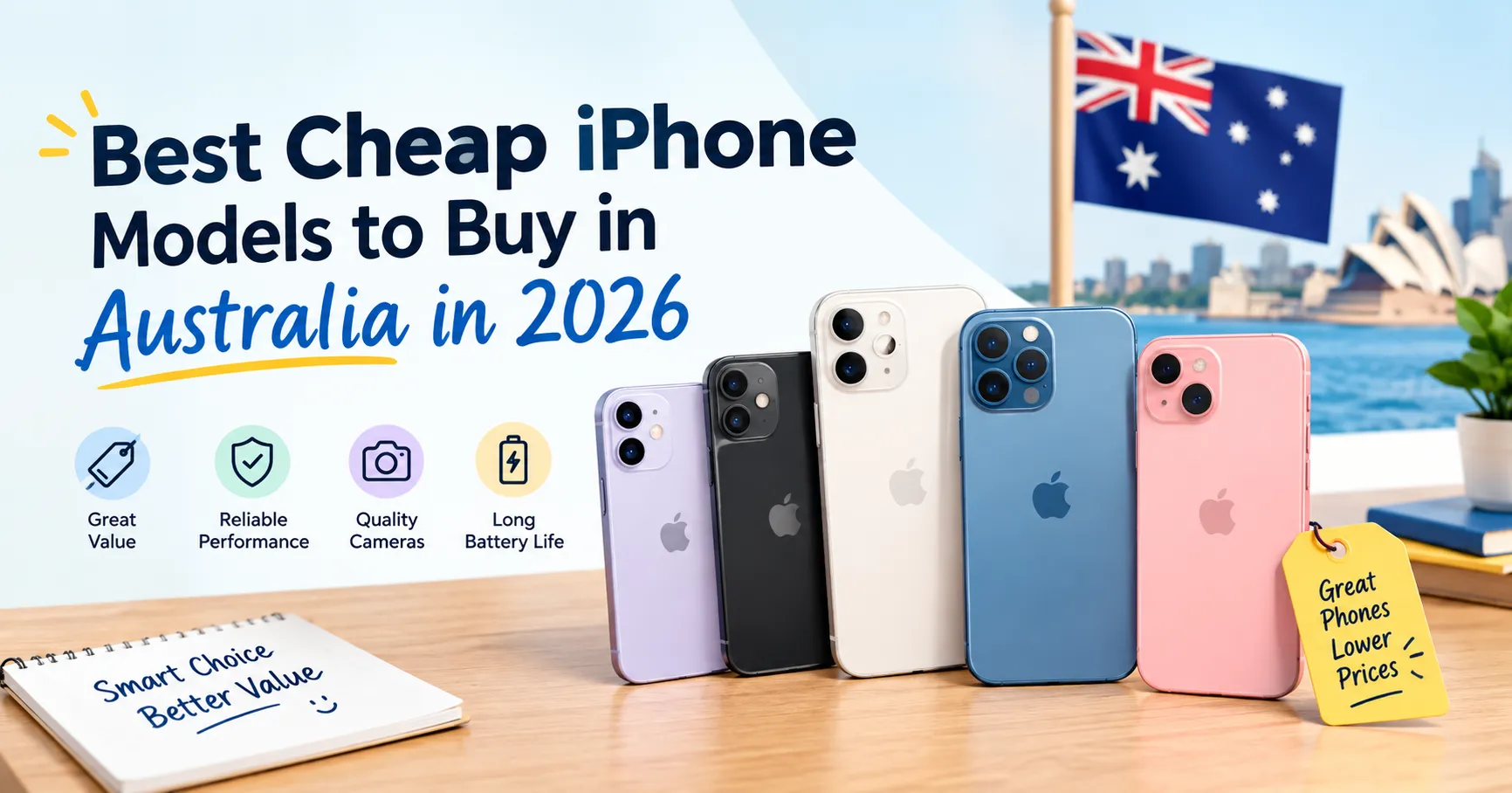

Buying an iPhone in Australia can get expensive pretty quickly. A new model can easily push past the A$1,000 mark, but that doesn’t mean you need to spend that much to get a good phone. A cheap iPhone can still handle photos, social media, streaming, banking, calls and everyday apps without feeling ancient. If you're also considering a mobile trade or a refurbished device, there are even more ways to bring the cost down.
The trick is knowing which iPhone models still make sense in 2026.
Some older iPhones are cheap for a reason. Others are surprisingly good for the money. You might find an iPhone 13 sitting beside a newer model and wonder if paying extra is really necessary. Sometimes it isn't.
So, which cheap iPhone models are actually worth looking at in Australia?
What Makes an iPhone “Cheap” in 2026?
There isn't one fixed price that makes an iPhone cheap.
For some people, cheap means spending less than A$500 on a used iPhone. For someone else, it could mean buying a new iPhone under A$1,000 instead of paying A$1,500 or more.
In Australia, you can generally look at three routes:
- New entry-level iPhones
- Refurbished iPhones
- Used iPhones
The new option gives you the least hassle, while used and refurbished models can bring the price down quite a bit.
Apple's current Australian range includes newer models such as the iPhone 17, iPhone 17e and iPhone 16, while Apple's comparison page still lists older models such as the iPhone 15, iPhone 14 and iPhone 13.
That gives buyers plenty of choice.
1. iPhone 17e – A New iPhone Without the Huge Price Tag
If you want a cheap iPhone that is new, the iPhone 17e is one of the first models to check.
The Australian starting price is A$999 for 256GB, according to Apple's current Australian store. It uses Apple's A19 chip and has a 48MP Fusion camera, a 6.1-inch Super Retina XDR display and USB-C.
The 256GB starting storage is a nice touch. Storage fills up faster than people expect, especially if you take lots of videos.
The iPhone 17e also supports Apple Intelligence and has features such as Emergency SOS via satellite and Crash Detection.
Why consider the iPhone 17e?
- New model
- 256GB starting storage
- A19 chip
- 48MP Fusion camera
- USB-C
- Apple Intelligence
- MagSafe
- 6.1-inch OLED display
It isn't the cheapest iPhone you can buy overall, especially if you're happy with refurbished or used phones. But if you want a new iPhone under $1,000, it deserves a look.
2. iPhone 16 – A Good Middle Ground
The iPhone 16 is another interesting choice for Australian buyers in 2026.
Apple's current Australian store lists the 128GB model from around A$1,249, although pricing can vary by retailer and promotions.
It has a 6.1-inch Super Retina XDR display, A18 chip, USB-C and a dual-camera setup. It also includes features such as the Action button and Camera Control.
For someone who wants a newer iPhone but doesn't need the newest model, the iPhone 16 can sit in a fairly comfortable middle ground.
And here's something worth checking before buying: retailer discounts.
Older models sometimes get price cuts when newer iPhones arrive. A sale can suddenly make the difference between buying the latest model and buying the previous one much smaller.
3. iPhone 15 – Worth Checking If You Find a Good Price
The iPhone 15 is another model that can make sense as a cheap iPhone in Australia, particularly through refurbished sellers.
It was originally released in 2023 and started at A$1,499 in Australia for the 128GB version.
Of course, you shouldn't pay that launch price for an older model in 2026.
The used and refurbished market is where the iPhone 15 becomes more interesting.
You get a modern design, USB-C, a 48MP main camera and the A16 Bionic chip. For someone who mainly uses a phone for Instagram, TikTok, YouTube, photos, WhatsApp, emails and general browsing, that is still plenty of phone.
I'd pay close attention to battery health if you're buying a used iPhone 15. A good price isn't really a good deal if the battery is already struggling.
4. iPhone 14 – A Budget-Friendly Refurbished Option
The iPhone 14 is another model worth checking if your budget is tighter.
It's old enough that you may find much lower prices compared with newer models, but it still has a 6.1-inch OLED display, 5G connectivity, Face ID and a capable camera system.
This is where refurbished iPhones can become particularly interesting.
A professionally refurbished iPhone 14 may cost considerably less than a new iPhone while still giving you a modern-looking phone.
Just don't assume every refurbished listing is the same.
Check:
- Battery condition
- Screen quality
- Whether parts have been replaced
- IMEI status
- Camera performance
- Charging port
- Warranty
- Return policy
A cheap price is nice. A cheap price with a warranty is much nicer.
5. iPhone 13 – Still a Popular Cheap iPhone Choice
The iPhone 13 is probably one of the first older models I'd check if the goal is simply to spend less.
Apple introduced the iPhone 13 in 2021, and it came with the A15 Bionic chip, 5G, a 6.1-inch Super Retina XDR display and 128GB as its entry-level storage.
It also has a dual 12MP camera system and IP68 water and dust resistance under laboratory testing conditions.
Four or five years can sound like a long time for a phone. But the iPhone 13 doesn't suddenly become useless because newer models exist.
For calls, messaging, browsing, streaming, social media, photos and everyday apps, it can still do the job.
The main thing I'd check is the battery.
If you're buying an iPhone 13 used in 2026, battery health matters. A phone with a worn battery may need a replacement sooner than expected, which changes the real cost of the purchase.
6. iPhone 13 Mini – Great If You Don't Like Big Phones
Not everyone wants a giant screen.
The iPhone 13 mini has a 5.4-inch display and many of the same core features as the standard iPhone 13. Apple lists it among its older iPhone models.
It's small, light and easy to hold. You can actually reach most parts of the screen with one hand, which sounds like a tiny thing until you spend a whole day using a large phone.
The catch?
Battery life can be more of a concern because of the smaller size.
If you find a refurbished iPhone 13 mini with a healthy battery at a good price, though, it can be a very appealing compact option.
Cheap iPhone vs Refurbished iPhone: Which Should You Buy?
This is where things get a little confusing.
A cheap iPhone isn't automatically a used iPhone. You can buy a new iPhone at a lower price, especially during retailer promotions. You can also buy refurbished or used models for much less.
Here's a quick comparison:
| Option | Typical advantage | What to check |
| New iPhone | Fresh battery and less wear | Sale price and storage |
| Refurbished iPhone | Lower price with tested hardware | Warranty and parts |
| Used iPhone | Often the lowest purchase price | Battery, damage and history |
If you want less uncertainty, a refurbished phone with a clear warranty can be easier to deal with than a random private listing.
If your budget is very tight, a used iPhone can work too. Just don't rush because the listing says “cheap.”
Cheap and good are not always the same thing.
What Should You Check Before Buying a Cheap iPhone?
Before handing over your money, spend a few minutes checking the phone properly.
Battery health
Go to the battery settings and check battery health.
A heavily worn battery may mean extra spending soon after your purchase.
IMEI
Check the IMEI number and make sure the phone hasn't been reported lost, stolen or blocked.
This is especially important with second-hand phones.
Activation Lock
Make sure the previous owner's Apple Account has been removed from the device.
You don't want to take home a phone that is still linked to somebody else's account.
Screen
Look closely under bright light.
Check for:
- Cracks
- Dead pixels
- Burn-in
- Touch problems
- Scratches
- Display discolouration
A screen can look fine in a dark shop and show problems once you're outside in daylight.
Cameras
Open both front and rear cameras.
Take a few photos. Record a short video. Test focus.
It takes less than two minutes.
Charging
Plug in a cable and check whether the phone charges normally.
Also test the charging port for loose connections.
Face ID
If the model supports Face ID, test it.
A phone can look almost perfect externally while having an expensive internal issue.
Network compatibility
Make sure the phone works with your Australian carrier and isn't carrier locked.
An unlocked iPhone gives you more freedom if you change providers later.
How Much Storage Do You Need?
This is easy to overlook when searching for a cheap iPhone.
For light use, 128GB can be enough for many people.
But if you take lots of photos, record 4K videos, download games or keep large music and video libraries offline, you'll fill it sooner.
The iPhone 13 came with 128GB, 256GB and 512GB storage options, for example.
I'd rather buy a slightly older iPhone with enough storage than save a little money and constantly delete photos.
That gets annoying fast.
Should You Buy an Older iPhone in 2026?
Yes, an older iPhone can still make sense. The important part is choosing the right age and condition.
A three- or four-year-old iPhone in good condition can be a smarter purchase than a very old model with a tired battery and damaged screen.
Look at the whole package:
Price + battery + condition + storage + warranty + software support.
Don't judge the phone only by the number on the price tag.
Where Can You Find a Cheap iPhone in Australia?
There are several places worth checking.
Apple's own store is useful for comparing current models and trade-in options. Apple currently lists the iPhone 17, iPhone 17e and iPhone 16 for sale in Australia.
For older models, refurbished phone marketplaces and second-hand sellers can offer more choices.
You can also look at private listings, but you'll need to do more checking yourself. Ask for the IMEI, battery health and proof that Activation Lock has been removed.
And if you already own an older iPhone, check its trade-in value before buying another phone. Apple also offers trade-in credit for eligible devices.
Which Cheap iPhone Should You Look At?
It really depends on your budget.
If you want a new cheap iPhone, the iPhone 17e is the obvious model to check first, with a starting Australian price of A$999 for 256GB on Apple's current store.
If you want something newer but don't need the newest model, look at the iPhone 16.
If you want to spend less, check refurbished iPhone 15, iPhone 14 and iPhone 13 models.
And if you're on a very tight budget, an older used iPhone may still work well, but the condition becomes much more important.
There isn't one perfect cheap iPhone for everyone. A student who mainly needs WhatsApp and YouTube has different needs from someone taking hundreds of photos every month.
So don't just chase the lowest price.
Look for the phone that gives you enough storage, a healthy battery, decent condition and a warranty or return option where possible. Spend a few minutes checking those things before buying, and that cheap iPhone can end up being a pretty sensible purchase after all.
Conclusion
Finding a cheap iPhone in Australia in 2026 doesn’t mean settling for an outdated phone. Models like the iPhone 13, 14, 15 and newer options can offer solid everyday performance at different price points. Check the battery, storage, IMEI, condition and warranty before buying, and compare used, refurbished and new options to find the right fit for your budget. Mobile Trade can also be worth considering when you want to sell or upgrade your current phone.


























Sign in to leave a comment.