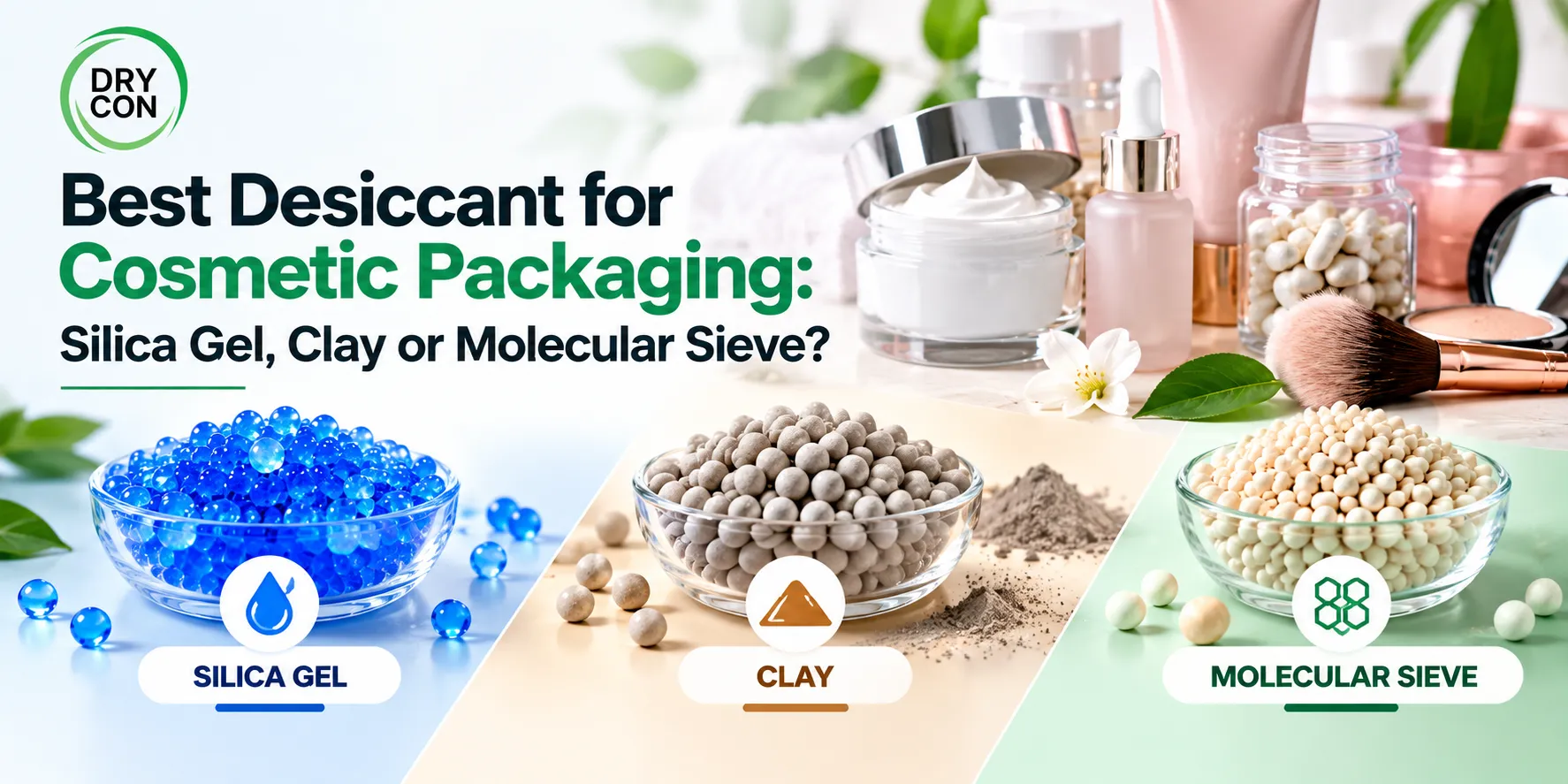

Best Desiccant for Cosmetic Packaging: Silica Gel, Clay or Molecular Sieve?
Moisture is one of the most overlooked risks in cosmetic packaging. Humidity can affect powders, creams, tablets, capsules, serums, skincare formulations, and other moisture-sensitive products during storage, transportation, and distribution. For manufacturers and exporters, selecting the right desiccant for cosmetic packaging can help maintain product quality and packaging performance throughout the intended shelf life.
But which desiccant is best: silica gel, clay, or molecular sieve?
There is no single answer for every cosmetic or nutraceutical product. Each desiccant has a different adsorption profile, cost structure, and performance at different relative humidity levels. The right choice depends on the product's moisture sensitivity, packaging volume, expected humidity, temperature, shelf life, and required internal RH.
This guide compares silica gel vs clay vs molecular sieve and explains when each is appropriate for cosmetic and nutraceutical packaging.
Why Moisture Control Matters in Cosmetic Packaging
Cosmetic and personal-care products can encounter moisture at several stages—from manufacturing and filling to warehousing, international shipping, and final storage.
Depending on the formulation, excess moisture can contribute to:
- Powder clumping
- Changes in product texture
- Reduced stability
- Packaging degradation
- Changes in appearance
- Loss of product performance
- Microbial-growth risks where formulation controls are insufficient
- Reduced shelf-life performance
Nutraceutical products can be similarly sensitive. Tablets, capsules, powders, vitamins, minerals, and botanical formulations may absorb moisture from the surrounding environment.
A desiccant works by adsorbing water vapor from the enclosed package environment. However, it should not be viewed as a substitute for appropriate moisture-barrier packaging. The package, seal integrity, product moisture content, and desiccant must work together as a moisture-control system.
What Is the Best Desiccant for Cosmetic Packaging?
For most conventional cosmetic and nutraceutical packaging applications, silica gel is the most practical starting point because it offers broad moisture-control performance, packaging flexibility, and widespread availability.
However:
- Silica gel is generally the best all-around choice.
- Clay can be attractive when cost efficiency and certain moderate-temperature applications are priorities.
- Molecular sieve is better when the package requires very low humidity or aggressive moisture removal.
The important point is that the cheapest desiccant is not necessarily the most cost-effective desiccant. An incorrectly specified material can provide inadequate protection, while an unnecessarily high-performance material can increase packaging costs without delivering meaningful additional value.
Silica Gel for Cosmetic Packaging
Silica gel is a porous form of silicon dioxide with a large internal surface area that adsorbs water vapor.
It is probably the most familiar packaging desiccant because it is available in formats such as silica gel packets, sachets, canisters, and other customized packaging formats.
Silica gel's adsorption capacity increases as relative humidity increases, making it particularly useful for many conventional packaging environments.
Why choose silica gel?
Silica gel is often preferred because it offers:
- Reliable moisture adsorption
- Broad application flexibility
- Easy integration into packaging
- Availability in different packet sizes
- Compatibility with many sealed packaging formats
- Good performance for moderate-to-high humidity exposure
Cosmetic applications
Silica gel can be considered for:
- Skincare products
- Cosmetic powders
- Makeup packaging
- Personal-care products
- Beauty accessories
- Moisture-sensitive formulations
- Cosmetic export packaging
For example, a cosmetic manufacturer shipping products internationally may place an appropriately sized silica gel sachet inside the secondary package to help control moisture entering the headspace.
Nutraceutical applications
Silica gel is also widely considered for:
- Vitamin bottles
- Supplement bottles
- Capsules
- Tablets
- Powdered supplements
- Herbal products
- Nutraceutical packaging
For these applications, desiccant quantity should be calculated rather than selected solely by packet size. Packaging volume, moisture load, expected humidity, product moisture, barrier properties, and storage duration should all be considered. SupplySide Supplement Journal
Clay Desiccant for Cosmetic Packaging
Clay desiccants are generally based on naturally occurring minerals such as bentonite or montmorillonite.
One of their main advantages is cost efficiency. Clay can be an attractive option for applications where extreme low-humidity control is not required.
Clariant, for example, lists bentonite clay alongside silica gel and molecular sieve as established desiccant materials for moisture-sensitive packaged products. Clariant Ltd.
Advantages of clay
Clay desiccant can offer:
- Cost-effective moisture control
- Natural mineral-based composition
- Useful performance across applicable humidity conditions
- Suitability for certain large-volume packaging applications
- A practical alternative where ultra-low RH is unnecessary
When should cosmetics manufacturers consider clay?
Clay may be worth considering when:
- The product has moderate moisture sensitivity.
- The package has a relatively large headspace.
- Cost per packaging unit is important.
- The required internal RH is not extremely low.
- The expected temperature conditions are compatible with the selected clay formulation.
However, performance varies by material grade and application. Therefore, manufacturers should evaluate actual product specifications rather than assuming that all clay desiccants perform identically.
Molecular Sieve for Cosmetic and Nutraceutical Packaging
Molecular sieve is different from conventional silica gel and clay.
It is a crystalline aluminosilicate with precisely controlled pore structures. This allows it to adsorb water very effectively at low relative humidity.
That makes molecular sieve particularly useful where a package must remain extremely dry.
Industry sources commonly identify molecular sieve as the stronger choice for applications requiring very low RH, while silica gel is generally more versatile for broader packaging conditions. Desiccant Global
When should you use molecular sieve?
Consider molecular sieve when:
- The product is highly moisture sensitive.
- The target internal RH is very low.
- Moisture levels must be tightly controlled.
- The package has a highly moisture-sensitive formulation.
- Small amounts of moisture ingress can cause significant quality problems.
- Specialized stability requirements justify the higher material cost.
Molecular sieve can therefore be useful for selected nutraceutical, diagnostic, pharmaceutical, and specialty cosmetic applications.
The trade-off
Molecular sieve is usually more expensive than conventional silica gel.
Therefore, using molecular sieve in every cosmetic package would not necessarily make sense.
If ordinary silica gel can maintain the required environmental conditions, switching to molecular sieve may simply increase packaging costs without providing a meaningful benefit.
Silica Gel vs Clay vs Molecular Sieve
| Factor | Silica Gel | Clay | Molecular Sieve |
|---|---|---|---|
| General packaging | Excellent | Good | Excellent |
| Moderate humidity | Excellent | Good | Excellent |
| Very low RH | Moderate | Moderate | Excellent |
| Cost efficiency | High | Very High | Lower |
| Moisture sensitivity | Moderate–High | Moderate | Very High |
| Cosmetic packaging | Excellent | Good | Application-specific |
| Nutraceutical packaging | Excellent | Good | Application-specific |
| Low-humidity applications | Good | Limited | Excellent |
| Typical role | General-purpose moisture control | Economical moisture control | High-performance moisture control |
The exact performance should always be confirmed using the supplier's technical data under conditions relevant to the actual application. Desiccant capacity numbers are not directly comparable if they were measured at different temperature and RH conditions. SinoRaw
How to Choose the Right Desiccant for Cosmetic Packaging
Choosing between silica gel, clay, and molecular sieve should be based on the packaging system rather than the desiccant alone.
1. Determine Product Moisture Sensitivity
First ask how sensitive the product is to humidity.
A relatively stable cosmetic accessory may require basic moisture protection, while a hygroscopic powder or moisture-sensitive nutraceutical formulation may require substantially tighter humidity control.
2. Calculate Packaging Volume
The amount of desiccant required depends partly on the volume of air inside the package.
A small supplement bottle and a large cosmetic shipping carton will not have the same moisture-control requirement.
3. Consider Initial Moisture
Moisture does not enter the package only from outside.
Moisture may already be present in:
- The product
- Packaging components
- Headspace air
- Filling environment
- Secondary packaging
This is why desiccant sizing should consider the total moisture load, rather than simply the physical size of the package.
4. Evaluate Packaging Barrier Properties
A desiccant cannot compensate indefinitely for a package with poor moisture-barrier performance.
The packaging material's Moisture Vapor Transmission Rate (MVTR) and seal integrity should be considered alongside the desiccant. Packaging experts identify MVTR, storage duration, product moisture, package volume, and target RH as important factors in desiccant selection. SupplySide Supplement Journal
5. Consider Temperature and Shipping Conditions
Cosmetic products may travel through multiple climate zones.
A shipment could encounter:
- High humidity
- Temperature fluctuations
- Warehousing conditions
- Ocean transportation
- Air freight
- Seasonal changes
The selected desiccant should be qualified for the actual expected conditions.
Sachet, Canister or Other Desiccant Format?
Choosing the desiccant material is only half of the decision.
The physical format also matters.
Desiccant Sachets
Sachets are useful for:
- Supplement bottles
- Cosmetic cartons
- Small product packages
- Individual units
- Export packaging
They are compact and easy to incorporate into existing packaging operations.
Desiccant Canisters
Canisters may be suitable when:
- A rigid format is preferred.
- The product requires a specific dispensing or containment format.
- Packaging machinery is designed around canister insertion.
- Higher desiccant quantities are required in certain containers.
Custom Desiccant Solutions
For larger manufacturers, customized fill weights, dimensions, packaging materials, and labeling can help optimize the desiccant for the production process.
The objective should be to achieve the required moisture-control performance without unnecessarily increasing packaging material or cost.
Can Cosmetic Packaging Use Both Desiccant and Oxygen Absorbers?
Yes, but they address different problems.
A desiccant controls moisture, while an oxygen absorber is designed to reduce oxygen.
This distinction is particularly important for formulations where both humidity and oxidation can affect stability.
For example, a product could potentially require:
Moisture control → Desiccant
Oxygen control → Oxygen absorber
These should not be treated as interchangeable technologies. Desiccare, Inc.
Common Mistakes When Selecting a Cosmetic Desiccant
Choosing only based on price
A low-cost desiccant that cannot meet the required RH target can become much more expensive through product damage and rejected shipments.
Using the same packet size everywhere
Different packages have different moisture loads. Desiccant quantity should be calculated based on the application.
Ignoring shipping conditions
A product shipped domestically under controlled conditions may require a different moisture-control strategy from one exported across humid climates.
Over-specifying molecular sieve
Molecular sieve offers excellent low-RH performance, but it is not automatically the best option for every cosmetic product.
Ignoring packaging performance
Desiccant selection should be coordinated with packaging barrier properties and seal integrity.
Final Verdict: Which Desiccant Should You Choose?
For most cosmetic and nutraceutical packaging applications, silica gel is the best starting point because it provides a strong combination of moisture adsorption, versatility, availability, and packaging convenience.
Choose clay when cost efficiency is important and the application does not require aggressive low-humidity control.
Choose molecular sieve when the product requires very low internal humidity or has a particularly high sensitivity to residual moisture.
The best approach is therefore not simply to ask, “Which desiccant absorbs the most moisture?” Instead, ask:
“Which desiccant can maintain the required humidity level inside my specific package for the required shelf life and distribution conditions?”
That question leads to a much more reliable packaging specification.
For cosmetic and nutraceutical manufacturers, exporters, and packaging teams, a properly selected desiccant can become an important part of an overall moisture-control strategy—alongside suitable barrier packaging, correct sealing, appropriate storage conditions, and validated desiccant capacity.
Need Help Selecting a Desiccant?
Drycon Global provides moisture-control solutions for different packaging applications, including silica gel desiccants and other moisture-control formats. The appropriate desiccant type and quantity should be selected based on the product, packaging dimensions, moisture sensitivity, expected environmental conditions, and required shelf life.
Looking for the right desiccant for your cosmetic or nutraceutical packaging? Contact Drycon Global to discuss your application and packaging requirements. Clariant Ltd.
Frequently Asked Questions
1. What is the best desiccant for cosmetic packaging?
Silica gel is generally the most versatile choice for conventional cosmetic packaging. Molecular sieve may be preferable for applications requiring very low humidity, while clay can provide a cost-effective option for suitable moderate-humidity applications.
2. Is silica gel safe for cosmetic packaging?
Packaging-grade silica gel is widely used as a moisture adsorbent. However, the specific sachet, fill material, packaging substrate, labeling, and regulatory requirements should be evaluated for the intended cosmetic application.
3. Is clay better than silica gel?
Not universally. Clay can be attractive for cost-sensitive applications, while silica gel generally offers broad and predictable moisture-control performance. The correct choice depends on RH, temperature, packaging, and product requirements.
4. When should I use molecular sieve instead of silica gel?
Molecular sieve should be considered when the package needs very low humidity or when the product is highly sensitive to small amounts of residual moisture. It is generally unnecessary to use molecular sieve when silica gel can already meet the required RH specification.
5. How much desiccant is required for cosmetic packaging?
There is no universal packet size. The required quantity depends on packaging volume, product moisture, initial humidity, packaging MVTR, storage duration, environmental conditions, and target internal RH. SupplySide Supplement Journal
6. Can the same desiccant be used for cosmetics and nutraceuticals?
The same desiccant type may be suitable for both, but the required grade, format, quantity, packaging material, and compliance requirements can differ. Each application should be evaluated independently.























Sign in to leave a comment.