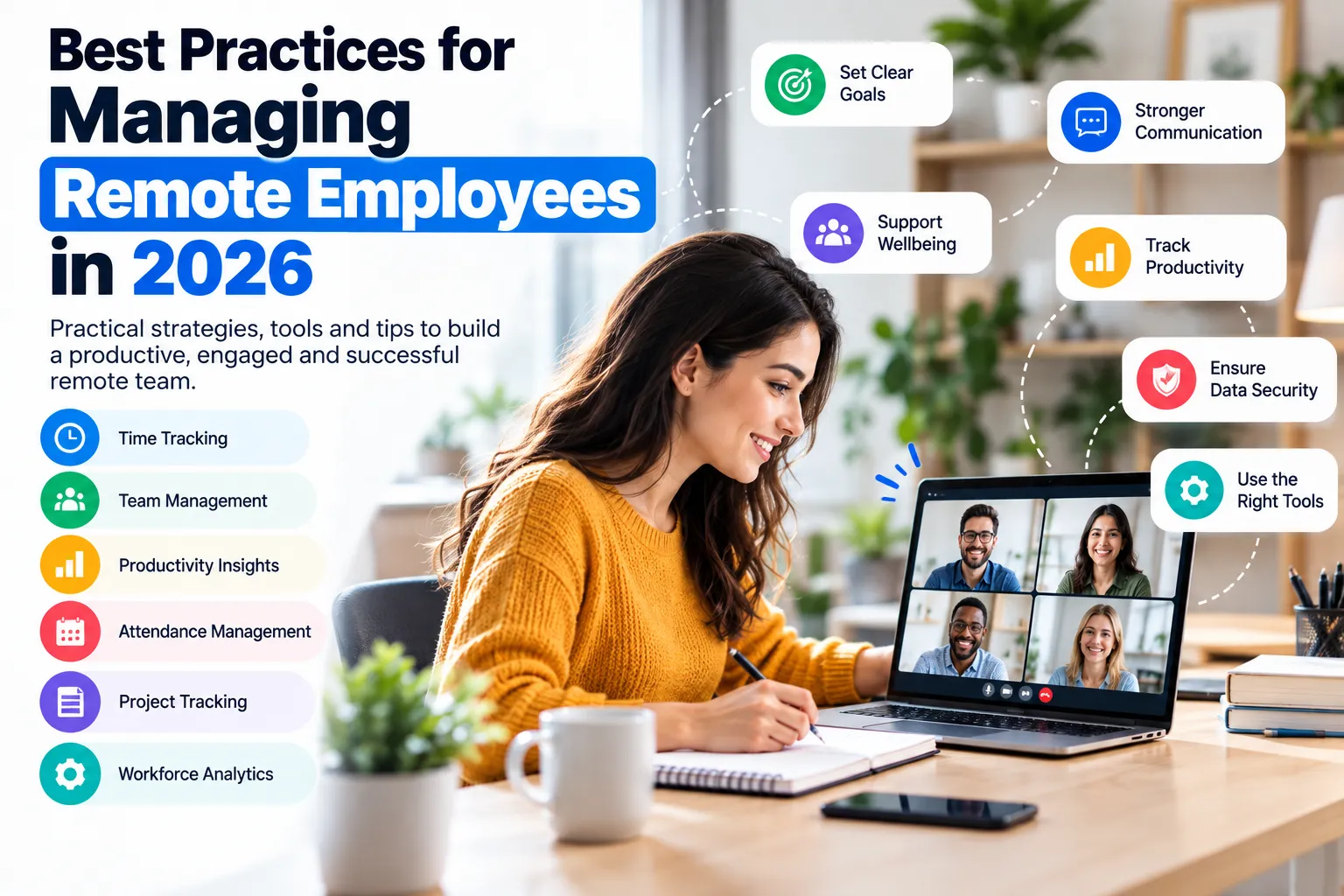


Managing remote employees in 2026 requires more than video calls and messaging apps. Businesses need clear expectations, reliable communication, measurable goals, secure technology, and practical ways to support employee wellbeing.
Remote and hybrid working can give organisations greater flexibility while helping them attract and retain talent. The CIPD's 2026 guidance highlights potential benefits including employee satisfaction, wellbeing, work-life balance, and organisational agility.
However, remote teams also create challenges. Managers may need better ways to coordinate workloads, track working hours, support communication, protect company data, and understand team performance.
This guide explains practical remote employee management strategies for 2026, including how businesses can use workforce management technology without creating unnecessary monitoring or pressure.
What Is Remote Employee Management?
Remote employee management is the process of organising, supporting, communicating with, and managing employees who work outside a traditional office.
It can include:
- Setting clear work expectations
- Managing employee workloads
- Tracking working hours
- Monitoring project progress
- Supporting employee communication
- Managing attendance and leave
- Measuring performance
- Protecting company information
Supporting employee wellbeing
Effective remote team management should focus on outcomes, communication, trust, and support, rather than simply checking whether employees are sitting at their computers.
Acas recommends agreeing clear objectives and discussing how performance will be measured. It also notes that employers may assess the quality of work rather than simply the amount of time someone spends at their desk.
Why Remote Employee Management Matters in 2026
Remote work has become an established part of modern workforce planning. Many organisations now operate fully remote, hybrid, or flexible teams.
This creates a need for management processes that work across different locations and schedules.
Without clear systems, businesses may experience:
- Unclear responsibilities
- Missed deadlines
- Poor communication
- Inaccurate timesheets
- Difficulties managing workloads
- Limited visibility of projects
- Security risks
Employee isolation
A structured approach helps managers create consistency while allowing employees to work independently.
For UK employers, flexible working also has an important legal context. GOV.UK states that employees have a legal right to request flexible working from their first day of employment, subject to the relevant rules and exceptions.
10 Best Practices for Managing Remote Employees
1. Set Clear Expectations From the Start
Remote employees need to understand what is expected from their role.
Managers should clearly explain:
- Working arrangements
- Core working hours
- Communication expectations
- Project responsibilities
- Deadlines
- Performance objectives
- Meeting requirements
Reporting procedures
Avoid assuming that employees understand informal office practices when they work remotely.
A written remote working policy can help create consistency across the organisation.
For hybrid teams, the policy should also explain which activities require office attendance and which can be completed remotely.
Acas recommends considering the needs of employees, the requirements of different roles, communication arrangements, working hours, rest breaks, and health and safety when developing home and hybrid working policies.
2. Focus on Outcomes Rather Than Constant Supervision
One of the biggest mistakes businesses can make is confusing employee monitoring with effective management.
Remote employees should have measurable goals and clear responsibilities. Managers can then assess whether work is being completed to the required standard.
For example, instead of asking:
"Was the employee online all day?"
Consider:
“Were the agreed tasks completed to the expected standard and within the required timeframe?”
Acas advises employers to trust employees to do their jobs wherever they work. It also warns that excessive or privacy-intrusive monitoring can damage trust, increase stress, and reduce productivity.
This makes outcome-based performance management an important principle for remote teams.
3. Create a Consistent Communication System
Remote teams need predictable communication.
Businesses should establish which tools are used for:
- Urgent communication
- Team discussions
- Project updates
- One-to-one meetings
- Documentation
Formal announcements
Too many communication channels can create confusion. Managers should also avoid unnecessary meetings. Acas recommends balancing communication methods and leaving sufficient gaps between online meetings to help reduce stress and fatigue.
A simple communication framework could be:
Instant messaging: Urgent questions
Project platform: Task updates
Email: Formal information
Video meetings: Collaboration and one-to-one discussions
Knowledge base: Policies and documentation
4. Use Employee Time Tracking Responsibly
For distributed teams, accurate working-time information can help businesses understand schedules, project hours, attendance, and workloads.
An employee time tracking software solution can bring together information that would otherwise be recorded across spreadsheets or separate systems.
Depending on the organisation, useful capabilities may include:
- Digital timesheets
- Attendance tracking
- Project time tracking
- Leave management
- Working-hour records
- Productivity insights
Reporting
However, time tracking should have a clear business purpose. It should not become a substitute for good management. For example, a manager might use time data to identify an overloaded project or compare planned and actual project hours rather than constantly checking individual activity.
5. Build a Clear Remote Performance Framework
Remote employees should know how their performance will be assessed.
A useful framework can include:
Goals: What needs to be achieved?
Measures: How will progress be evaluated?
Deadlines: When should work be completed?
Quality: What standard is expected?
Support: What resources does the employee need?
Review: When will progress be discussed?
This approach makes performance discussions more objective. It can also help managers identify where an employee needs training, additional resources, or workload adjustments.
Acas recommends setting performance targets, explaining how employees will be monitored, discussing performance, supporting improvement, and keeping appropriate records.

6. Protect Remote Employees and Company Data
Remote working introduces additional information security considerations. Employees may work from homes, coworking spaces, cafés, hotels, or other locations. These environments can create risks involving devices, confidential conversations, passwords, documents, and company systems.
The UK's Information Commissioner's Office recommends clear remote-working policies and appropriate security controls. Its guidance includes using approved technology, protecting confidential information, maintaining strong passwords, communicating securely, and keeping software updated.
Businesses should consider:
- Multi-factor authentication
- Strong passwords
- Secure devices
- Access controls
- Approved software
- Secure cloud storage
- Software updates
- Data protection policies
Employee security training
Remote workforce management should therefore include both productivity and information security.
7. Use Monitoring Transparently
Some businesses use screenshots, application tracking, website activity, GPS, or other monitoring features. These technologies can have legitimate uses, but organisations should carefully consider why monitoring is necessary and whether a less intrusive approach could achieve the same purpose.
For UK organisations, employee monitoring must be handled carefully. GOV.UK states that employers must be able to justify workplace monitoring and tell employees that monitoring is taking place and why.
Acas also recommends consulting employees and creating a clear monitoring policy. It advises employers to consider the potential negative effects and carry out an impact assessment when appropriate.
Therefore, good remote employee monitoring should be:
- Transparent
- Purpose-driven
- Proportionate
- Secure
- Clearly communicated
Reviewed regularly
8. Support Employee Wellbeing
Remote work can provide flexibility, but employees may also experience isolation, blurred work-life boundaries, or difficulties switching off.
Managers should regularly discuss workload and wellbeing.
Useful practices include:
- Regular one-to-one meetings
- Reasonable meeting schedules
- Encouraging breaks
- Clear working boundaries
- Social team activities
- Access to support
Flexible arrangements where appropriate
Acas specifically highlights supporting employees with motivation, organisation, time management, work-life balance, health, safety, and wellbeing when working from home.
Managers should also remember that not every employee has the same home-working circumstances.
9. Give Remote Employees the Right Technology
Technology should make remote work easier rather than create additional administrative work.
Depending on the organisation, a remote team may need:
- Secure communication tools
- Project management software
- Cloud document storage
- Video conferencing
- Time tracking
- Attendance management
- Payroll integration
- Workforce reporting
- Cybersecurity tools
Acas recommends considering what equipment and technology employees need, who provides or pays for it, and what technical support and training are required.
A connected workforce management software platform can also reduce the need to maintain separate spreadsheets for time, attendance, projects, leave, and reporting.
10. Review Your Remote Working Strategy Regularly
Remote work policies should not remain unchanged for years. Businesses should review:
- Employee feedback
- Productivity
- Workloads
- Communication
- Attendance
- Project performance
- Technology
- Security
- Wellbeing
Business requirements
The right approach may also differ between departments. For example, a software development team may have different remote-working requirements from a customer service team.
Acas recommends considering individual circumstances and the practical requirements of different roles when developing hybrid and home-working arrangements.
How Technology Can Support Remote Employee Management
Technology can give managers a central view of workforce information.
For example, Staff Time Tracker combines tools for time tracking, attendance, productivity, projects, timesheets, leave, workforce activity, reporting, and other workforce management needs.
Businesses can use this type of platform to reduce manual administration and create a clearer record of work activity.
Useful capabilities can include:
| Feature | Potential Business Use |
|---|---|
| Time Tracking | Record working hours |
| Timesheets | Manage employee time records |
| Attendance | Monitor attendance patterns |
| Project Tracking | Understand project hours |
| Leave Management | Organise employee leave |
| Productivity Insights | Identify work patterns |
| GPS Tracking | Support location-based teams |
| Screenshots | Provide activity records where appropriate |
| Reporting | Analyse workforce information |
The important point is that technology should support management decisions, rather than replace communication and trust.
How to Manage Remote Employees Without Micromanaging
Effective remote management does not require constant surveillance. Instead, managers can:
- Set measurable goals.
- Agree communication expectations.
- Give employees ownership of their work.
- Review outcomes regularly.
- Use data to identify issues.
- Ask employees about workload.
- Provide appropriate support.
- Use monitoring only where justified.
- Explain how workforce data is used.
- Review policies based on evidence.
This creates a healthier balance between visibility and autonomy.
Remote Employee Management Checklist for 2026
Use this checklist when reviewing your current remote-working strategy:
- Remote working policy is documented
- Roles and responsibilities are clear
- Performance objectives are measurable
- Communication channels are defined
- Meetings have a clear purpose
- Employees have suitable equipment
- Security policies are communicated
- Remote access is protected
- Employee monitoring is transparent
- Workforce data is handled securely
- Working hours are recorded where required
- Leave and attendance are managed consistently
- Managers conduct regular one-to-ones
- Employee wellbeing is considered
Remote policies are reviewed regularly
Frequently Asked Questions
What is the best way to manage remote employees?
The most effective approach depends on the organisation and the roles involved. Start with clear objectives, communication expectations, performance measures, appropriate technology, and regular employee support.
How do you track remote employee productivity?
Businesses can track productivity using agreed performance objectives, completed work, project progress, timesheets, and workforce analytics. Employee monitoring tools can also provide activity data, but monitoring should have a clear purpose and be transparent.
Should remote employees use time tracking software?
Time tracking can help businesses record working hours, manage projects, support payroll processes, and understand workloads. It should be introduced for a clear business purpose and communicated transparently.
How can businesses monitor remote employees legally in the UK?
UK employers should have a clear reason for monitoring, explain what monitoring takes place and why, and consider privacy and data protection requirements. GOV.UK and Acas provide guidance on workplace monitoring.
How can remote teams improve productivity?
Remote teams can improve productivity through clear priorities, realistic workloads, focused communication, effective project management, suitable technology, and regular feedback.
What should a remote working policy include?
A remote working policy can cover eligible roles, working arrangements, communication, working hours, equipment, security, data protection, performance management, health and safety, expenses, and employee support.
Final Thoughts
Managing remote employees in 2026 is about creating the right balance between flexibility, accountability, trust, and visibility. Businesses need clear expectations and reliable systems, but technology should not replace good leadership.
A strong remote workforce strategy combines measurable goals, effective communication, employee support, data security, responsible monitoring, and suitable workforce management tools.
For growing businesses, remote employee management software can help bring working hours, attendance, projects, leave, productivity data, and reporting into a more organised workflow.
The goal is not to watch employees constantly. It is to give managers the information they need to support their teams while giving employees the clarity and autonomy they need to do their work effectively.























Sign in to leave a comment.