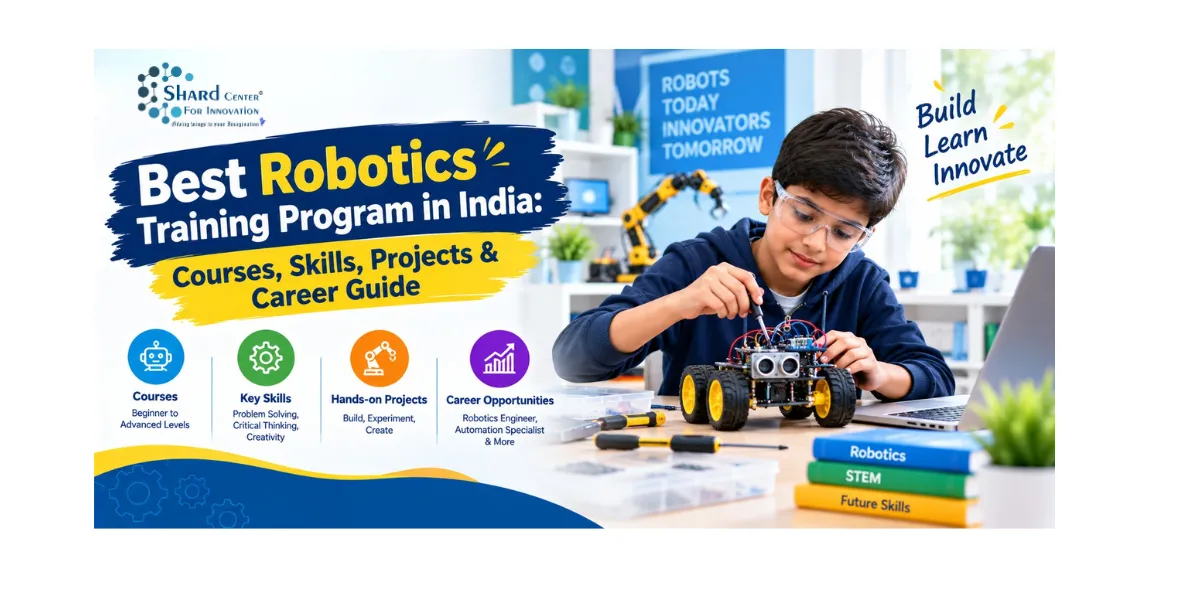

The best robotics training program in India is becoming an important part of modern technology education, combining programming, electronics, mechanical concepts, sensors, automation, and artificial intelligence. Choosing the best robotics training program in India depends on more than the course title. Students and professionals should look at the curriculum, hands-on projects, tools used, instructor experience, learning level, and opportunities to apply robotics concepts in real-world situations.
A good robotics program should help learners understand how robots work and, more importantly, give them opportunities to build, program, test, and improve robotic systems.

What Is Robotics Training?
Robotics training teaches learners how to design, build, program, and control robots. Depending on the learner's age and level, a course may cover topics such as:
- Robotics fundamentals
- Electronics and circuits
- Sensors and actuators
- Arduino and microcontrollers
- Python or C/C++ programming
- Robot programming
- Automation
- Internet of Things (IoT)
- Artificial Intelligence and Machine Learning
- Computer vision
- Robot design and prototyping
- 3D design and 3D printing
- Project development
For beginners, robotics can be introduced through simple projects such as obstacle-avoiding robots, line-following robots, sensor-based systems, and basic automation models.
How to Choose the Best Robotics Training Institute in India
There are many robotics courses available, but the right institute should match the learner's age, existing knowledge, and learning goals.
Consider these factors before enrolling:
1. Practical, Project-Based Learning
Robotics is a hands-on field. A course should provide opportunities to work with actual components, sensors, microcontrollers, motors, and robotics kits rather than relying only on theoretical lessons.
Projects also help students understand how individual concepts work together in a complete system.
2. Curriculum and Technology
Check whether the curriculum covers the technologies relevant to your learning level. A beginner may start with electronics, sensors, Arduino, and basic programming, while advanced learners may explore AI, computer vision, automation, and autonomous robots.
3. Programming Skills
Programming is an important part of robotics. Depending on the course, learners may work with languages such as Python, C, or C++.
Learning programming alongside robotics can help students understand how instructions are converted into actions by a robotic system.
4. Instructor Experience
Instructors should be able to explain technical concepts according to the learner's level and guide students while they work on projects. Practical industry or project experience can also be useful for advanced learners.
5. Age and Skill Level
A robotics program for school students should not follow the same structure as a professional-level course.
For children, visual programming, simple electronics, robotics kits, and guided projects may be appropriate. Older students and professionals can move towards programming, automation, AI, computer vision, and advanced robotics applications.
Top Robotics and Automation Course for Kids
Children can start learning robotics through age-appropriate activities that combine creativity with technology.
A Top Robotics and Automation course for Kids may introduce concepts such as:
- Basic electronics
- Sensors and motors
- Simple robot mechanisms
- Block-based or beginner programming
- Arduino-based projects
- Automation concepts
- Problem-solving
- Design thinking
- Team-based projects
The objective at this stage should not simply be to teach complicated technical terminology. Instead, children should understand concepts by building and experimenting.
For example, a student could build a simple obstacle-avoiding robot and learn how sensors detect objects and how programmed instructions control the motors.
Top Robotics Classes for Students in India
For school and college students, robotics can provide a practical way to connect concepts from STEM education with real projects.
Top Robotics classes for students in India may include progressively advanced topics such as:
- Introduction to robotics
- Electronics and circuits
- Sensors and actuators
- Arduino and microcontrollers
- Python or C/C++ programming
- Robot movement and control
- IoT-based robotics
- Automation
- AI and robotics
- Project development
Students can also work on projects such as line-following robots, robotic arms, smart automation systems, sensor-based robots, and autonomous robotics models.
Best Robotics Courses for Professionals in India
Professionals generally need a different learning path from school students. Their requirements may be connected to automation, engineering, programming, manufacturing, research, or emerging technology.
The Best Robotics courses for professionals in India may cover more advanced areas, including:
- Industrial automation
- Robot programming
- Embedded systems
- Python and C++
- Computer vision
- Artificial Intelligence
- Machine Learning
- IoT
- Robotic process automation
- Autonomous robotics
- Sensors and control systems
Professionals should check whether a course includes practical projects and tools that are relevant to their existing technical background.
Online Robotics Training Courses in India
Online learning has made robotics education accessible to learners who may not have a training centre nearby.
Online Robotics training Courses in India can be useful for learning programming, robotics concepts, simulation, electronics fundamentals, and theoretical foundations.
However, practical robotics requires access to hardware at some stage. Learners should therefore check whether an online course provides:
- Robotics simulation tools
- Practical assignments
- Hardware-based projects
- Project guidance
- Recorded or live sessions
- Technical support
- Assessment or certification
For beginners, a blended approach that combines online learning with practical experimentation can help connect theory with physical robotics systems.
What Skills Can You Learn Through Robotics Training?
A structured robotics program can develop both technical and problem-solving skills.
Technical Skills
Learners may develop knowledge of:
- Programming
- Electronics
- Sensors
- Microcontrollers
- Automation
- Robotics design
- IoT
- AI and Machine Learning
- Computer vision
- 3D modelling and prototyping
Problem-Solving Skills
Robotics projects often involve testing a system, identifying why something is not working, and making changes. This process encourages logical thinking, troubleshooting, experimentation, and iterative design.
These skills can be useful beyond robotics because they are also relevant to engineering, software development, automation, product design, and technology-based projects.
Robotics Projects Students Can Try
Projects make robotics learning more practical. Some beginner and intermediate project ideas include:
- Line-following robot
- Obstacle-avoiding robot
- Smart home automation system
- Bluetooth-controlled robot
- Robotic arm
- Automatic plant monitoring system
- IoT-based robot
- Voice-controlled robot
- Object-detection robot
- Autonomous navigation project
The complexity of a project should match the learner's age and technical level.
Robotics Training and Career Opportunities
Robotics is connected to several technology fields, including manufacturing, automation, automotive technology, healthcare technology, agriculture, logistics, research, and consumer products.
Depending on their education and skills, learners can explore areas such as:
- Robotics engineering
- Automation engineering
- Embedded systems
- Robot programming
- AI and Machine Learning
- Computer vision
- IoT
- Industrial automation
- Research and development
- Robotics product development
A short-term robotics course alone does not guarantee a particular career. For professional roles, learners generally need relevant academic qualifications, programming knowledge, practical experience, and project work.
Why Practical Robotics Education Matters
Robotics brings multiple technical disciplines together. A student may need to understand programming to control a robot, electronics to connect components, sensors to collect information, and mechanical design to build the physical structure.
This makes project-based learning particularly useful.
Instead of only memorising how a sensor or motor works, learners can see how these components behave inside a working system. They can then test the system, identify problems, and improve their design.
Robotics Training at Shard Center for Innovation
Shard Center for Innovation focuses on practical technology learning across areas such as robotics, AI, coding, IoT, drones, 3D design, and related emerging technologies.
For learners comparing robotics programs, it is useful to examine the course curriculum, project work, learner level, available tools, mentoring approach, and the technologies covered before making a decision.
Frequently Asked Questions
1. Which is the Best Robotics Training Program in India?
There is no single program that is suitable for every learner. The right choice depends on age, existing skills, learning goals, curriculum, practical projects, instructor support, and the technologies taught.
2. What age can children start learning robotics?
Children can begin with age-appropriate robotics activities at an early age. Beginner programs generally focus on simple electronics, sensors, building activities, and basic programming.
3. Is robotics useful for school students?
Yes. Robotics can help students apply programming, electronics, mathematics, design, and problem-solving concepts through practical projects.
4. Can professionals learn robotics without an engineering degree?
It depends on the course and the professional's goals. Beginner courses can introduce robotics fundamentals, while advanced professional programs may require programming, electronics, mathematics, or engineering knowledge.
5. Is online robotics training effective?
Online training can be useful for concepts, programming, simulation, and theory. Practical hardware work is also important for developing hands-on robotics skills.
6. Which programming languages are used in robotics?
Python, C, and C++ are commonly used in different robotics and embedded-system applications. The language taught depends on the course and robotics platform.
7. What should I check before joining a robotics course?
Check the curriculum, practical projects, hardware and software used, instructor experience, course level, project support, duration, and certification details.
8. Can robotics training help with AI and Machine Learning?
Yes. Advanced robotics can combine robotics systems with AI and Machine Learning for applications such as computer vision, object detection, navigation, and autonomous decision-making.
9. What is the difference between robotics and automation?
Robotics focuses on programmable machines that can perform physical tasks, while automation is a broader concept involving systems designed to perform processes with limited human intervention. The two fields often overlap.
10. Can robotics be a career option?
Yes. Robotics skills can be relevant to fields such as automation, embedded systems, AI, computer vision, manufacturing, research, and robotics product development. Career requirements vary by role.
Conclusion
Choosing a robotics program should be based on the learner's age, skill level, goals, curriculum, practical exposure, and project opportunities rather than the course name alone. Whether someone is looking for robotics classes for students, an automation program for professionals, or online robotics training, hands-on learning and a clear progression from fundamentals to advanced concepts can make the learning process more meaningful.
Related keywords: Best Robotics Training Program in India, Best robotics training institute in India, Top Robotics and Automation course for Kids, Best Robotics courses for professionals in India, Online Robotics training Courses in India, Top Robotics classes for students in India.
























Sign in to leave a comment.