

Why your AI copilots aren't moving the needle and how multi-agent orchestration turns chat prompts into governed, automated enterprise execution.
Let’s be honest about the state of enterprise technology today: most organizations have spent the past two years funding generative AI initiatives, but very few have seen it touch the bottom line.
We rolled out conversational interfaces, intelligent search assistants, and coding copilots. Yet, your engineering teams are still manually fixing broken ETL pipelines, operations teams are still manually copying data between legacy ERPs and Salesforce, and data scientists are still wrestling with schema drift.
Why? Because chatbots can answer questions, but they cannot do the work.
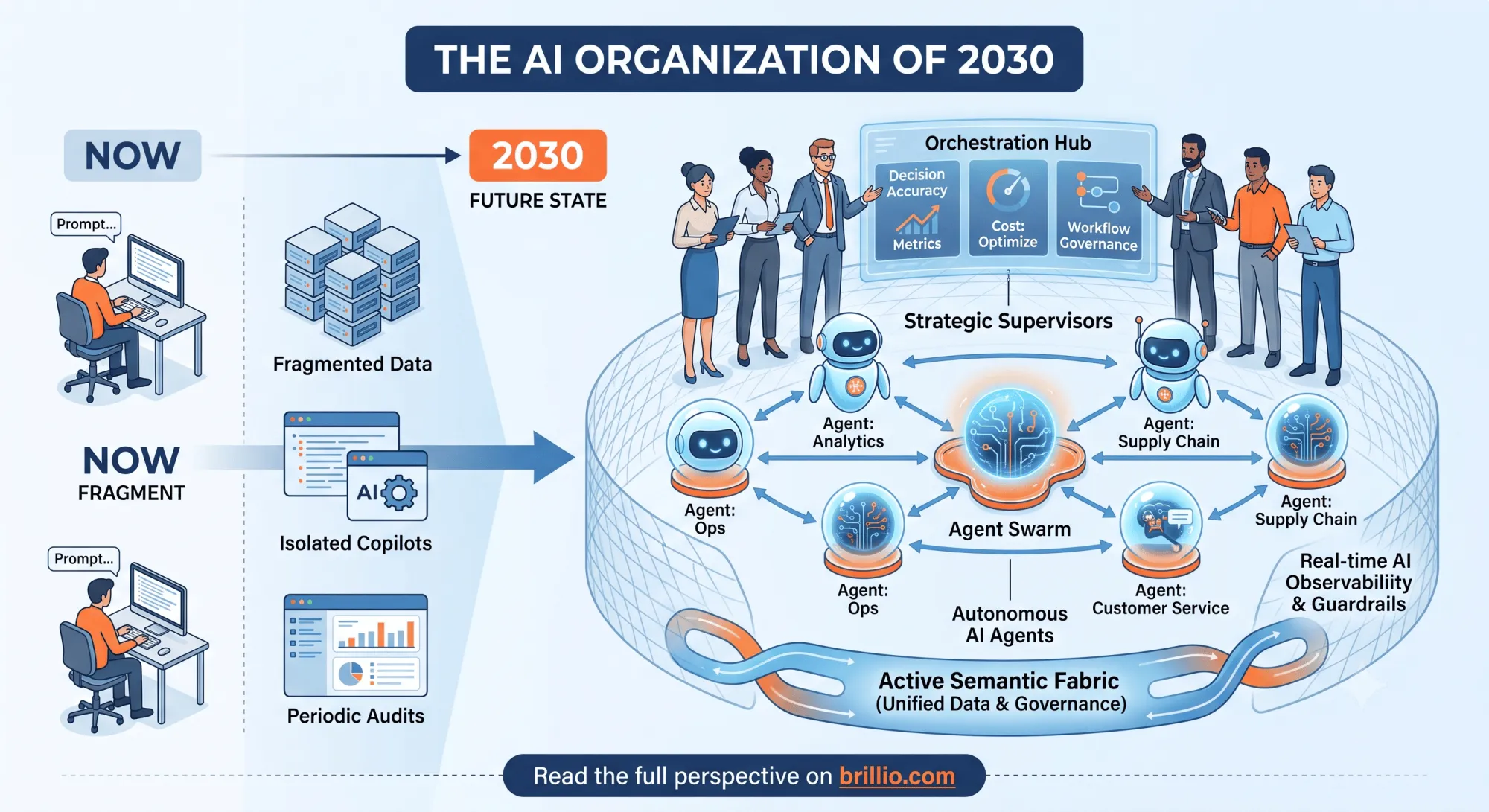
According to research from Gartner, while more than 40% of enterprise software applications will feature embedded autonomous agentic workflows by the end of 2026, the vast majority of internal proof-of-concept remains stalled before production. Organizations find themselves trapped in the pilot paradox-a state of pilot paralysis where isolated AI tools function well in sandboxes but break the moment they interact with real-world enterprise databases and complex business rules.
When you ask a basic copilot to complete a multi-step business workflow, it hits an architectural wall. It cannot safely write back to your systems of record, it cannot coordinate with other software tools, and if it hallucinates, it can halt critical business operations.
To move from novelty experiments to genuine Enterprise AI Transformation, organizations are shifting to an Agentic AI Platform for Enterprises-a system where software moves past simple text generation to take reliable, autonomous, and strictly governed action.
What is an Agentic Data Management Platform?
An agentic data management platform-often called Agentic Data and Application Management (ADAM)-is an enterprise software architecture where autonomous, context-aware AI agents monitor, maintain, and execute tasks across enterprise data pipelines and business applications. Instead of human operators manually triaging error logs, autonomous agents detect anomalies, remediate pipeline failures, and orchestrate cross-platform workflows in real time.
To understand why this architectural shift is accelerating, look at how operational execution has changed across enterprise systems:
Traditional data operations are brittle. If an upstream team renames a database column without warning, an entire data pipeline crashes, taking critical executive dashboards offline until an engineer can debug the code.
An agentic data platform handles this dynamically. Instead of crashing, an integrated data agent spots the schema discrepancy, matches the semantic context using an active metadata graph & lineage, writes a tested schema patch, updates the pipeline, and notifies the team. That is the difference between passive assistance and true autonomous action.
The Core Architecture of an AI Agent Orchestration Platform
Deploying autonomous agents without a centralized coordination system leads directly to agent sprawl-uncontrolled spending, redundant API calls, and competing agents attempting conflicting database updates.
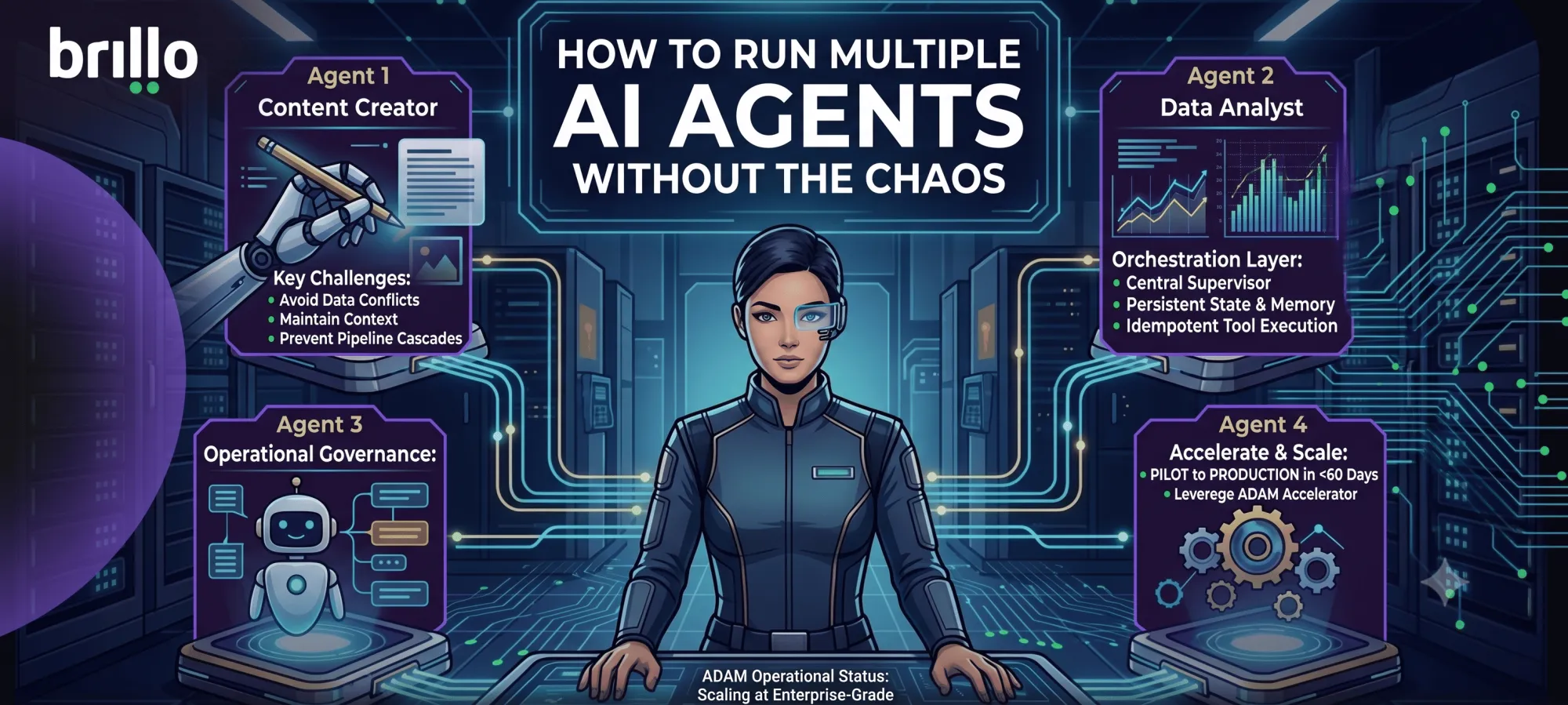
Solving this requires a production-grade AI Agent Orchestration Platform. Think of this platform as an experienced project manager coordinating a team of specialized specialists. It relies on three operational layers:
1. The Multi-Agent Orchestration Engine
Individual agents cannot solve complex enterprise challenges alone. A multi-agent orchestration engine takes high-level business goals and decomposes them into discrete, sequential steps.
- It assigns specific tasks to domain-focused autonomous data agents (for example, one agent to parse unstructured PDF invoices, another to validate purchase orders, and a third to record line items in an ERP).
- It preserves long-term contextual memory across multi-step jobs through decoupled agent state & memory, preventing system deadlocks and memory corruption during long execution runs.
2. The Agentic Data Plane & Unified Data Fabric
Agents are only as intelligent as the data they can access. An agentic data plane provides a clean, secure data transport layer that connects agents directly to enterprise storage-whether your data lives in Snowflake, Databricks, Google Cloud BigQuery, or on-premises systems.
By operating on top of an active metadata layer, the data plane allows agents to query schemas, inspect data lineage, and verify data quality before taking any programmatic action.
3. Pre-Built Agents and Accelerators
Building enterprise integrations from scratch drains time and engineering resources. Leading platforms bypass custom development by offering pre-built agents and modular agentic ai accelerators.
These out-of-the-box templates handle standard enterprise requirements-such as legacy code modernization, automated data cleansing, and API synchronization-shortening deployment schedules from months to a few business weeks.
Why Autonomy Demands an Enterprise AI Governance Platform
Giving autonomous agents programmatic write access to production systems without guardrails creates severe operational risk. If an agent hallucinates a customer discount or alters sensitive clinical data, the financial and regulatory damage can be catastrophic.
To build trust, organizations follow established safety frameworks like the NIST AI Risk Management Framework, implementing an Enterprise AI Governance Platform that enforces strict operational boundaries:
- Agentic Role-Based Access Control (Agentic RBAC): Agents should never share broad administrative API keys. Every autonomous agent must be granted scoped, temporary security tokens restricted exclusively to the specific task at hand.
- Deterministic Guardrails: While language models reason probabilistically, security must remain deterministic. Hard guardrail layers inspect agent outputs against fixed corporate rules, data privacy laws, and security standards before an API call can execute.
- Human-in-the-Loop (HITL) Thresholds: High-risk workflows-such as financial payments over defined thresholds, deletions of customer records, or changes to healthcare files-must trigger automated approval checkpoints that require explicit human review.
- Immutable Audit Trails: Regulatory compliance demands full visibility. An enterprise governance platform maintains an unalterable log detailing the context the agent reviewed, the chain of reasoning it followed, the tools it queried, and the action it took.
- Token Budget Optimization & FinOps: Autonomous agents can consume millions of tokens if trapped in iterative loops. Integrated FinOps controls monitor compute spending, enforce request timeouts, and activate kill-switches to prevent runaway cloud expenses.
Delivering ROI: Which Platform Uses AI Agents to Reduce Time-to-Value?
When evaluating enterprise software, technology executives consistently ask one core question: Which platform uses AI agents to reduce time-to-value?
The answer lies in platforms that prioritize composability, pre-built domain templates, and direct data plane integration over isolated chat interfaces.
By deploying integrated agentic data and application management solutions, enterprises achieve concrete, measurable business outcomes:
- 90% Faster Pipeline Remediation: Self-healing data pipelines diagnose and repair schema mismatches and API failures automatically, virtually eliminating operational downtime.
- 70% Reduction in Technical Debt: Purpose-built code conversion and application modernization agents automate migration tasks, accelerating legacy system refactoring.
- Elimination of Pilot Paralysis: Rather than building coordination frameworks from scratch, organizations leverage proven architectures to move projects from experimental sandboxes into production in under 60 days.
How Can Consulting Partners Accelerate Agentic AI Implementation?
Many IT leaders struggle with a common operational roadblock: their internal teams understand legacy enterprise systems, but lack the bandwidth to design multi-agent orchestration architectures.
This is where specialized implementation partners make a difference. When exploring which service includes ai agent integration services, enterprise leaders look for partners who provide end-to-end support:
- Strategic Workflow Discovery: Identifying which high-volume business processes will yield the highest return from agentic automation.
- Infrastructure Integration: Connecting modern agent frameworks directly into hybrid-cloud environments and enterprise data warehouses.
- Continuous Governance Alignment: Calibrating deterministic guardrails and auditing layers to align with evolving regulatory mandates.
Scaling Autonomous Systems with Agentic Data and Application Management Solutions
The era of passive, text-only AI assistants is quickly coming to a close. While copilots provided a helpful introduction to generative AI, scaling production value requires systems capable of reliable, autonomous execution.
Leading organizations that successfully navigate this shift avoid building complex orchestration and governance scaffolding from scratch. Instead, they deploy composable accelerators like the Brillio Agentic Data and Application Management platform to connect multi-agent orchestration directly into enterprise data planes.
Known as Brillio ADAM, this enterprise blueprint provides a unified ADAM framework that integrates dynamic orchestration with built-in governance control towers. By leveraging the ADAM platform, organizations deploy specialized ADAM agent networks that automate data engineering, monitor application health, and execute complex workflows safely.
Whether your priority is modernizing legacy code, eliminating broken data pipelines, or automating cross-application operations, adopting an enterprise-ready ADAM core solutions architecture provides the foundation required to turn AI models into production workhorses.
By uniting multi-agent orchestration, unified data access, and real-time governance, enterprises can finally leave pilot paralysis behind and turn autonomous AI into an engine of operational excellence.
Getting Started: Next Steps for Enterprise Leaders
- Audit Your Current AI Pilots: Identify where conversational copilots have stalled due to an inability to interact with production databases.
- Consolidate the Data Plane: Ensure enterprise data in platforms like Snowflake, Databricks, or cloud ERPs is connected through unified metadata rather than siloed point integrations.
- Deploy with Governance First: Establish agentic RBAC and human-in-the-loop approval thresholds before giving autonomous agents write permissions in production environments.
- Explore the Blueprint: Learn how Enterprise AI Transformation powered by composable agent accelerators delivers scalable, governed, and reliable automation across your enterprise applications.

























Sign in to leave a comment.