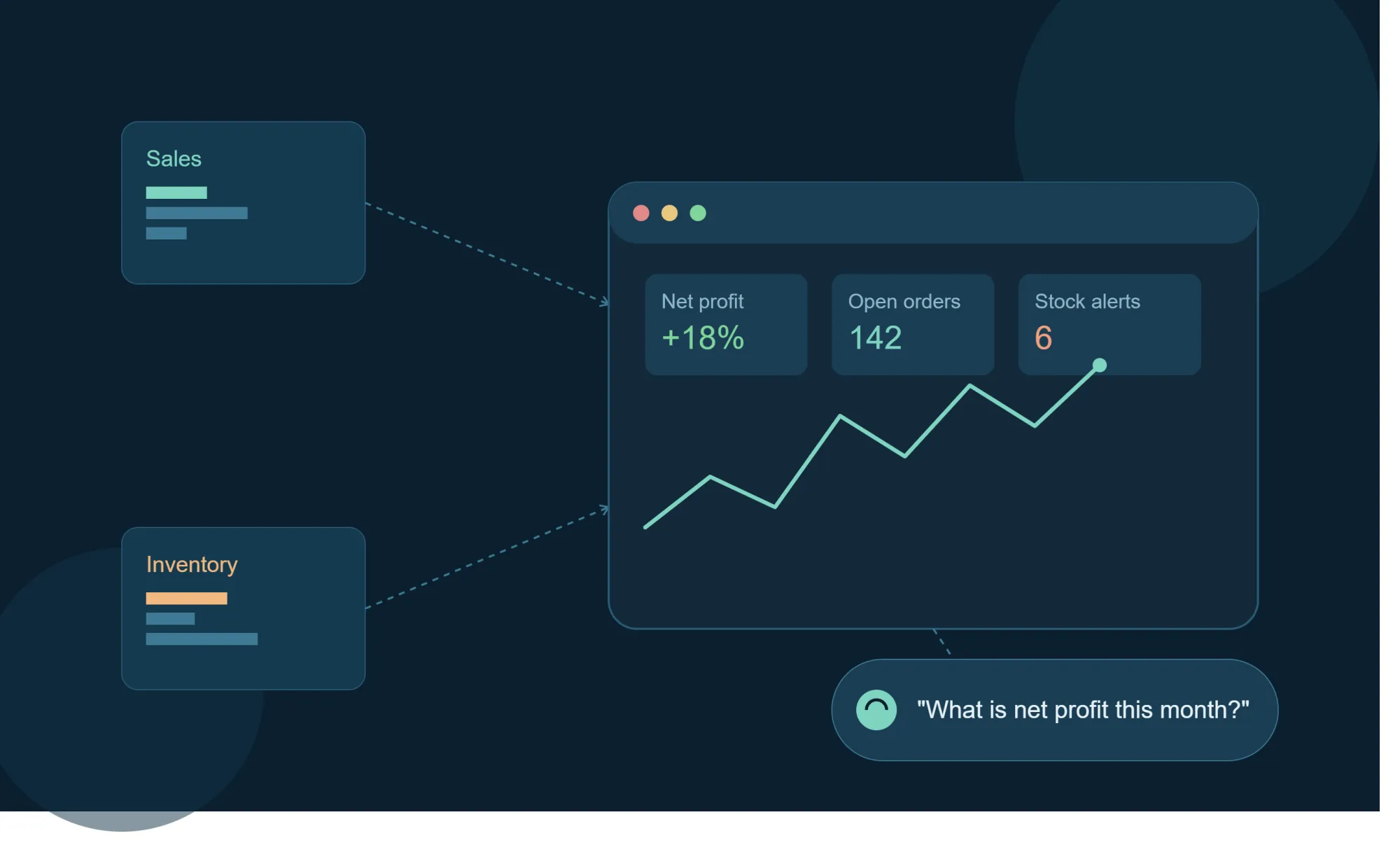

For years, Odoo has been the backbone of operations for thousands of growing businesses — managing sales, inventory, finance, manufacturing, and more from a single ERP. But when it comes to understanding what all that data actually means, most teams are still stuck doing things the old way: pulling static reports, applying filters, exporting to Excel, and manually piecing together the bigger picture.
That's changing. Businesses are increasingly turning to an AI business intelligence platform to sit on top of Odoo and transform raw operational data into real-time, decision-ready insight. Here's why the shift is happening — and what it means for how executives and teams interact with their ERP data.
The Problem with Static Reports
Odoo's built-in reporting tools are solid for day-to-day operations. But static reports have real limitations:
- They answer only the exact question they were built to answer
- They require someone with technical know-how to build or modify them
- They don't update the narrative — just the numbers
- They live in silos, module by module, instead of telling a connected story
For an executive trying to make a fast decision — "Which product line is underperforming this quarter?" or "Are we at risk of a stockout?" — digging through multiple reports and filters isn't just slow, it's a barrier to timely action.
Enter Conversational AI for Business Data
Instead of navigating menus and building filters, imagine simply asking your ERP a question and getting an instant, contextual answer. That's the core promise of conversational AI for business data — a natural-language layer that lets any user, technical or not, ask things like:
- "Which lead sources generated the most opportunities this month?"
- "What's our net profit trend over the last quarter?"
- "Which vendors have the most open purchase orders?"
No filters. No report-building. No waiting on a BI analyst. Just a direct answer, often paired with a visual — pulled live from your Odoo data.
This is the fundamental difference between traditional reporting and an AI-powered data analytics tool: one requires you to know what to look for and how to find it; the other lets you simply ask, and lets the intelligence layer do the interpretation.
From Static Numbers to Executive Dashboards
Beyond conversational queries, businesses are also moving toward pre-built, real-time executive dashboards that unify data across departments — Sales, CRM, Inventory, Manufacturing, Finance, Purchase, and POS — into a single, coherent view.
Rather than toggling between disconnected module reports, an executive dashboard powered by AI can:
- Surface trends and variances automatically, without manual comparison
- Generate plain-language narratives alongside charts (so the "why" is as clear as the "what")
- Update continuously with live data, eliminating outdated snapshots
- Flag operational risks — like slowing sales velocity or rising stock-outs — before they escalate
This is where the real value of AI business intelligence for Odoo shows up: it doesn't replace your ERP, it extends it, converting operational data into strategic visibility without disrupting existing workflows.
Why This Shift Is Happening Now
A few forces are driving the move toward AI-powered analytics layers:
1. Decision speed matters more than ever. Businesses can't afford to wait days for a report to be built and reviewed. Leaders want answers in the moment a question arises.
2. Teams are stretched thin. Not every organization has a dedicated BI analyst. Conversational, self-serve intelligence removes the bottleneck of relying on one or two technical people to generate every report.
3. Cross-functional visibility is now table stakes. Sales, inventory, and finance data can no longer live in silos if leadership wants an accurate, real-time picture of the business.
4. AI has matured enough to be trustworthy. With read-only access, secure API integration, and no data storage or model training on customer data, modern Odoo AI analytics platform solutions are being built with governance and security as a foundation — not an afterthought.
What This Means for Your Business
Moving beyond static Odoo reports doesn't mean replacing your ERP or overhauling your workflows. It means adding an intelligence layer that makes your existing data work harder — turning operational transactions into structured, decision-ready insight.
Whether it's asking a quick question in natural language, monitoring a live executive dashboard, or spotting a trend before it becomes a problem, the goal is the same: faster, more confident decisions, without the manual reporting burden.
For businesses already running Odoo, the question isn't whether to add AI-powered intelligence — it's how soon they can start using it to close the gap between data and decision-making.





















Sign in to leave a comment.