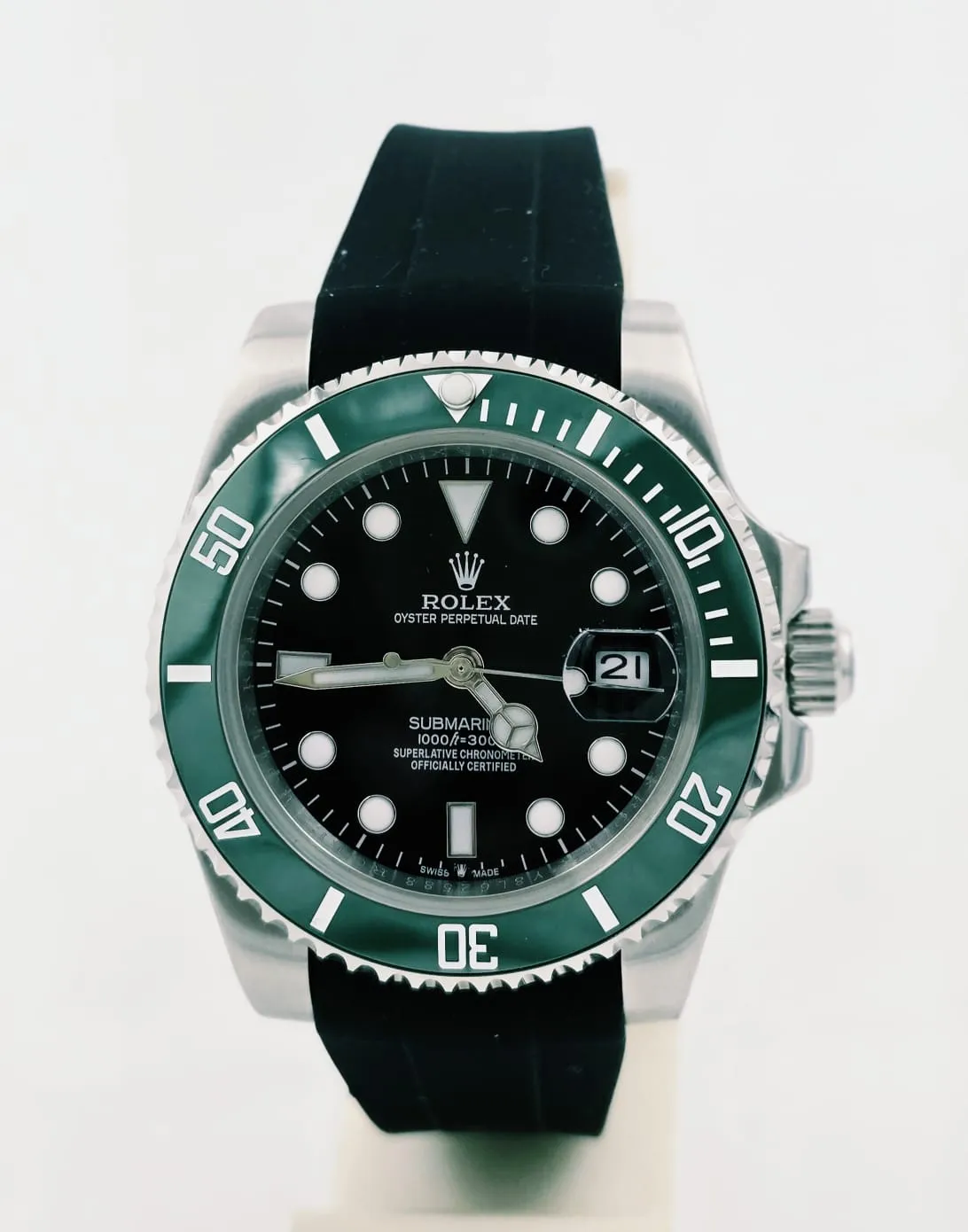

In the pantheon of luxury tool watches, few names command as much respect and intrigue as the Rolex Submariner and the Rolex Sea-Dweller. At a cursory glance, they appear as siblings, sharing a common design language of robust Oystersteel cases, unidirectional rotating bezels, and a legacy of aquatic adventure. However, to the discerning eye, these two icons are distinguished by fundamental differences in purpose, engineering, and physical presence. The Submariner is the archetypal "go-anywhere, do-anything" luxury sports watch, while the Sea-Dweller is its formidable, hyper-specialized sibling, built to conquer the crushing pressures of the abyss.
The Genesis of Two Icons
The story of these two titans begins not in competition, but in evolution. The Rolex Submariner, introduced in 1953, was a pioneer. It was one of the first wristwatches specifically designed for scuba divers, setting the aesthetic and functional benchmark for all dive watches to come . It boasted a water resistance of 100 meters (330 feet), a figure that has since been increased to 300 meters (1,000 feet) in modern iterations . Its revolutionary Oyster case, with its screw-down crown and case back, provided the waterproof integrity that allowed divers to explore the shallower depths with confidence.
As underwater exploration pushed into the realm of "saturation diving" in the 1960s—where divers lived in pressurized habitats for extended periods to avoid lengthy decompression—a new challenge emerged. Professional divers found that during decompression in hyperbaric chambers, the crystals on their Submariners were popping off . The culprit was helium. The gas mixture used in saturation diving contains tiny helium atoms that are small enough to infiltrate the watch case through its seals. During decompression, the pressure inside the watch could not escape fast enough, leading to a catastrophic internal pressure build-up. Rolex’s response to this existential threat was not a mere upgrade but the creation of a new watch: the Sea-Dweller, introduced in 1967
The Defining Feature: The Helium Escape Valve
The Sea-Dweller's most iconic and pivotal feature is the helium escape valve (HEV), a patented innovation that solved the decompression crisis . This automatic valve, typically located on the side of the case at 9 o'clock, is a one-way pressure release mechanism. When the pressure inside the watch case exceeds the external pressure during a dive or in a decompression chamber, the valve opens to safely release the trapped helium, preserving the watch's structural integrity . This technology allowed the Sea-Dweller to achieve a depth rating of 1,220 meters (4,000 feet), nearly four times that of the Submariner . In contrast, the Submariner, designed for recreational and professional scuba diving, has never required this feature.
A Tale of Two Cases: Size and Presence
The technical demands placed on the Sea-Dweller have a direct impact on its physical form. For decades, both watches were offered in a 40mm case, but the Sea-Dweller was always noticeably thicker to accommodate a more robust construction and the HEV . The difference in stature became more pronounced in 2017 when Rolex marked the 50th anniversary of the Sea-Dweller by increasing its case diameter to 43mm . This, coupled with a thickness of approximately 15.1mm, gives the modern Sea-Dweller a substantial and commanding presence on the wrist . It is a watch that declares its purpose. The Submariner, by contrast, now features a more refined 41mm case that, while still robust, sits more comfortably and elegantly on the wrist, easily transitioning from a dive trip to a business meeting .
The Eyes of the Watch: The Cyclops Lens and Dial Aesthetics
Another key aesthetic and functional distinction lies in the date display. A signature Rolex feature is the Cyclops lens, a magnifying window integrated into the sapphire crystal that enlarges the date display at 3 o'clock. For the longest time, the Sea-Dweller existed without this lens. Its thicker, more heavily constructed crystal made the addition of a Cyclops technically challenging and, perhaps, a compromise on its pure tool-watch ethos . However, in a significant break from tradition, the 2017 50th-anniversary Sea-Dweller (ref. 126600) received a Cyclops lens, finally aligning it with the Submariner Date in this regard . The modern Sea-Dweller also features a subtle touch of personality with "SEA-DWELLER" printed in red on its dial, a nod to the legendary "Double Red" vintage models, while the Submariner’s dial text is uniformly white .
Market Position and Legacy
This divergence in design and technical specification is reflected in the watches' market positions. The Submariner, particularly the no-date version, is revered for its purity and is one of the most sought-after luxury watches in the world, often commanding substantial premiums on the secondary market . Its versatility makes it an ideal "one-watch" collection. The Sea-Dweller, while equally coveted, exists in a more niche space. It is the choice for those who want the ultimate Rolex dive watch, one with a deeper history of professional use and a more imposing wrist presence. Interestingly, despite its higher retail price, the Sea-Dweller often trades at a smaller premium relative to retail on the grey market, making it a potentially more accessible entry point for collectors seeking a heavy-duty Rolex sports watch .
Conclusion
The choice between the Rolex Submariner and the Rolex Sea-Dweller is a choice between two distinct philosophies of watchmaking. The Submariner is the master of all trades, a timeless icon that is as comfortable in the boardroom as it is on a coral reef. Its design is the very definition of a classic. The Sea-Dweller is the uncompromising specialist, a triumph of engineering born from a specific, life-threatening challenge. It is a watch with a singular focus: to withstand extreme pressure and perform flawlessly in the most hostile environments. One is the benchmark for what a dive watch should be; the other is a monument to what a dive watch can be. Whether you choose the legendary "水鬼" (Shuǐguǐ - Water Ghost) or the formidable "鬼王" (Guǐwáng - Ghost King), you are acquiring a piece of horological history, a testament to Rolex's relentless pursuit of innovation and mastery of the deep .
























Sign in to leave a comment.