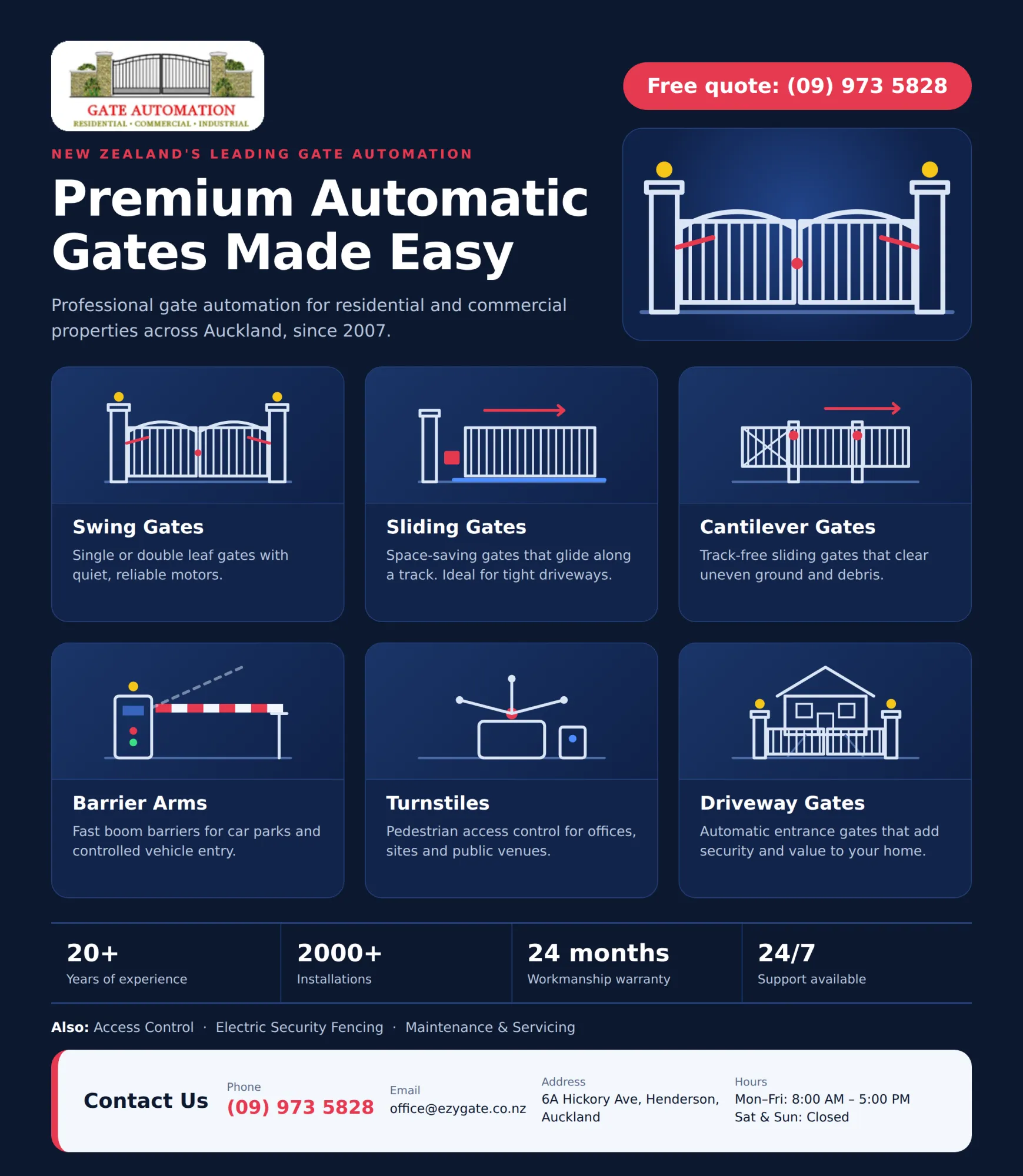

A gate used to have one simple job: keep an entrance closed when nobody was coming through. Today, that idea has changed considerably. Property owners increasingly want their entrances to be secure, convenient, reliable, and easy to manage, whether the property is a family home, office, warehouse, industrial facility, or large commercial site. Modern automatic gate solutions bring these requirements together by combining physical barriers with motors, access technologies, safety features, and smart systems. Instead of treating a gate as just another part of the boundary, property owners can now make it an active part of the overall security and access strategy.
The Entrance Is More Important Than It Looks
The entrance is usually the point where people and vehicles move between public and private areas.
For a residential property, it may be the driveway where family members arrive several times a day. For a business, it may be the main vehicle entrance used by employees, customers, contractors, suppliers, and delivery vehicles.
That makes the entrance more than an architectural feature.
It becomes a point where security, convenience, traffic movement, and property design all meet.
A poorly planned entrance can create unnecessary delays or make access difficult to control. A well-designed automated entrance, on the other hand, can make everyday movement smoother while providing an additional layer of property security.
This is why gate automation has become increasingly relevant to modern property owners.
What Does Gate Automation Actually Mean?
Gate automation is the process of using mechanical and electronic equipment to operate a gate without requiring someone to physically open and close it.
A typical automated setup may include a gate structure, motor, control equipment, safety sensors, remote controls, and access devices. Depending on the property, the system can also be connected to intercoms, RFID readers, keypads, smartphones, CCTV, or other security technologies.
The important point is that automation does not necessarily mean the same thing for every property.
A homeowner may want simple remote-controlled driveway access.
A commercial facility may need a heavy-duty sliding gate capable of handling frequent vehicle movements.
An apartment complex may require controlled access for residents and visitors.
An industrial property may need automation combined with advanced access management.
The right solution therefore begins with understanding how the property is used.
Why More Property Owners Are Choosing Automated Gates
Convenience is one of the most obvious benefits.
Nobody wants to leave their vehicle in the rain just to open a heavy driveway gate. Similarly, businesses do not want employees repeatedly stopping operations to manually manage vehicle access.
Automation can make the process much easier.
But convenience is only one part of the picture.
Automated gates can also help property owners control access, improve privacy, support security procedures, and create a more organised entrance.
EzyGate describes its automatic gate systems as solutions designed to improve security, convenience, and long-term property value.
The combination of these benefits is what makes automation useful beyond simple comfort.
Residential Gates: Security Without Making Life Complicated
For homeowners, security should not come at the expense of convenience.
A residential gate needs to protect the property while still allowing family members to come and go easily. If the system is complicated or unreliable, people may stop using it properly.
Automatic residential gates can provide a practical middle ground.
A homeowner can operate the gate using an appropriate remote, keypad, mobile access system, or other configured control method. Depending on the setup, additional technologies can also be incorporated to manage visitors or monitor access.
The design of the gate itself matters too.
It should complement the property rather than looking like an afterthought. Material, colour, size, opening direction, driveway layout, and surrounding landscaping can all influence the final result.
A good installation therefore considers both security and appearance.
Commercial Gates Have Different Requirements
Commercial properties tend to place greater demands on automated gate systems.
A business entrance might be used dozens or hundreds of times in a day. Employees may arrive at different times, deliveries may need scheduled access, and contractors may require temporary entry.
This means a commercial gate needs to be designed for more than occasional use.
EzyGate provides commercial gate systems for businesses and industrial environments, including sliding gates, swing gates, access control integration, high-traffic automation, and warehouse or facility gates.
The focus is on dependable operation, controlled access, and suitability for demanding environments.
Sliding Gates for Busy Entrances
Sliding gates can be particularly useful where driveway or entrance space makes a swinging gate impractical.
Instead of opening inward or outward, the gate moves horizontally along a defined path.
This can help maximise usable driveway space and can be a practical option for commercial and industrial properties.
Sliding systems can also be automated for regular vehicle movement.
However, the available space beside the entrance needs to be considered carefully. The gate requires sufficient room to travel, and the track or operating mechanism needs to be installed appropriately.
A site assessment can help determine whether a sliding system is suitable.
Swing Gates Remain a Popular Choice
Swing gates have a different operating style and can work well in many residential and commercial environments.
They can offer a traditional appearance while still incorporating modern automation technology.
For a home, a swing gate may complement an established architectural style. For a commercial property, an automated swing gate can provide controlled vehicle access where site conditions permit.
The number of gate leaves, available space, weight, frequency of use, and automation equipment all influence the design.
There is no universal answer as to whether sliding or swing gates are better. The right choice depends on the entrance.
Custom Gates Can Combine Security and Style
Security does not mean a property has to sacrifice its appearance.
Custom-made gates allow owners to consider both practical and visual requirements.
A residential driveway may need a gate that matches the home's exterior. A commercial property may want a professional-looking entrance that reflects the organisation's image.
Customisation can involve dimensions, materials, layout, automation, access methods, and other details.
The result is a gate that is designed around the property rather than forcing an existing property to accommodate a standard design.
Access Control Adds Another Layer
An automatic gate can open and close by itself, but access control determines who is allowed to operate it.
This distinction becomes particularly important when several people use the same entrance.
Modern access control can include keypads, RFID cards, mobile systems, and video intercoms.
For example, an office could give authorised employees individual credentials while using an intercom for visitors. A residential complex could provide access to residents while requiring visitor verification.
EzyGate offers keypad entry, card and RFID access, mobile access control, video intercoms, and multi-user access management.
This makes the gate part of a larger access management system rather than an isolated device.
Smartphone Access Is Changing Everyday Entry
Smartphone technology has made property access more flexible.
Instead of relying exclusively on physical remotes or cards, compatible systems can allow authorised users to manage entry through mobile devices.
This can be particularly useful for property managers and business owners who need flexibility.
For example, a manager may need to provide access to a contractor without being physically present at the gate. A suitable mobile access system can make this process more convenient.
The technology also creates possibilities for remote management and notifications, depending on the system installed.
Video Intercoms Help Manage Visitors
Not everyone approaching a gate should automatically be allowed through.
Visitors, delivery personnel, contractors, and service providers may need to be identified before entry.
A video intercom can help solve this problem by allowing the person inside the property to communicate with and visually verify the visitor.
For residential properties, this can improve visitor convenience while maintaining control.
For commercial properties, it can help staff manage unexpected arrivals or restricted entrances.
When integrated with automated gates, video intercoms can become a useful part of a complete entry system.
Electric Security Fencing for Larger Perimeters
A gate controls an entrance, but what happens around the rest of the property?
For properties with large or sensitive boundaries, perimeter protection may require more than a gate.
Electric security fencing can provide an additional deterrent around the property's boundary and can be integrated with monitoring technology.
EzyGate offers residential, commercial, perimeter intrusion detection, and high-security electric fencing systems.
This can be especially relevant for warehouses, industrial sites, large commercial properties, and locations where perimeter protection is a significant concern.
Barrier Arms for Controlled Vehicle Movement
Not every entrance needs a traditional gate.
Barrier arms can be useful for locations where vehicles need to be controlled without completely blocking the visual openness of the entrance.
They can be suitable for car parks, commercial facilities, apartment complexes, and other areas where vehicle flow needs to be managed.
The benefit is particularly noticeable at sites with regular vehicle movement.
Instead of manually opening a large gate for every vehicle, a barrier system can be connected to an appropriate access control arrangement.
Turnstiles for Pedestrian Access
Vehicle entrances are only one part of access management.
Some properties also need to control pedestrian movement.
Turnstiles can help manage pedestrian entry at workplaces, commercial buildings, facilities, and other environments where authorised access needs to be controlled.
They provide a defined entry point and can be integrated with access credentials.
This creates a clear separation between pedestrian and vehicle access where a property requires both.
Why Integration Matters
One of the biggest changes in modern security is the move away from isolated systems.
A gate can work with access control.
Access control can work with an intercom.
CCTV can monitor the entrance.
Alarms can provide notifications.
Electric fencing can protect the perimeter.
When these technologies are planned together, they can provide multiple layers of protection.
EzyGate's service offering includes residential and commercial gates, barrier arms, access control, electric security fencing, and turnstiles and maintenance.
The advantage of an integrated approach is that each system has a defined role.
Choosing the Right Gate Motor
The gate itself is only one part of an automated system.
The motor needs to match the gate's size, weight, opening style, and expected frequency of operation.
A lightweight residential gate and a high-traffic commercial gate should not necessarily use the same automation equipment.
The operating environment also matters.
An installer may need to consider driveway slope, available power, weather exposure, gate alignment, usage frequency, and safety requirements.
Selecting equipment based only on appearance or initial price can create problems later.
A properly assessed system is more likely to deliver dependable performance over time.
Safety Should Never Be an Afterthought
Automated gates involve moving mechanical components and therefore need appropriate safety measures.
Sensors, controls, emergency release mechanisms, and other safety features can help reduce risks around moving gates.
The installation should also take into account how pedestrians and vehicles interact with the entrance.
For a commercial property, this may be more complex because large numbers of people and vehicles may use the same area.
Professional planning helps identify these interactions before installation begins.
Maintenance Keeps Automation Working
Even a high-quality automated gate needs maintenance.
Moving components experience wear, and outdoor equipment is exposed to weather conditions throughout the year.
Regular servicing can help identify issues before they become major failures.
For businesses, preventive maintenance can be particularly valuable. A gate that stops operating during a busy working day can affect deliveries, staff access, customers, and site operations.
EzyGate provides ongoing maintenance, repairs, servicing, and support for its gate systems. The company also states that its installations include a workmanship warranty, while motors and components carry applicable manufacturer warranties.
What Happens During a Professional Installation?
A successful gate installation starts well before the equipment arrives on site.
The property needs to be assessed first.
Important factors include:
- Gate type and size
- Driveway or entrance layout
- Vehicle movement
- Available operating space
- Electrical requirements
- Access control needs
- Safety considerations
- Existing security systems
- Future expansion requirements
Once these factors are understood, the system can be designed around the property.
EzyGate states that its projects begin with a free site assessment, followed by a written quote before work starts.
This type of planning can help property owners understand what they are actually investing in.
Why Experience Matters
Gate automation combines several different disciplines.
There is mechanical engineering, electrical equipment, access technology, safety, property layout, and sometimes integration with other security systems.
An installer therefore needs to understand more than simply how to mount a motor.
EzyGate says it has more than 20 years of experience in gate automation and works with experienced and certified technicians.
For a property owner, experience can be valuable because every site presents different challenges.
Looking Beyond the Initial Installation
A gate should be considered a long-term property investment.
The initial installation is important, but so is what happens afterward.
Property owners should think about servicing, repairs, replacement components, upgrades, and future technology integration.
A system that can adapt over time may provide better long-term value than one designed only for today's requirements.
For example, a homeowner may initially choose remote-controlled access and later decide to add a video intercom or smartphone control.
A business may begin with a single entrance and eventually need additional access points.
Planning for these possibilities can make future upgrades easier.
Security and Convenience Can Coexist
There is sometimes a misconception that stronger security means more inconvenience.
Modern automation challenges that idea.
A properly designed system can actually make secure access easier.
Authorised users can enter without manually opening heavy gates. Visitors can be verified remotely. Businesses can manage different types of users. Large sites can control vehicle movement more efficiently.
The goal is not to make access difficult.
The goal is to make access intentional.
People who are authorised should be able to enter efficiently, while the property remains protected from uncontrolled access.
Making the Property Entrance Part of the Overall Design
A gate is often one of the first things people notice when they approach a property.
For a home, it contributes to curb appeal.
For a business, it can influence the first impression customers, suppliers, and visitors receive.
This makes design an important part of gate planning.
The best automated entrance is not necessarily the most complicated one. It is the one that fits the property, works reliably, looks appropriate, and provides the required level of control.
Good design is therefore about balance.
A Better Way to Think About Property Security
Modern property security is no longer about one product.
A gate alone cannot solve every security challenge. CCTV alone does not control who enters. Access control alone does not protect an entire perimeter.
Each technology has a role.
When those technologies are planned together, they can create a stronger and more practical security environment.
This is particularly important for properties with multiple entrances, high vehicle movement, valuable assets, or different categories of users.
Why Auckland Properties Need Flexible Solutions
Auckland properties vary considerably.
There are compact urban homes, large residential properties, offices, warehouses, industrial sites, apartment developments, retail locations, and specialised facilities.
Their security requirements are therefore not identical.
EzyGate is based in Henderson and states that it services Auckland, including West Auckland, North Shore, Central Auckland, East Auckland, and South Auckland, with projects also available in Hamilton and the wider Waikato region.
Local site knowledge can be useful when designing an entrance around actual property conditions.
Making a Smarter Investment Decision
Before choosing an automated gate system, property owners should ask a few practical questions.
How frequently will the gate be used?
Who needs access?
Are visitors common?
Is vehicle traffic heavy?
Does the property already have CCTV or alarms?
Will mobile access be useful?
Is there enough space for a sliding gate?
Would a swing gate be more appropriate?
Does the property need perimeter protection?
What maintenance will be required?
These questions help shift the decision away from simply asking, "Which gate looks best?"
Instead, the focus becomes, "Which system will work best for this property?"
That is a much more useful question.
The Future of Automated Property Access
Gate automation is likely to become even more connected as smart technology develops.
Mobile access, remote monitoring, integrated security systems, intelligent notifications, and increasingly sophisticated access management are changing what property owners expect from an entrance.
But technology should always serve a practical purpose.
A system is valuable when it makes security easier to manage, access more convenient, and property operations more reliable.
The best future-ready systems will therefore not simply add features for the sake of adding features. They will use technology where it genuinely improves the property.
Final Thoughts
A modern entrance can be much more than a physical barrier. With the right combination of gate design, automation, access control, safety equipment, monitoring, and maintenance, it can become an important part of a property's overall security and daily operation. Whether the requirement is for a family driveway, a busy commercial facility, a warehouse, or a larger industrial site, the system should be designed around real-world usage and future needs. For Auckland property owners looking for dependable gate automation services, choosing an experienced team that can handle installation, integration, maintenance, and long-term support can make the entire process considerably easier.
















Sign in to leave a comment.