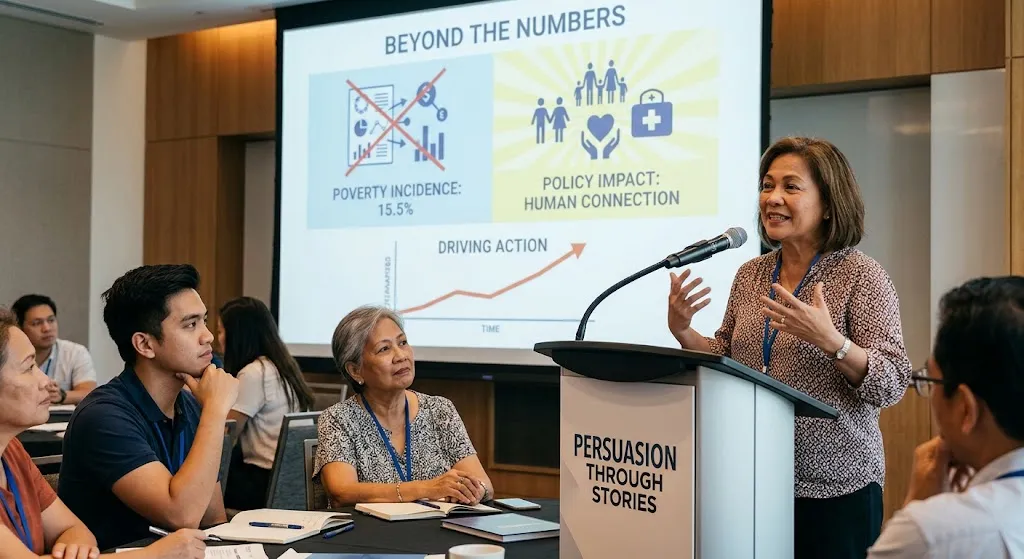

In the world of public governance, policy development, and social reform, data reigns supreme. Economists, analysts, and decision-makers spend countless hours gathering statistics, constructing regression models, and building comprehensive policy briefs. Yet, time and again, well-researched policy proposals stall in legislative chambers, lose traction in civic discussions, or fail to gain public support.
Why does this happen? The core reason is straightforward: data alone rarely sways human minds.
While numbers provide necessary evidence, stories evoke the human connection required to spark real-world action. To build meaningful momentum for societal reform, leaders must look beyond raw metrics and learn how storytelling renders policy communication truly persuasive.
The Limit of Pure Statistics
Consider a standard government statistic: According to the Philippine Statistics Authority (PSA), poverty incidence among families was recorded at 15.5% during the first semester of 2023.
As a metric, this percentage is crucial. It gives policymakers a baseline to measure economic trajectory, allocate budget reserves, and assess national progress. However, as a persuasion tool directed at the public or key stakeholders, "15.5%" is abstract. It is a sterile data point that fails to capture human struggle, daily sacrifices, or systemic barriers.
When policy advocacy relies exclusively on figures, it risks triggering what psychologists call psychic numbing—a cognitive phenomenon where large statistics fail to register emotional urgency. A single family struggling to afford rice, healthcare, and schooling in an urban settlement paints a far clearer picture of economic vulnerability than any spreadsheet line item ever could.
Why Human Brains Are Wired for Narrative
Storytelling is not merely an artistic choice; it is deeply rooted in human cognition. Evolutionary psychology reveals that people process information, draw conclusions, and retain memories far better through narrative frameworks than isolated facts.
- Stories Build Empathy: Dry numbers engage only the language-processing parts of the brain. Narrative arc, character development, and personal context activate broader neural pathways—including sensory and emotional regions — allowing audiences to internalize another person's lived experience.
- Context Defines Problem Statements: A number explains what is happening, but a story explains why it matters and who is impacted. Contextual narratives humanize complex problems, turning passive observers into active advocates.
- Persuasion Drives Behavioral Action: Logic persuades opinion, but emotion drives action. Whether convincing legislators to sponsor a bill or mobilizing communities to adopt public health measures, narrative gives stakeholders a compelling reason to act.
Blending Data with Narrative: The Frame-Fact-Future Model
Effective policy communication does not mean abandoning rigorous data. Rather, it requires weaving data seamlessly into a structured narrative framework. Advocating for structural change requires combining cold, hard metrics with compelling human context:
1. Frame with the Human Reality
Begin not with a spreadsheet, but with an individual or community experience that encapsulates the systemic problem. Introduce the real-world conditions affected by current policy gaps.
2. Anchor with Credible Data
Once the audience is emotionally engaged, introduce official statistics—such as data from the Philippine Statistics Authority (PSA) — to demonstrate that this personal story reflects a widespread structural reality rather than an isolated incident.
Oxford Poverty and Human Development Initiative
3. Point to the Policy Solution (The Future)
Conclude by showing how specific policy measures directly address the human challenge presented at the start. Offer a clear, actionable vision of what changes when the policy is enacted.
Bridging the Gap in Public Policy
In an era of information overload, policy experts must recognize that data is the framework, but narrative is the delivery system. When policy briefs are treated purely as technical exercises, they remain unread on official desks. But when grounded in authentic human experiences, policies gain the public momentum necessary to achieve meaningful, lasting impact.
To explore how data-backed narratives can transform civic engagement, discover more about why data-driven narratives matter in public policy advocacy.

























Sign in to leave a comment.