
The BIW Welding System Market: Strategic Trends and Commercial Opportunities Through 2032
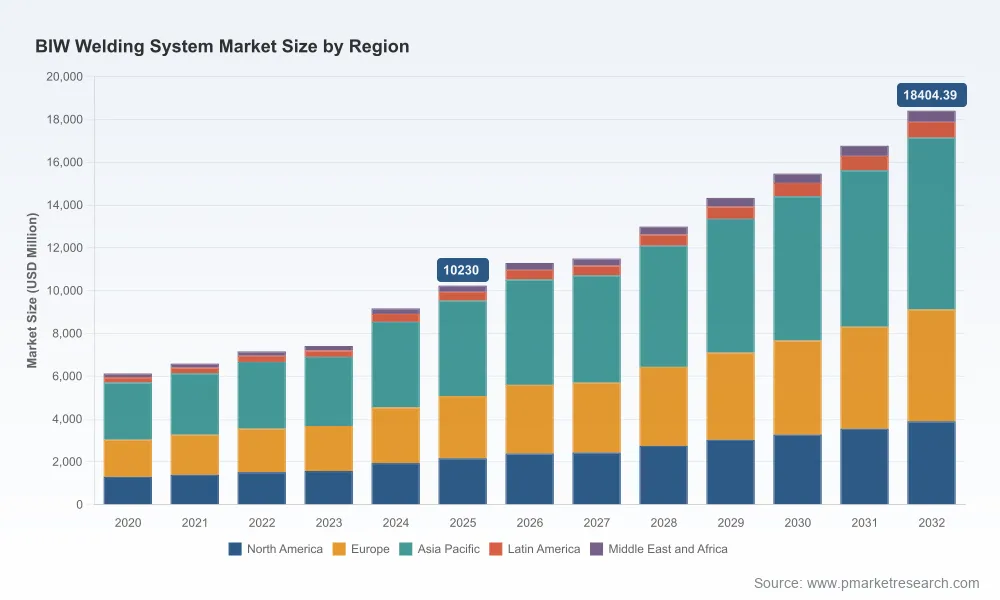
The Body-in-White (BIW) welding system market has entered a phase of structural expansion, driven by the convergence of electrification, lightweighting mandates, and manufacturing automation. Valued at approximately $10.23 billion in 2025, the sector has demonstrated consistent growth from its 2020 baseline, projecting a compound annual growth rate of 8.75 percent through 2032. The revenue trajectory points toward a $18.4 billion market by the end of the forecast period, reflecting sustained capital expenditure in automotive assembly and a broadening application base. This expansion is not merely cyclical; it is rooted in a fundamental reengineering of how vehicle bodies are joined, assembled, and validated. For executives and investors, the central question is no longer whether the market will grow, but where value will concentrate and which capabilities will separate leaders from the rest.
Despite the favorable growth backdrop, the industry faces three critical inflection points that will shape competitive outcomes over the next several years. First, the shift toward aluminum and advanced high-strength steel (AHSS) introduces complex joining requirements that legacy welding architectures struggle to accommodate. These materials deliver significant mass reduction but demand precise thermal control, adaptive clamping, and hybrid joining approaches to maintain structural integrity. Second, mixed-model production lines are becoming the norm rather than the exception. Automotive manufacturers increasingly require flexible welding systems capable of handling multiple vehicle variants and material grades on a single line without sacrificing throughput. Third, capital intensity and integration complexity are rising. Welding systems are no longer standalone equipment purchases; they are integral nodes within broader digital manufacturing ecosystems, requiring seamless data exchange, real-time process monitoring, and predictive maintenance capabilities. Companies that underestimate these integration demands risk delivering solutions that perform well in isolation but create friction downstream.
Key Drivers Reshaping the BIW Welding Landscape
Technological Innovation and Process Evolution
The most transformative force in the BIW welding market is the continuous refinement of joining technologies that balance speed, precision, and material compatibility. Resistance spot welding remains a cornerstone, but the spotlight increasingly falls on laser welding and hybrid processes that enable tighter joint geometries, reduced heat-affected zones, and faster cycle times. Laser-based solutions are gaining traction particularly in applications where seamless aesthetics and high structural performance intersect, while advanced spot welding systems are being reengineered with adaptive current control and real-time monitoring to accommodate variable material thicknesses. The integration of simulation-driven offline programming and digital twin capabilities is also accelerating deployment timelines and reducing changeover costs. These technological shifts are not incremental improvements; they represent a rethinking of how welding cells are designed, commissioned, and operated in high-mix environments.
Regulatory Pressure and Lightweighting Mandates
Policy frameworks and emissions standards are exerting direct influence on BIW design philosophy and, by extension, welding system requirements. Corporate average fuel economy (CAFE) and greenhouse gas regulations push automakers toward aggressive mass-reduction targets, which in turn drive the adoption of AHSS and aluminum alloys. These materials offer substantial weight savings but introduce joining challenges that conventional welding approaches cannot always address efficiently. Welding system suppliers are responding by developing specialized process configurations, including tailored current profiles, multi-point sequencing, and hybrid joining strategies that combine welding with adhesive bonding or mechanical fastening. The regulatory environment is effectively acting as a design constraint that rewards flexibility, precision, and the ability to validate joint performance across diverse material combinations. Manufacturers that can demonstrate reduced cycle times while meeting structural and mass targets are well positioned to capture share as automakers reorient their engineering priorities.
Demand-Side Shifts in Automotive Production Models
Vehicle production strategies are evolving in response to electrification, platform consolidation, and the need for faster model rollouts. Passenger vehicles continue to account for the largest share of BIW welding demand, but commercial vehicle segments are also growing as fleet electrification and payload optimization reshape body architectures. The underlying trend is a move toward modular platforms and more frequent derivative updates, which require welding lines that can accommodate rapid changeovers and mixed-model sequencing without compromising quality. In parallel, the rise of gigacasting and structural battery enclosures is altering where and how BIW welding is applied, shifting some joining complexity from traditional stampings to large-scale assemblies that demand advanced positioning, clamping, and multi-axis welding integration. These changes are expanding the addressable scope of BIW welding systems beyond conventional body lines and into new assembly configurations that reward adaptable automation.
Supply Chain Dynamics and Cost Structure Evolution
Cost pressures and supply chain resilience are reshaping how welding systems are sourced, integrated, and serviced. Raw material fluctuations, particularly in aluminum and steel grades used in BIW assemblies, influence both vehicle design choices and the welding processes required to join them. Aluminum offers significant mass reduction but comes with higher material costs and welding complexities, including oxidation management and thermal distortion control. Suppliers are responding by embedding intelligence into welding cells to minimize scrap, reduce rework, and optimize consumable usage. At the same time, the shift toward integrated automation solutions—where welding, material handling, clamping, and sealing are offered as coordinated systems—reflects a broader industry preference for reducing integration risk and accelerating time to production. This trend favors companies that can deliver end-to-end process reliability rather than point solutions, and it is gradually raising the bar for entry as system-level validation becomes more rigorous.
PW Consulting Automotive & Machinery Research Center
Competitive Landscape and Strategic Positioning
Incumbent Capabilities and Differentiation
The competitive field in the BIW welding market is anchored by a mix of global automation specialists, robotics manufacturers, and system integrators with deep automotive expertise. Comau stands out for its comprehensive BIW manufacturing and assembly solutions, offering a portfolio that spans spot welding, laser welding, Open RoboGate framing, and power roller beds designed for flexible mixed-model production. Its recent introduction of high-speed power roller beds with integrated precision locating underscores a clear focus on reducing cycle time while supporting variant flexibility—directly addressing one of the industry’s most pressing production requirements. ABB complements this landscape with robotic solutions tailored for spot welding, arc welding, material handling, sealing, and flexible hemming, positioning itself as a versatile automation partner for body lines that require multiple process types within a single integrated cell.
KUKA reinforces its position through process-reliable joining technology that combines spot welding, adhesive bonding, and laser brazing, along with complete automated production lines that emphasize repeatability and quality assurance. FANUC contributes with arc welding robots and broader robotic systems widely used in BIW spot and arc welding applications, supported by simulation tools that streamline programming and deployment. YASKAWA Electric brings comparable strength in welding robots and automation systems, including positioners that integrate smoothly with automotive body lines, reinforcing a competitive theme around motion control reliability and line integration. On the tooling and workholding side, DESTACO focuses on power clamps, end effectors, and positioning solutions that support precise BIW welding and assembly, highlighting how critical ancillary components are to overall line performance. WEBEN SMART MANUFACTURING SYSTEM reflects the growing capability of regional integrators, specializing in BIW welding automation lines that combine spot welding, unilateral welding, flexible piping, glue, and laser welding process integration, illustrating how localized engineering support and customized line design are becoming competitive differentiators in certain markets.
Worldwide Non-pleated Air Filters Market
Market Structure and Evolution Trends
Market concentration remains notable, with a relatively small group of large players accounting for a substantial share of total revenue, while a broader set of integrators and niche specialists compete on flexibility, regional proximity, and application-specific expertise. This structure is evolving along two main axes. First, consolidation is likely to continue as larger automation and robotics providers seek to expand their system-level offerings and reduce dependency on discrete equipment sales. Second, differentiation is increasingly shifting from hardware specifications alone to performance assurance—encompassing process repeatability, digital integration, changeover speed, and service responsiveness. New entrants that can deliver novel process combinations, faster commissioning models, or highly adaptable tooling strategies have opportunities to carve out positions, particularly in regions where localized support and rapid engineering response carry significant weight. At the same time, established players are reinforcing their moats by embedding simulation, monitoring, and cross-process integration into their core offerings, making it harder for competitors to compete on price alone without equivalent system-level credibility.
Forward-Looking Trends and Commercial Implications
Over the next three to five years, the BIW welding market is likely to be defined by three emerging trends with clear commercial implications. The first is the accelerated adoption of hybrid joining architectures that combine welding with adhesives, clinching, or laser brazing within a single station or line. This trend is driven by the need to manage material diversity, reduce joint weight, and improve fatigue performance while keeping cycle times competitive. Suppliers that can intelligently orchestrate multiple joining processes and validate their interaction will capture preference in programs where structural and mass targets are especially stringent.
Insurance Market
The second trend is the deepening integration of data-driven process control across welding cells. Real-time monitoring, adaptive parameter adjustment, and predictive maintenance are moving from optional features to baseline expectations, particularly as manufacturers seek to reduce variability in mixed-model production and lower total cost of ownership. The commercial opportunity here lies not only in the equipment itself but in the ability to deliver measurable improvements in first-pass yield, rework reduction, and line availability. Providers that can quantify these outcomes during commissioning and sustain them through service will differentiate effectively.
The third trend is the broadening of application boundaries as BIW welding systems adapt to new body architectures, including structures associated with electric vehicle platforms and large structural components. This expands the role of welding automation beyond traditional stamping-based body lines and into assemblies where positioning precision, multi-axis flexibility, and material-specific process tuning are critical. The associated risk is that program-specific requirements can become highly customized, raising engineering costs and lengthening sales cycles if suppliers cannot demonstrate reusable platform architectures. Uncertainty also remains around material mix evolution, as the pace of aluminum adoption and the role of alternative alloys will depend on cost trajectories, sourcing reliability, and regulatory emphasis on mass reduction versus total lifecycle impacts.
Actionable Guidance for Decision Makers
For manufacturing executives and automation leaders, the strategic priority is to align welding system investments with flexibility and data integration rather than maximizing single-line throughput for a fixed product mix. Evaluating suppliers on changeover speed, mixed-model capability, and the maturity of process monitoring will provide better long-term resilience than optimizing solely for current program requirements. For investors, the opportunity lies in identifying companies that are monetizing system-level integration, hybrid joining expertise, and regional engineering support, since these are the capabilities most likely to command pricing power and stickiness as programs become more complex. For procurement and engineering teams, the focus should be on total cost of ownership and validation support, ensuring that selected systems can handle anticipated material shifts and assembly variations without repeated redesign. Given the pace of change in materials, regulatory expectations, and production models, timely access to detailed segmentation data, company-level assessments, and scenario-based forecasts can materially improve capital allocation and sourcing decisions. A deeper dive into the full research report provides the granular breakdowns and customized analysis needed to translate these market dynamics into specific program and investment choices.
For detailed analysis of this topic, please visit the official page: BIW Welding System Market
Lacy Lee
Senior Marketing Manager
[email protected]
PW Consulting: www.pmarketresearch.com


























Sign in to leave a comment.