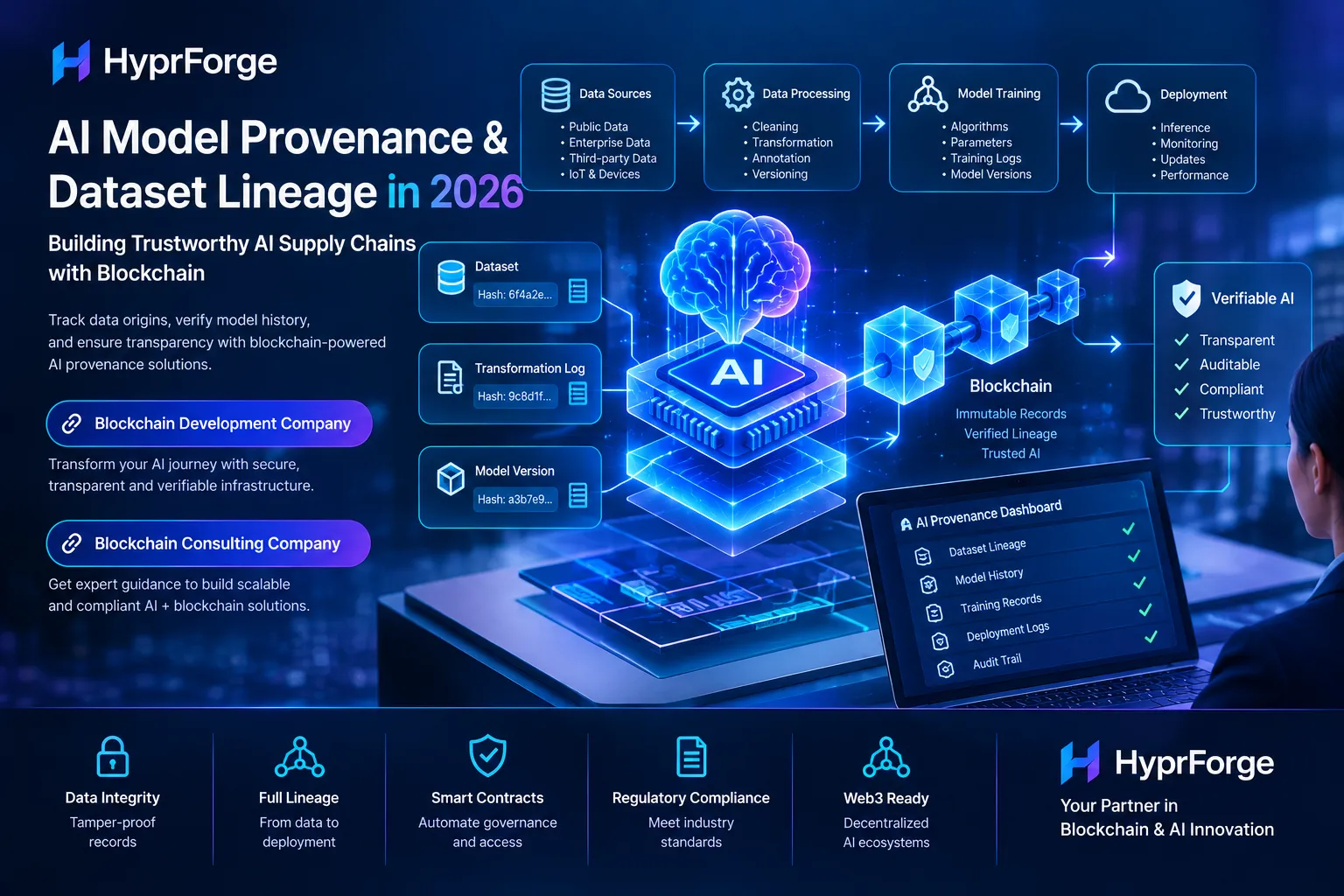

Contracts are becoming increasingly digital, but many organizations still manage their contract lifecycle through fragmented systems, spreadsheets, email approvals, document repositories, and manual reviews.
In 2026, artificial intelligence is changing this model.
AI can analyze agreements, identify obligations, monitor deadlines, summarize clauses, detect potential risks, and assist legal and procurement teams. Blockchain can complement these capabilities by providing verifiable records for document versions, approvals, signatures, transactions, and contractual events.
Together, blockchain and AI are creating an emerging model for autonomous contract lifecycle management.
The objective is not to replace legal professionals. Instead, intelligent systems can automate repetitive contract operations while blockchain provides an additional trust and verification layer.
What Is Autonomous Contract Lifecycle Management?
Contract lifecycle management covers the journey of an agreement from creation to completion.
A typical lifecycle includes:
- Contract drafting
- Review
- Negotiation
- Approval
- Signing
- Execution
- Obligation tracking
- Renewals
- Amendments
- Termination
- Archiving
Traditional processes can involve multiple departments and systems.
An AI-powered platform can automate many of these activities.
For example, an AI agent could identify a renewal deadline, retrieve the relevant contract, summarize the agreement, check internal policies, notify the responsible employee, and prepare the next workflow.
Blockchain can record important events so organizations can later verify the history of the agreement.
Why Blockchain and AI Work Well Together
AI is excellent at processing complex information and automating workflows.
Blockchain is useful for maintaining verifiable records and programmable transactions.
Their roles can therefore be separated:
AI → Understands and automates
Blockchain → Verifies and records
This architecture can be particularly useful when several organizations need to coordinate around a contract.
Instead of relying entirely on one organization's database, authorized participants can reference a shared verification layer.
AI-Powered Contract Analysis
Modern AI systems can process large collections of contracts much faster than traditional manual review.
AI can help identify:
- Important clauses
- Renewal dates
- Payment conditions
- Termination requirements
- Service-level commitments
- Liability provisions
- Missing information
- Potential inconsistencies
- Non-standard terms
A RAG architecture can connect AI systems with approved legal policies, company guidelines, regulatory information, and historical contracts.
This allows an AI assistant to retrieve relevant organizational knowledge before generating an analysis.
Blockchain for Contract Version Control
Contract negotiations often create many versions of the same document.
A small wording change can have major consequences.
Organizations therefore need to know which version was reviewed, approved, and signed.
Blockchain can provide a verifiable record containing:
- Contract identifier
- Version hash
- Timestamp
- Approval event
- Signatory information
- Amendment reference
- Execution status
The complete contract can remain in secure enterprise storage.
The blockchain record can serve as a verification mechanism.
If someone later modifies the document, the resulting hash can be compared against the trusted record.
AI Agents for Contract Operations
AI agents can take contract management beyond document analysis.
An AI contract agent could potentially:
- Monitor active agreements.
- Identify approaching deadlines.
- Retrieve relevant contract clauses.
- Check internal policies.
- Notify responsible teams.
- Prepare renewal recommendations.
- Request human approval.
- Trigger an approved workflow.
- Record the completed event.
This transforms contract management from a passive document repository into an intelligent operational system.
A Blockchain Development Company can help organizations integrate blockchain infrastructure with AI-agent workflows, enterprise systems, and smart contracts.
Smart Contracts and Traditional Contracts
Smart contracts should not automatically replace legal contracts.
Instead, they can complement conventional agreements by automating clearly defined digital conditions.
For example, a commercial agreement might specify that payment is released after a verified delivery event.
A smart contract could execute the corresponding digital transaction when the required conditions are satisfied.
This creates a connection between:
Legal Agreement → Digital Condition → Verification → Automated Execution
A blockchain smart contract development agency can design these programmable components around specific business rules.
Autonomous Contract Negotiation
AI agents may increasingly assist with contract negotiations.
An organization's procurement agent could compare supplier agreements against approved business requirements.
It could identify unusual terms and recommend alternative language.
However, high-impact decisions should remain subject to appropriate human oversight.
The AI can assist with:
- Clause comparison
- Risk identification
- Requirement matching
- Version analysis
- Negotiation preparation
- Approval routing
The final authority can remain with designated business or legal professionals.
Blockchain for Multi-Party Contract Coordination
Contracts often involve multiple organizations.
Consider a supply agreement involving:
Manufacturer → Supplier → Logistics Provider → Distributor
Each organization may have different internal systems.
Blockchain can provide a shared record for selected events, such as:
- Agreement activation
- Delivery confirmation
- Inspection completion
- Payment milestones
- Amendment approval
This can reduce disagreements over the sequence of important events.
A Blockchain Consulting Company can help determine which contractual events benefit from shared blockchain verification and which should remain within existing enterprise systems.
RAG for Contract Intelligence
RAG can significantly improve AI-powered contract management.
An enterprise contract assistant can retrieve information from:
- Internal legal policies
- Contract templates
- Regulatory guidance
- Supplier agreements
- Previous negotiations
- Approved clause libraries
- Corporate procedures
The AI can then use the retrieved information to answer questions or assist with workflows.
For example:
“Does this supplier agreement comply with our current payment policy?”
The system could retrieve the current policy, relevant contract clauses, and approved requirements before generating an answer.
Contract Provenance and AI Governance
AI-generated contract analysis should be traceable.
Organizations may need to determine:
- Which contract version was analyzed?
- Which policies were retrieved?
- Which AI workflow generated the recommendation?
- When was the analysis performed?
- Who approved the resulting action?
Blockchain can record selected provenance metadata while detailed information remains in enterprise systems.
This can strengthen accountability around AI-assisted legal and commercial operations.
Use Cases Across Industries
Procurement
AI can compare supplier contracts, identify deviations, and monitor renewal dates.
Financial Services
Organizations can automate agreement monitoring while maintaining stronger records of important contractual events.
Real Estate
AI can analyze leases and identify critical dates, payment requirements, and renewal conditions.
Technology Companies
AI can monitor software licensing agreements, vendor contracts, and service-level obligations.
Logistics
Smart contracts can connect verified delivery events with contractual payment conditions.
Manufacturing
Contract systems can coordinate suppliers, quality requirements, delivery milestones, and payment events.
Building the Technical Architecture
A modern autonomous contract platform can contain several layers.
Document Layer
Contracts and supporting documents remain within secure enterprise storage.
AI Layer
AI models analyze contracts and assist with decision-making.
RAG Layer
Relevant policies, clauses, and organizational knowledge are retrieved dynamically.
Agent Layer
AI agents execute authorized contract-management workflows.
Blockchain Layer
Selected document hashes, approvals, timestamps, and events are recorded.
Smart Contract Layer
Predefined digital conditions can trigger automated actions.
Enterprise Integration Layer
APIs connect the system with ERP, CRM, procurement, finance, and document-management platforms.
A blockchain developer company can help build integrations between these components.
Web3 and Contract Automation
Web3 infrastructure can expand contract automation beyond conventional enterprise applications.
A Web3 Development Agency can build decentralized applications where participants interact through wallets, smart contracts, and decentralized identity systems.
A Web3 Development Company can also create blockchain-native marketplaces where contractual conditions are executed programmatically.
Cryptocurrency development can support digital payment components where blockchain-based transactions are appropriate.
Supporting Application Development
Blockchain infrastructure is only one component of a complete platform.
A Blockchain Development Agency can build the decentralized components.
A blockchain technology development company can help design scalable blockchain architecture.
A Web Development Agency or Web Development Company can create contract dashboards, approval interfaces, analytics platforms, and administrative portals.
For decentralized financial ecosystems, a Decentralized Exchange Development Company can apply similar contract automation principles to trading and settlement workflows.
A Decentralized Exchange Software Development Company can integrate AI-powered monitoring and smart-contract interactions into exchange applications.
A dex development company can also develop AI-assisted interfaces for decentralized financial agreements and transaction workflows.
Security and Privacy
Contracts can contain highly confidential commercial information.
Therefore, organizations should avoid placing sensitive contract content directly onto public blockchains.
A better architecture can store:
- Contract documents
- Negotiation history
- Sensitive business information
in secure enterprise systems.
Blockchain can store selected:
- Hashes
- Timestamps
- Verification records
- Approval events
- Transaction identifiers
Security should also include strong identity controls, encryption, access management, secure key storage, and smart contract auditing.
Why HyprForge Can Help
HyprForge can help businesses explore the convergence of blockchain, AI agents, RAG, and intelligent contract-management infrastructure.
A practical architecture can connect:
Contract Data + AI Analysis + RAG Knowledge + AI Agents + Blockchain Verification + Smart Contracts
This enables businesses to automate repetitive contract operations without treating blockchain as a replacement for their existing enterprise systems.
The focus should be on using each technology where it creates measurable value.
The Future of Autonomous Contracts
Contract management is likely to become increasingly proactive.
Instead of employees manually checking agreements for upcoming deadlines, AI agents could continuously monitor contracts and initiate appropriate workflows.
An AI system might identify an approaching renewal, analyze current business conditions, compare supplier performance, retrieve the relevant agreement, prepare a recommendation, and request approval.
Blockchain can preserve selected events throughout this process.
This could create a future where contracts become connected digital assets rather than static documents.
Conclusion
Blockchain and AI are opening new possibilities for contract lifecycle management in 2026.
AI can understand agreements, retrieve relevant knowledge, identify obligations, and automate repetitive workflows. RAG can provide access to current enterprise policies and contract knowledge. AI agents can coordinate multi-step processes, while blockchain can provide verifiable records for important contractual events.
Smart contracts can further automate clearly defined digital conditions.
The result is an emerging model of intelligent, traceable, and partially autonomous contract management.
For businesses looking to modernize their contract operations, combining AI-agent development with blockchain infrastructure can create a more efficient foundation for managing agreements from creation through execution, renewal, and completion.
















Sign in to leave a comment.