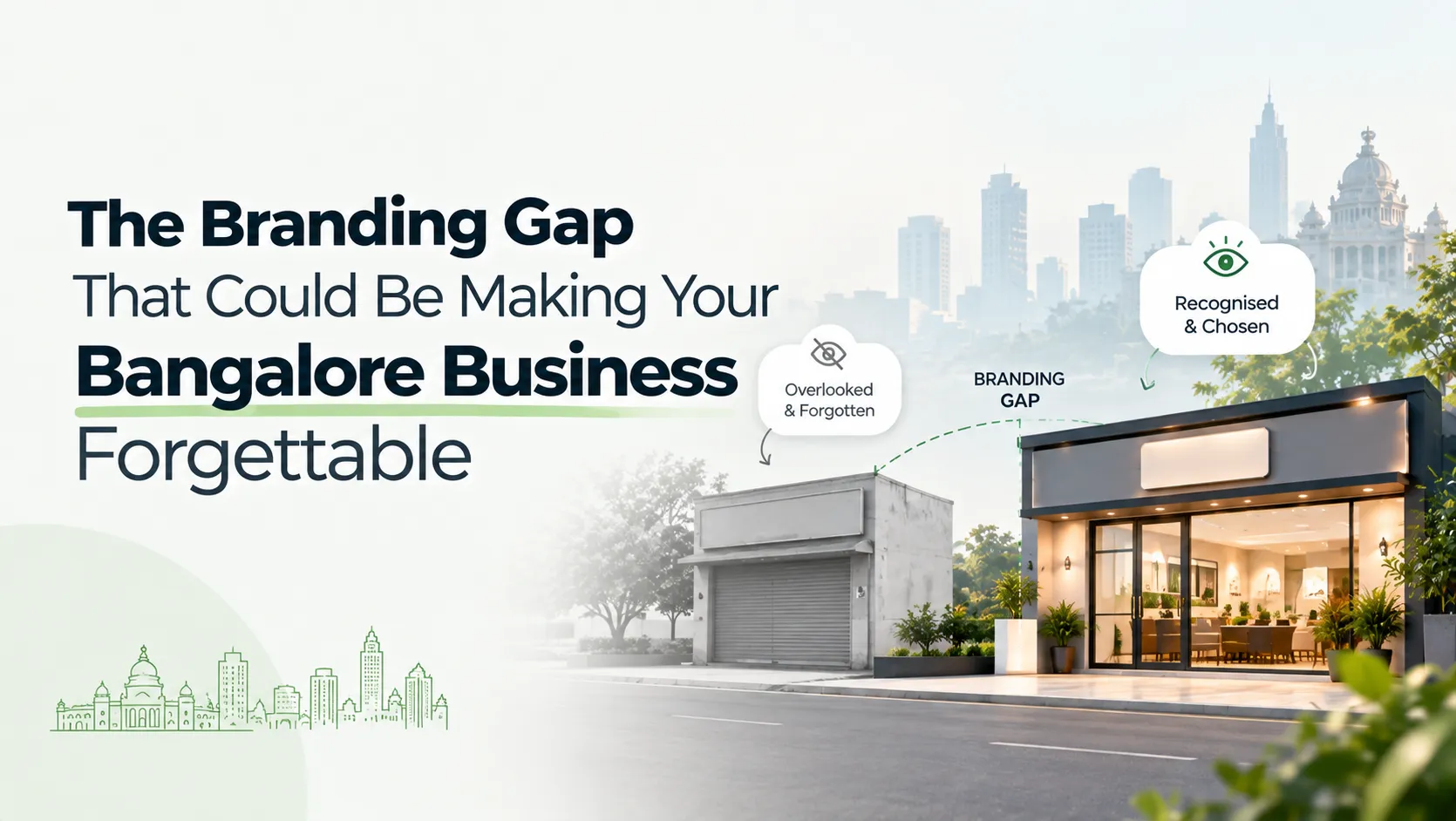

A customer walks out of your store, tries your product, even tells a friend about it over coffee a few days later — and then completely blanks on your name. It happens more than most business owners realize, and it rarely has anything to do with the quality of what you're selling.
Walk through any commercial stretch in Bangalore, from Koramangala's cafes to the tech parks lining Outer Ring Road, and you'll see dozens of businesses doing solid, honest work. Good products, decent service, real effort. And yet, ask ten customers a week later to name three of them, and most will struggle past one or two. That's not a coincidence — it's a pattern.
What separates the businesses people remember from the ones that quietly fade isn't talent or budget. It's usually a gap between how a business sees itself and how customers actually experience it. This piece looks at where that gap comes from, why it tends to hit Bangalore businesses especially hard, and what closing it really involves.
What "Forgettable" Actually Looks Like in Practice
Forgettable branding rarely announces itself. It shows up in small, everyday signals:
- A customer who liked your product but can't recall your name a week later
- Someone who follows your Instagram page but never engages with a single post
- A client who says "you guys did great work" but refers a competitor by mistake
- A website visitor who leaves without remembering what made you different
None of these are dramatic failures. That's exactly why they're dangerous — they pile up quietly until you notice sales have plateaued and you can't quite explain why.
Why Bangalore Businesses Are Especially Vulnerable to This
Bangalore's business environment is unusually crowded and fast-moving, which sounds like an advantage until you realize what it does to attention spans. A few reasons the gap tends to widen here specifically:
- High competitive density — in categories like food, fashion, fitness, and tech services, there are often dozens of local options fighting for the same customer
- Short attention windows — a city that moves this fast doesn't give brands a second chance to make a first impression
- Copy-paste visual identity — many small and mid-sized businesses use similar fonts, similar color palettes, and similar messaging, which makes differentiation harder
- Growth outpacing identity — a business scales revenue and headcount but never revisits its branding to match, so the outside world sees a company that looks smaller than it actually is
A working branding company in Bangalore understands this local context well, because generic branding advice built for a different market often misses exactly what makes Bangalore's customer base tick.
The Real Cost of an Unclear Brand
An unclear brand isn't just an aesthetic issue — it quietly drains revenue in ways that are hard to trace back to their source.
| What Happens | Why It Hurts | What It Costs You |
| Customers can't describe you to others | Word-of-mouth referrals drop | Fewer organic leads |
| Your messaging looks like everyone else's | You compete mainly on price | Thinner margins |
| Visual identity feels inconsistent across platforms | Trust erodes before the first purchase | Lower conversion rates |
| No clear brand story | Customers don't feel emotionally connected | Weaker repeat business |
Here's the uncomfortable part: none of these show up as a single missed sale. They show up as a slow leak — and slow leaks are the hardest problems to fix because nobody feels the urgency until the tank is already low.
Signs Your Brand Has a Gap Worth Closing
Not sure whether this applies to your business? A few honest questions tend to surface the answer fast:
- Do your social media posts, website, and packaging all feel like they belong to the same company?
- Could a new employee explain your brand's core message in one sentence without checking notes?
- When customers describe you, do they use your words — or do they struggle to explain what makes you different?
- Has your visual identity kept pace with how much your business has actually grown?
- Are you still using messaging you wrote in your very first year, even though the business has changed since?
If two or more of these give you pause, there's a real gap worth addressing.
What Effective Branding Actually Involves
Good branding isn't a new logo and a tagline slapped on top of the same business. It's closer to a full alignment exercise between how you see your company and how the market experiences it. The core pieces usually include:
- Brand strategy: A clear answer to who you serve, what you stand for, and why anyone should care — before a single design decision gets made
- Visual identity: Logo, color palette, typography, and imagery that stay consistent across every touchpoint, from packaging to Instagram
- Messaging and tone of voice: Language that sounds like an actual person, not a generic corporate script, and stays consistent whether it's a sales email or a product description
- Brand guidelines: A reference document so every team member, freelancer, and vendor represents the brand the same way
- Ongoing brand management: Periodic reviews to make sure the identity keeps up as the business grows into new markets or categories
Branding teams that specialize in this kind of growth-stage work, such as Geekonomy, tend to approach it as an ongoing partnership rather than a one-time project — because a brand identity that's right for a 20-person team often needs rework by the time that team hits 100.
How a Branding Company in Bangalore Typically Approaches the Fix
For teams considering outside help, a branding team based right here in Bangalore usually follows a fairly consistent path:
- Audit the current brand — reviewing everything from the website to social channels to packaging, and identifying where the story falls apart
- Research the competitive landscape — understanding what similar businesses in the same Bangalore neighborhoods and categories are already doing
- Define the core positioning — pinning down exactly what makes the business different, in language customers would actually use
- Rebuild the visual and verbal identity — updating logo, colors, typography, and tone so everything works together instead of feeling stitched from different eras
- Roll it out consistently — applying the new identity across the website, packaging, social media, and any physical spaces, so customers see one coherent brand everywhere they look
Done properly, this isn't a rebrand for the sake of looking modern — it's about making sure the business is remembered accurately, and remembered at all.
Where to Start If This Sounds Familiar
If any part of this feels familiar, the fix doesn't have to start with a full rebrand. A few practical starting points that tend to move the needle fast:
- Write down your brand in one sentence — if your own team can't agree on it, customers definitely can't
- Audit every touchpoint against each other — website, packaging, social, signage — and note anywhere the tone or visuals feel inconsistent
- Ask five recent customers to describe you unprompted — their exact words often reveal the gap faster than any internal meeting
- Fix the biggest inconsistency first — not everything needs to change at once, but the most visible mismatch usually deserves priority
These steps won't fully close the gap on their own, but they'll show you exactly how wide it is and that's usually the push a business needs to take branding seriously instead of treating it as a someday project.
Frequently Asked Questions
1. How do I know if my business actually needs rebranding, or just a small refresh?
If your core offering and audience haven't changed much, a refresh of visuals and messaging is often enough. A full rebrand makes sense when the business itself has outgrown its original identity.
2. How long does a typical branding project take?
Depending on scope, a full brand strategy and identity project usually takes anywhere from 6 to 12 weeks, while smaller refreshes can move faster.
3. Is branding really worth the investment for a small or early-stage business?
Yes — early clarity is often cheaper to build than fixing confusion later, once inconsistent messaging has already spread across multiple platforms and touchpoints.
4. What's the difference between branding and marketing?
Branding defines who you are and how you're perceived; marketing is how you communicate that to the world. Marketing without strong branding tends to feel inconsistent and forgettable.
5. How do I choose the right branding company in Bangalore for my business?
Look for a team that asks about your business strategy before jumping to design, and review past work to see if they've handled businesses of a similar size and category to yours.
Being forgettable isn't a talent problem — it's a clarity problem, and it's fixable. Businesses across Bangalore that take the time to close their branding gap tend to see the difference show up in ways that are hard to fake: customers remembering their name, referring to them correctly, and choosing them without hesitation. That kind of recall doesn't happen by accident; it's built, deliberately, one consistent touchpoint at a time. Explore More to see what that process could look like for your business.
























Sign in to leave a comment.