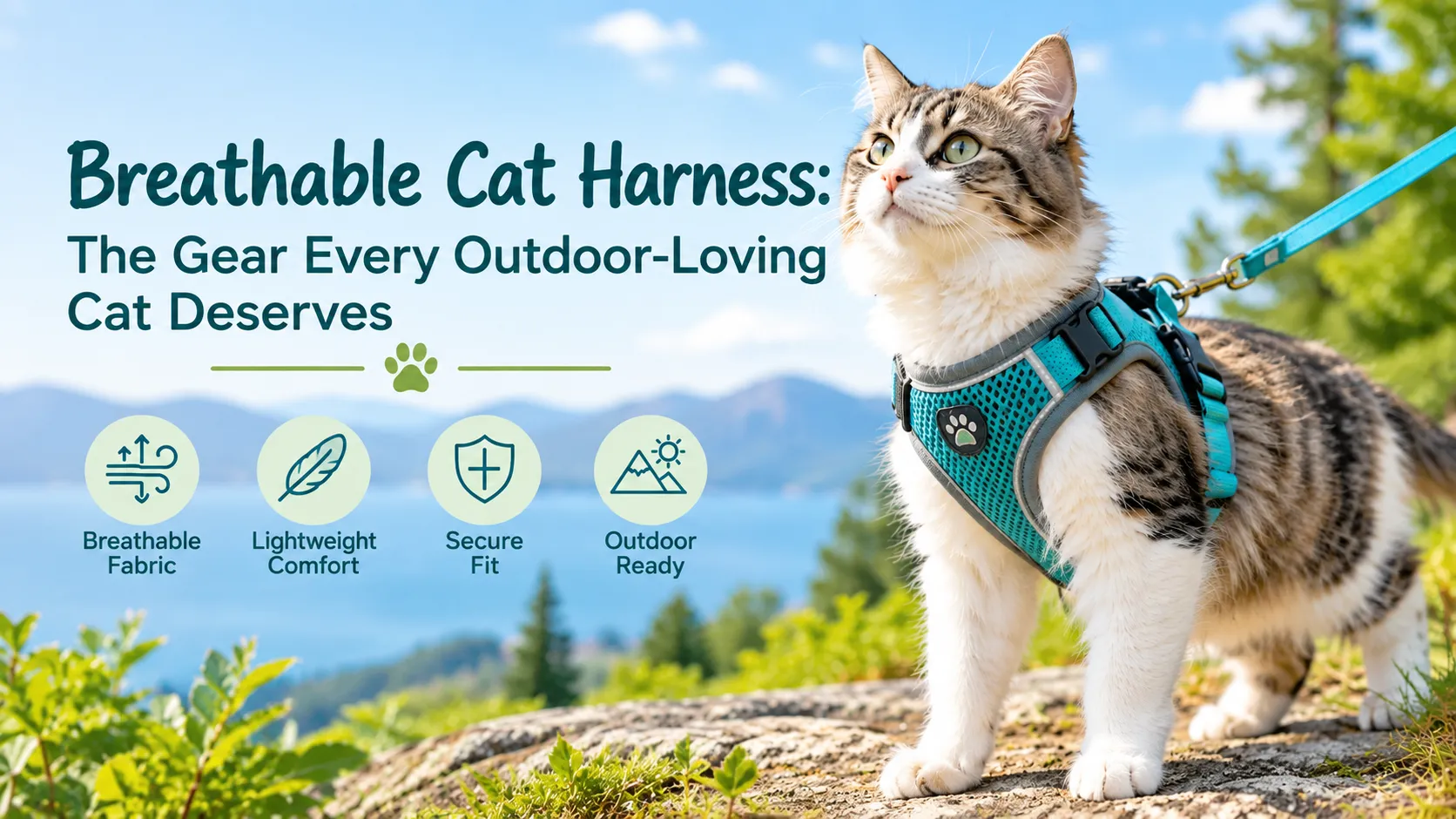

Cats do not cool themselves the way we do. They have sweat glands only in their paw pads, so almost all of their heat management happens through panting and through the air moving across their skin and coat. That single fact explains why a breathable cat harness is not a luxury upgrade but the baseline requirement for any cat who spends time outside on a leash. Wrap a cat in thick neoprene on a warm afternoon and you have essentially put them in a wetsuit.

If you are shopping for your first adventure kitty harness, or replacing one your cat has already wriggled out of twice, here is what actually matters.
Why Breathability Changes Everything ?
Heat stress in cats builds quietly. There is no dramatic moment where your cat tells you they are overheating. Instead you see slowing down, flattened ears, heavy panting, and a sudden refusal to walk. By the time those signs appear, body temperature has already climbed.
A breathable cat harness helps in three ways. Air passes through the fabric instead of trapping warm, humid air against the coat. Moisture from the skin evaporates rather than sitting there. And the lighter material simply weighs less, so your cat burns less energy carrying it around.
There is a second benefit people rarely mention. Cats with thick undercoats, such as Maine Coons and Ragdolls, tend to mat under any padded strap. Mesh panels reduce the friction and the trapped humidity that cause matting in the first place.
What to Look For in a Cat Adventure Harness
Not all mesh is equal. Cheap single-layer mesh tears at the stitching and offers almost no structure, which is exactly how escapes happen. A quality cat adventure harness usually has these features:
Air mesh or spacer fabric. Look for a three-dimensional knit rather than flat screen-door mesh. Spacer fabric holds a gap between the two surfaces, so air circulates even where the harness contacts the body.
Vest style, not string style. The old figure-eight designs concentrate pressure on the throat and shoulders. A vest spreads load across the chest and back, which is safer if your cat bolts. It also gives a cleaner surface for reflective trim.
Two adjustment points minimum. One at the neck, one at the girth. Three is better. Cats are shaped like liquid and they exploit every millimetre of slack.
A back-mounted D-ring with reinforced stitching. Front-clip designs work for dogs. For cats, back attachment keeps the leash out from under their legs.
Light colours for hot climates. A dark breathable cat harness still absorbs sun. If you walk in strong midday light, pale grey or sand beats black.
Machine-washable fabric. Outdoor cats find mud, sap and things you would rather not identify.
Weight matters too. Anything over about 120 grams starts to feel like a burden on a five-kilogram cat. The best adventure cat harness options usually land well under 100 grams while still holding their shape.
Getting the Fit Right
Fit is where most owners go wrong, and it undermines even the best breathable cat harness on the market.
Measure the girth just behind the front legs, at the widest part of the ribcage. Measure the neck low, near the base where the harness will actually sit, not up near the jaw. Then check those numbers against the manufacturer's chart rather than guessing from your cat's weight. Two cats at the same weight can differ by four centimetres in girth.
The two-finger rule applies, with a caveat. You should be able to slide two fingers flat under any strap, but no more than that. If you can pull the strap away from the body far enough to see daylight underneath, your cat can back out of it. Escape almost always happens in reverse, with the cat pulling backward and downward while you are holding the leash forward.
Check the fit again after ten minutes of movement. Straps settle. What felt snug in the living room can be loose by the end of the driveway.
Training: The Part Nobody Wants to Hear
Cats need a slow introduction. Plan on two to three weeks, not two to three days.
Start by leaving the harness on the floor near the food bowl for several days so it stops being a foreign object. Then drape it over your cat's back without fastening anything, for maybe ten seconds, followed by a treat. Fasten it loosely for a minute indoors. Build up from there.
The flop is normal. Many cats lie down flat and refuse to move the first time a harness is fastened. Do not pull the leash. Distract with a toy or a treat and let them walk out of it on their own terms. Most cats stop flopping within a week.
Only after your cat walks comfortably indoors should you open the door. A breathable cat harness worn calmly indoors is worth more than an expensive one your cat fights every time.
Cat Harness Hiking: Taking It Outside
Trail walking is where a well-ventilated design earns its price. Cat harness hiking involves more sustained effort than a garden stroll, often on exposed ground with reflected heat from rock and dirt.
Go early or late. Midday trail surfaces can exceed 50°C, which burns paw pads regardless of what your cat is wearing. Carry water and a collapsible bowl. Bring a backpack carrier so your cat has somewhere to retreat when they have had enough, because they will decide that abruptly.
Keep the leash short on narrow paths. A breathable cat harness with reflective stitching is genuinely useful if you are out near dusk.
Watch the tail. A low, twitching tail combined with a crouched posture means your cat is overwhelmed, and it is time to pick them up.
Cat Travel Harness Use: Cars, Vets and Airports
A cat travel harness serves a different purpose. Here you are not managing exertion, you are managing confined spaces and stress.
Cars get hot fast, and stressed cats pant. Ventilated fabric matters even more inside a carrier than it does outdoors. Keep the harness on during vet visits so there is always something to hold if the carrier door opens unexpectedly. Many clinics now recommend this.
For flights, check your airline's rules. Most require the cat to stay in the carrier, but you will need to remove them at security screening, and a harness attached to a leash prevents a genuinely terrible moment in an airport concourse.
Common Mistakes Worth Avoiding
Buying a small dog harness. The proportions are wrong and cats slip out of them routinely.
Leaving the harness on unsupervised. Cats snag straps on furniture and door handles.
Skipping the measuring tape and ordering by weight category.
Using a retractable leash. The sudden stop at the end of the line can injure a cat's neck and shoulders.
Assuming one season's gear works year-round. A summer-weight adventure kitty harness may be too thin for a cold, windy autumn walk.
Choosing Well
The best adventure cat harness is the one your particular cat tolerates, fitted correctly, matched to your climate. Brand names matter less than mesh quality, adjustability and honest sizing.
Start with a well-made breathable cat harness, invest the three weeks in training, and pay attention to what your cat's body language tells you. Do that and the outdoors becomes something you share rather than something they watch through a window.
Ready to Take Your Cat Outside?
Your cat is already watching the door. The only thing standing between them and their first proper adventure is the right piece of gear and a couple of weeks of patient training.
Pick a breathable cat harness that fits your cat's actual measurements, not a guess. Get the mesh quality right, get the girth strap snug, and start indoors today. By the time the weather is perfect, your cat will be ready for it.
Grab your measuring tape, check your cat's neck and girth, and find a harness that matches. Then tell us where you take them first we love seeing the trail photos.
Not sure which size you need? Send us your cat's measurements and we'll help you narrow it down before you buy.
Frequently Asked Questions
At what age can I start harness training a cat?
Kittens from around 10 to 12 weeks adapt fastest, because they have not yet formed strong opinions about wearable objects. That said, adult and senior cats learn too. An eight-year-old indoor cat can absolutely be trained; it just takes more repetitions and more patience. There is no upper age limit as long as the cat is healthy and mobile.
How do I stop my cat escaping the harness?
Almost all escapes happen in reverse. The cat pulls backward, drops their shoulders, and slides out through the neck opening. The fix is a snug girth strap behind the front legs and a vest-style design rather than a thin strap harness. Use the two-finger rule at every adjustment point and re-check the fit after ten minutes of walking, since straps loosen as the cat moves.
Is a breathable cat harness warm enough for winter walks?
On its own, usually not. Mesh is designed to release heat, which is the opposite of what you want at 2°C. For cold weather, either switch to a lined harness or layer a lightweight cat jacket over the harness. Shorthaired and hairless breeds need this sooner than longhaired cats do.
How long should the first outdoor walk be?
Five minutes is plenty. Many cats spend that entire time sitting still and sniffing, which is a completely successful first outing. Build up in small increments and let your cat set the distance. Pushing for a long walk early on is the fastest way to create a cat who hides when the harness comes out.
Can I attach a leash to a cat's collar instead?
No. A collar concentrates all force on the neck and throat, which risks injury to the trachea and cervical spine if your cat bolts. Collars are for ID tags only. Always use a properly fitted harness with a back-mounted D-ring for leash attachment.
How do I know if my cat is overheating on a walk?
Watch for heavy panting, drooling, bright red gums, flattened ears, staggering, or a sudden refusal to keep moving. If you see any of these, move to shade immediately, offer water, and cool the paw pads and belly with a damp cloth. Persistent symptoms need a vet the same day.
Should my outdoor cat be vaccinated and parasite-protected?
Yes. Leashed outdoor time still exposes your cat to fleas, ticks, and infectious disease from wildlife and other animals. Talk to your vet about a preventative schedule before your first outing, and check your cat for ticks after every walk in grass or woodland.
Can two cats walk on harnesses together?
It is possible but genuinely difficult. Cats do not pace themselves the way dogs do, and two leashes tangle fast. Train each cat separately first, and only try walking together once both are confident solo.
How do I wash the harness?
Most mesh harnesses are machine washable in a laundry bag on a cold, gentle cycle. Skip fabric softener, which coats the fibres and reduces breathability. Air dry only tumble drying warps the plastic buckles and shrinks the webbing.
My cat just lies down and refuses to move. Is the harness wrong?
Probably not. The flop is one of the most common reactions and it usually passes within a week or two. Check the fit is not too tight, then simply wait it out with treats and a favourite toy nearby. Never drag your cat by the leash that turns a temporary phase into a lasting fear.
























Sign in to leave a comment.