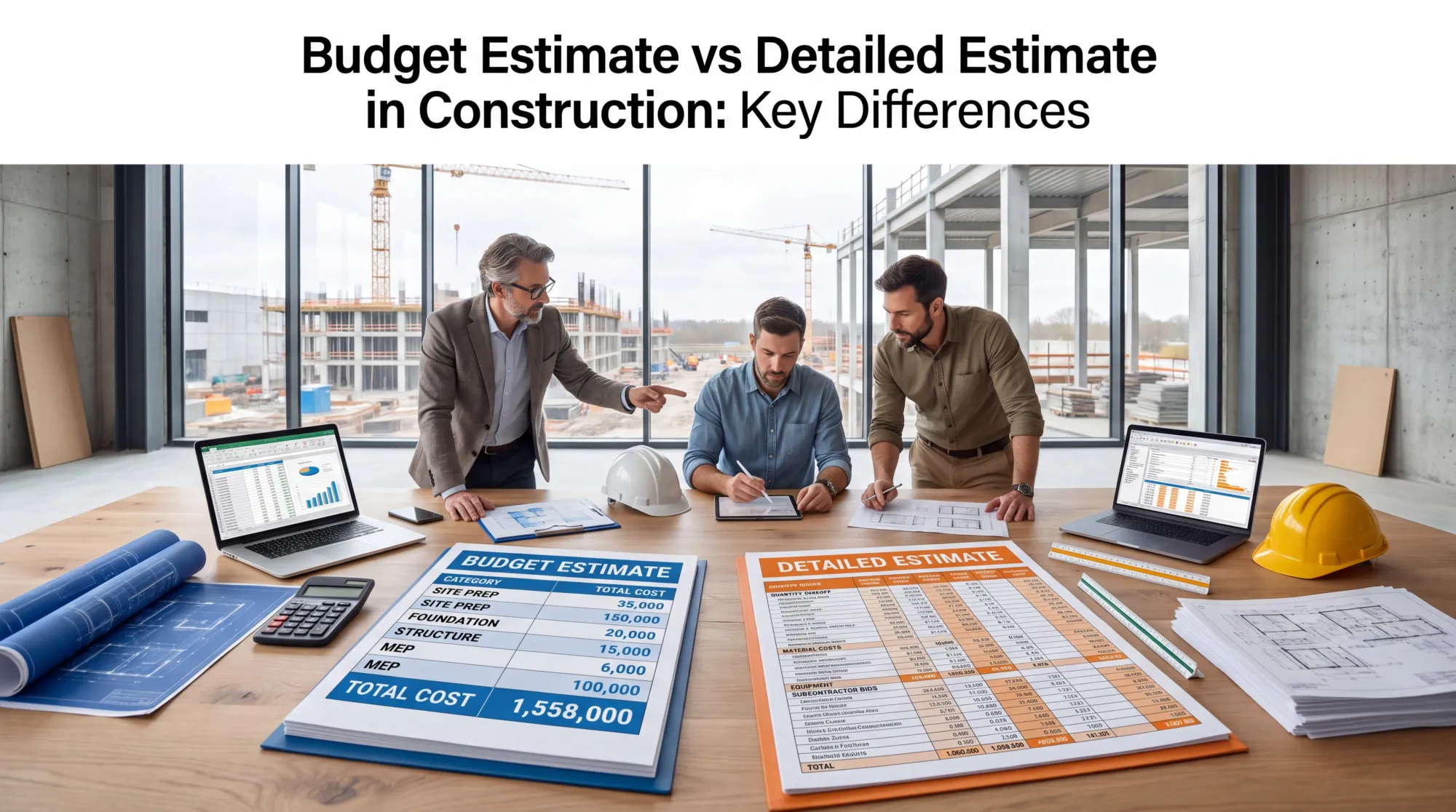

A construction project can have several estimates before work begins, and those estimates do not all serve the same purpose. Two of the most important are the budget estimate and the detailed estimate.
Both are used to understand project cost, but they are prepared at different levels of project definition and support different decisions.
A budget estimate is generally useful when the project team needs to understand the likely financial scale of a project, establish a target budget, or evaluate whether a developing concept is financially practical. A detailed estimate goes further by breaking the project into measurable quantities, materials, labor, equipment, subcontractor costs, and other applicable expenses.
The difference is therefore not simply the number of line items.
It is about how much is known, how the cost is developed, and what decision the estimate is expected to support.
The Real Difference Is the Level of Cost Detail
The simplest way to distinguish the two is to look at how the project is represented.
A budget estimate answers a question such as:
“What should we expect this project to cost?”
A detailed estimate moves toward:
“How does the project cost add up?”
A budget estimate may use broad cost categories, historical information, assemblies, allowances, or cost factors.
A detailed estimate can use:
- Measured quantities
- Unit costs
- Labor hours
- Material pricing
- Equipment
- Subcontractor quotations
- General conditions
- Project-specific requirements
This does not mean that a budget estimate is unimportant or that a detailed estimate is automatically better.
Each one has a different job.
What Is a Budget Estimate?
A budget estimate is an early or intermediate cost projection used to establish, test, or monitor a project's financial target.
The available information might include:
- Project type
- Approximate building area
- Location
- Preliminary design
- Construction quality
- Intended use
- Major building systems
- Site requirements
The estimator develops a cost model using the information that is currently available.
For example, a preliminary commercial building may have an approximate area of 60,000 square feet while its detailed design is still being developed.
The project team could use an appropriate cost factor or other estimating methodology to establish an initial construction budget.
The result provides a financial reference point while design decisions are still evolving.
What Is a Detailed Construction Estimate?
A detailed estimate breaks the project into substantially more specific components.
Depending on the project stage, it can include:
- Quantity takeoffs
- Material costs
- Labor hours
- Labor rates
- Equipment
- Subcontractor pricing
- Supplier quotations
- General conditions
- Indirect costs
- Allowances
- Assumptions
- Exclusions
For example, instead of simply stating:
Flooring — $250,000
a detailed estimate may separate:
- Carpet
- Ceramic tile
- Resilient flooring
- Adhesives
- Underlayment
- Base
- Installation labor
The contractor can then see how the flooring cost was developed.
Budget Estimate vs Detailed Estimate at a Glance
| Factor | Budget Estimate | Detailed Estimate |
| Main purpose | Establish or test a budget | Develop project-specific cost |
| Project stage | Early or developing | More developed design or bidding |
| Quantity detail | Broad | Detailed |
| Pricing | Factors, historical data, preliminary pricing | Unit costs, quotes, labor and material pricing |
| Assumptions | Usually more numerous | Generally more defined |
| Scope definition | Developing | More clearly defined |
| Time required | Usually less | Usually more |
| Best use | Planning and budget decisions | Bidding, detailed review and cost control |
The terminology used by estimating teams can vary, but the underlying distinction remains useful.
When a Budget Estimate Makes More Sense
A budget estimate is useful when the project team needs cost information before every component has been designed.
This can happen during:
- Project feasibility
- Early development
- Concept design
- Schematic design
- Initial funding discussions
- Property evaluation
- Early design comparisons
For example, a developer may be considering a 100-unit multifamily project.
At that point, the final apartment layouts, finishes, mechanical systems, and site details may not be completely defined.
Waiting for final drawings before considering cost would delay an important financial decision.
A budget estimate can provide an early cost framework.
When a Detailed Estimate Becomes Necessary
A detailed estimate becomes more useful as project information becomes more complete.
It can be appropriate when:
- Construction documents are developed
- Major materials are specified
- Quantities can be measured
- Trade scopes are defined
- Subcontractor pricing is available
- The project is approaching bidding
At this stage, the estimator can move away from broad assumptions and toward measurable project-specific costs.
This allows the contractor to examine individual cost drivers rather than relying primarily on broad project-level factors.
The Information Behind Each Estimate Is Different
The quality of an estimate depends heavily on the information available when it is prepared.
A budget estimate may be based on:
- Approximate square footage
- Historical project costs
- Preliminary building systems
- Broad material assumptions
- Preliminary site information
A detailed estimate may be based on:
- Current drawings
- Specifications
- Schedules
- Detailed quantities
- Supplier quotations
- Subcontractor proposals
- Labor assumptions
- Equipment requirements
The estimator should therefore document the information used for each version.
This makes it easier to explain why the estimate changes as the project develops.
More Detail Does Not Automatically Mean Better Estimating
It can be tempting to assume that adding more line items will always make an estimate better.
That is not necessarily the case.
The U.S. Government Accountability Office's Cost Estimating and Assessment Guide explains that the level of detail should correspond with the available technical information and intended use of the estimate. It also notes that pursuing excessive detail too early can be counterproductive when the underlying project information is not sufficiently developed.
This principle is highly relevant to construction.
If the design only shows a preliminary building concept, creating hundreds of detailed line items may give the appearance of precision without having enough information to support those numbers.
A well-structured budget estimate can therefore be more appropriate than an artificial detailed estimate at an early stage.
How the Budget Estimate Can Develop Over Time
A project may move through several cost versions.
For example:
Initial budget
↓
Updated budget
↓
Design development estimate
↓
Pre-bid estimate
↓
Detailed bid estimate
The project does not necessarily need to be completely re-estimated from scratch every time.
Previous information can be retained and updated as new information becomes available.
For example, an early allowance for mechanical systems may later be replaced by:
- Equipment quantities
- Ductwork
- Piping
- Controls
- Insulation
- Labor
- Current supplier pricing
The estimate becomes more detailed because the project itself has become more defined.
How Quantities Change the Estimate
Quantity takeoff is one of the biggest differences between broad budgeting and detailed estimating.
Consider a flooring scope.
A budget estimate might use:
20,000 SF × preliminary flooring cost factor
A detailed estimate could divide the same project into:
| Flooring Type | Quantity | Unit |
| Carpet | 8,000 | SF |
| Ceramic Tile | 5,000 | SF |
| Vinyl | 4,000 | SF |
| Wood Flooring | 3,000 | SF |
The detailed version allows the estimator to apply different material and installation costs to each scope.
This can produce a more useful cost picture because the estimate reflects the actual developing design.
Labor Becomes More Specific in a Detailed Estimate
Labor is another area where detail can increase.
A budget estimate may contain a broad labor allowance or labor component.
A detailed estimate can consider:
- Quantity
- Productivity
- Crew composition
- Labor hours
- Labor rate
- Installation conditions
For example:
10,000 SF × 0.08 labor hours/SF = 800 labor hours
The estimator can then apply the relevant labor rate.
The exact productivity assumption depends on the work, conditions, and estimating methodology.
The important difference is that the detailed estimate makes the basis of the labor cost more visible.
Material Pricing Can Move From Allowances to Specific Costs
Early estimates may use allowances because product selections have not been finalized.
Later, the estimator may have:
- Product specifications
- Manufacturer information
- Supplier quotations
- Current material prices
- Delivery requirements
This allows the estimate to move toward more specific costs.
For example:
Early stage:
Flooring allowance — $X/SF
Later stage:
Specified flooring product + adhesive + underlayment + installation + applicable accessories
The change does not necessarily mean the original budget was wrong.
It may simply mean that the project has become more clearly defined.
Subcontractor Quotes Add Another Layer of Detail
Near the bidding stage, subcontractor quotations can become important.
A detailed estimate may incorporate pricing from:
- Electrical contractors
- Plumbing contractors
- HVAC contractors
- Roofing contractors
- Concrete contractors
- Masonry contractors
- Fire protection contractors
- Sitework contractors
However, the estimator should compare each quotation with the project's actual scope.
A quote should be reviewed for:
- Included work
- Exclusions
- Alternates
- Materials
- Labor
- Equipment
- Delivery
- Schedule requirements
This prevents a low quotation from being accepted without understanding whether its scope is complete.
Budget Estimates Are Useful for Design Decisions
One of the strongest uses of a budget estimate is evaluating design choices before the project reaches the bidding stage.
Suppose a project team is considering two exterior systems.
The initial comparison might show:
Option A — lower preliminary cost
Option B — higher preliminary cost
The team can then investigate the implications of each option.
Cost is only one consideration. Performance, durability, maintenance, appearance, schedule, and availability may also influence the final selection.
The estimate provides financial information that helps the team evaluate those alternatives.
Detailed Estimates Support Bid Preparation
When the project reaches the bidding stage, the contractor needs much more than a broad budget.
The estimator may need to know:
- Exact quantities
- Material specifications
- Labor requirements
- Equipment needs
- Subcontractor costs
- Supplier pricing
- General conditions
- Project requirements
- Alternates
- Allowances
This is where a detailed estimate becomes particularly valuable.
The contractor can use the cost breakdown to develop the final proposal while considering company overhead, profit, risk, bonding, insurance, schedule, and contractual requirements.
The Two Estimates Can Produce Different Totals
A common question is:
Why does the detailed estimate not match the original budget?
There can be many legitimate reasons.
Scope Changed
The building became larger or additional work was added.
Design Became More Specific
The project selected higher-cost materials or systems.
Quantities Changed
Detailed drawings revealed different quantities.
Market Pricing Changed
Material or labor costs changed between estimate dates.
Site Information Improved
New information revealed additional site requirements.
Allowances Were Replaced
Preliminary allowances were replaced by specific costs.
Schedule Changed
A different construction schedule affected labor, equipment, or project-level costs.
A difference between two estimates should therefore be investigated rather than automatically treated as an estimating error.
Example: How a Project Budget Can Evolve
Consider a hypothetical commercial project.
Early Budget
The project team establishes a preliminary construction budget of:
$8 million
At this stage, the design is still developing.
Design Development
The building footprint increases and the mechanical system becomes more sophisticated.
The updated estimate becomes:
$8.7 million
Detailed Estimate
The construction documents now provide specific quantities and material specifications.
The detailed estimate becomes:
$9.1 million
The $1.1 million difference from the original budget does not automatically mean the estimator made a mistake.
The project itself changed.
The important question is:
What caused the difference?
A properly documented estimate history can answer that question.
What Should Be Included in a Budget Estimate?
A useful budget estimate can include:
- Project description
- Project location
- Approximate size
- Major construction categories
- Preliminary cost assumptions
- Building systems
- Site allowances
- General conditions
- Indirect costs
- Contingency where appropriate
- Exclusions
- Estimate date
- Basis of estimate
The exact structure depends on the project's stage and purpose.
The document should clearly communicate what is known and what remains uncertain.
What Should Be Included in a Detailed Estimate?
A detailed estimate may contain:
- Detailed quantity takeoffs
- Material quantities
- Material unit costs
- Labor hours
- Labor rates
- Equipment
- Subcontractor quotations
- Supplier quotations
- General conditions
- Indirect costs
- Allowances
- Alternates
- Assumptions
- Exclusions
- Markups where applicable
- Final cost summaries
The additional information makes the estimate easier to audit and revise.
Choosing Between Budget and Detailed Estimating
The decision should start with the purpose of the estimate.
Choose a Budget Approach When:
- The project is still being defined
- Major design decisions are unresolved
- The owner needs an early financial target
- Feasibility is being evaluated
- Multiple design options are being considered
Move Toward Detailed Estimating When:
- Drawings are substantially developed
- Specifications are available
- Quantities can be measured
- Trade scopes are defined
- Current pricing is available
- The project is approaching bidding
The transition should happen as project information becomes sufficient to support greater
detail.
Where Budget Estimating Services Fit
Professional budget estimating services can be useful when an owner, developer, builder, or contractor needs structured cost information before the project reaches final construction documents.
Support can include:
- Preliminary cost models
- Building-level budgets
- Trade-level budget development
- Cost comparisons
- Design-stage updates
- Allowance development
- Budget reconciliation
The objective is to provide useful cost information without creating unnecessary detail that the available project information cannot support.
As the project develops, the estimating approach can then move toward detailed quantity takeoffs and bid-level pricing.
A Practical Workflow From Budget to Bid
A project can use the following progression:
1. Establish the Initial Budget
Use available project information to create the first cost framework.
2. Identify Major Cost Drivers
Determine which building systems or project requirements have the greatest influence on cost.
3. Update During Design
Revise the budget when important design decisions change.
4. Develop Detailed Quantities
Once drawings are sufficiently developed, measure the project scope.
5. Collect Current Pricing
Use appropriate material, labor, supplier, and subcontractor information.
6. Review the Detailed Estimate
Check scope, quantities, pricing, assumptions, and exclusions.
7. Prepare for the Bid
Use the detailed estimate as a cost foundation for the contractor's proposal.
This approach allows the level of estimating effort to grow with the project.
Common Mistakes When Comparing Budget and Detailed Estimates
Treating the Original Budget as Fixed
An early budget is based on the information available at that time.
Comparing Different Scopes
Two estimates should not be compared without confirming that they cover the same work.
Ignoring Estimate Dates
Market conditions can change between estimate versions.
Removing All Allowances Too Early
Some project components may genuinely remain undefined.
Creating Excessive Detail Too Early
Detail without reliable underlying information can create unnecessary work without improving the estimate.
Failing to Explain Changes
Each major difference between estimate versions should have a reason.
Frequently Asked Questions
What is the difference between a budget estimate and a detailed estimate?
A budget estimate provides an early or intermediate view of expected project cost, while a detailed estimate breaks the project into more specific quantities, materials, labor, equipment, subcontractor costs, and other applicable expenses.
Is a detailed estimate always more accurate?
Not necessarily. The usefulness of an estimate depends on the quality of its underlying information, methodology, assumptions, and review. More detail does not automatically improve an estimate when the project itself is still poorly defined.
When should a budget estimate become a detailed estimate?
The transition should occur as project drawings, specifications, quantities, systems, and scope become sufficiently developed to support detailed measurement and pricing.
Why does a detailed estimate cost more to prepare?
It generally requires more document review, quantity takeoff, pricing research, labor analysis, subcontractor coordination, quality control, and documentation.
Can a budget estimate be used for bidding?
A budget estimate may help establish the expected project cost, but a competitive bid generally requires a level of scope and pricing detail appropriate to the project's bidding requirements.
Why can the detailed estimate be higher than the original budget?
Design changes, scope growth, material selections, quantity changes, updated market pricing, site conditions, and other project developments can increase the projected cost.
Should allowances be included in a budget estimate?
They can be appropriate when certain project elements are not yet defined, provided the allowance and its basis are clearly identified.
What information is needed for a detailed estimate?
The requirements vary by project, but detailed drawings, specifications, schedules, scope information, quantities, pricing data, subcontractor quotations, and project conditions are commonly important.
Need Help Moving From Budget to Detailed Pricing?
A project does not have to jump directly from an early concept to a final bid.
All State Estimation provides budget estimating services and detailed estimating support for contractors, builders, developers, and other construction professionals across the USA.
Our estimating support can include:
- Preliminary cost estimates
- Budget development
- Quantity takeoffs
- Material estimating
- Labor estimating
- Trade-specific estimating
- Detailed construction estimates
- Bid estimates
- Estimate revisions
Whether your project is still being designed or is approaching the bidding stage, the estimating approach should match the information available.
Have a project budget that needs to be developed or refined? Upload your plans and project information to All State Estimation and get professional cost estimating support built around your project's current stage.
Final Thoughts
The difference between a budget estimate and a detailed estimate is primarily about purpose, project definition, level of detail, and the decision being supported.
A budget estimate can provide an early financial framework when the project is still evolving. It can help owners, developers, architects, and contractors evaluate feasibility, compare design options, and establish a target cost.
A detailed estimate goes further. It connects the developing project to measurable quantities, material and labor costs, equipment, subcontractor pricing, and other project-specific expenses.
The two should not be treated as competing versions of the same document.
They are stages within a broader estimating process.
As project information improves, the estimate can move from broad cost planning toward detailed pricing. The strongest approach is to use the right level of estimating detail for the information available and the decision that needs to be made.
























Sign in to leave a comment.