

I still remember the feeling of standing in Akihabara, staring at shelves full of parts and wondering which ones actually mattered. The flashy boxes shouted about RGB, “extreme” cooling, and premium branding, but the truth was much simpler: a budget gaming PC lives or dies on balance. Not hype. Not marketing. Balance! That lesson matters even more in 2026, when prices have stabilized in some categories, crept up in others, and the difference between a smart build and a wasteful one can easily be several hundred dollars.
A budget gaming PC is no longer a sad compromise. With the right choices, it can handle competitive esports titles at very high frame rates and many modern AAA games at 1080p high settings or 1440p with carefully tuned presets. That is why the budget segment remains so exciting. According to Steam’s long-running hardware survey, 1080p is still the dominant gaming resolution among PC users, which means the mainstream target has not disappeared. Most players do not need halo-tier hardware. They need stable performance, fast storage, enough memory, and a graphics card that matches the monitor they already own.
Across the market, media outlets keep arriving at the same conclusion from different angles. BGR’s look at sub-$1,000 gaming PCs argues that a capable build is still realistic if buyers resist overspending on secondary parts. Meanwhile, Geeky Gadgets’ budget 1440p experiment shows how aggressively prices can be pushed when expectations are clear and component pairing is disciplined. That aligns with what many builders in Japan, Europe, and North America are seeing on the ground: the sweet spot is not dead, but it punishes bad decisions faster than ever.
This guide is for players who want maximum value, not maximum bragging rights. If your goal is smooth gameplay, reasonable upgrade paths, and no money burned on parts that add little real-world performance, you are in the right place. High tension! Let’s enjoy the process properly.
Set the budget first, then define the mission
The biggest mistake in a budget build is treating “budget” as a vague feeling. It needs a number. Before comparing CPUs or GPUs, decide whether your ceiling is roughly $500, $700, $900, or £1,000-equivalent in your region. Those brackets produce very different machines. A $500 build often leans on used parts, integrated graphics, or a low-end discrete GPU. Around $700, you can begin building a genuinely strong 1080p machine. Near $900 to $1,000, 1440p becomes realistic if the graphics card is chosen carefully.
That mission matters because component priorities change with the target. If you mainly play Valorant, Counter-Strike 2, Fortnite, Apex Legends, or League of Legends, your system should favor consistent CPU performance and a monitor-friendly frame rate. If you spend weekends inside Cyberpunk 2077, Black Myth: Wukong, or large open-world RPGs, the GPU becomes the star. Builders who ignore this usually overspend on the wrong side of the equation and then wonder why the results feel underwhelming.
A practical way to think about it is to choose one of three profiles:
- Entry budget: 1080p medium to high settings, esports first, strict cost control.
- Mainstream value: 1080p high or ultra in many games, strong esports frame rates, occasional 1440p.
- Upper-budget sweet spot: 1440p-focused, better longevity, room for heavier single-player games.
Once the profile is set, every purchase becomes easier. You stop chasing the “best” part and start chasing the right part. That mindset is reflected in WriteUpCafe’s Budget Gaming PC Build Guide: What You Really Need to Know, which correctly emphasizes matching parts to use case rather than buying prestige. I would go even further: every dollar that does not improve frame rate, frame-time consistency, thermals, or future compatibility should be questioned.
A budget build succeeds when every component supports the same performance target. The moment one part is chosen for ego instead of need, the whole system becomes less efficient.
There is also a regional reality. In Tokyo, I often see first-time builders copy a U.S. parts list and then panic because local pricing changes the whole equation. The lesson is universal: budget building is not about one perfect shopping list. It is about priorities that survive price fluctuations.
Where your money should go: the performance hierarchy
If you ask experienced builders where the money should go, most will give the same core answer: graphics card first, then processor, then memory and storage, then motherboard and case, with the power supply protected from reckless cutting. That order is not glamorous, but it is usually correct. For gaming, the GPU still determines the ceiling more than any other part, especially once you move beyond lightweight competitive titles.
A useful budget split for many mainstream systems looks like this:
- GPU: roughly 35% to 45% of the total budget
- CPU: around 15% to 20%
- Motherboard: around 10% to 15%
- RAM: around 8% to 12%
- Storage: around 8% to 12%
- PSU and case: the rest, with the PSU never treated as an afterthought
That does not mean every build should follow the same percentages exactly. It means the shape of the budget should make sense. If someone spends more on the motherboard, AIO cooler, and decorative fans than on the graphics card, the machine may look amazing on social media but it will not be a strong value gaming system.
Recent budget-focused coverage shows this pattern clearly. Manchester Evening News highlighted sub-£1,000 part combinations that keep the graphics card central instead of allowing accessories to consume the budget. The same principle appears in assembly-focused pieces like MSN’s practical budget build review, where trade-offs in the case and extras are more acceptable than compromises that cripple gaming performance.
The processor question has become more nuanced in 2026. Midrange CPUs are very capable, and many six-core chips remain excellent for budget gaming. Eight cores are nice for heavier multitasking, streaming, or future comfort, but they are not mandatory for a value-first gaming machine. The trap is buying too much CPU and too little GPU. I see this often with players who fear “bottlenecks” because internet discussions make it sound catastrophic. In reality, every system has a limiting factor somewhere. On a gaming PC, you usually want that limit to be the GPU. That is normal.
Memory is another area where the market has matured. For a new budget build, 16GB is still the sensible floor, while 32GB is becoming more attractive if the price gap is small and your game library includes newer, heavier titles. Storage should almost always begin with an SSD, ideally NVMe if pricing is close. A slow hard drive as the main game drive makes even a decent system feel old.
Spend for frames first, responsiveness second, aesthetics last. That order keeps a budget PC honest.
The parts that matter most in 2026
What has changed recently is not just raw performance. It is the shape of value. By late 2026, buyers are working in a market where upscaling technologies, frame generation features, VRAM concerns, and uneven regional pricing all affect what “budget” means. A cheap card with too little memory may look attractive on day one, but it can age badly in modern AAA games with large texture pools. At the same time, an older used card with enough VRAM can still be a smart buy if it is priced correctly and paired with realistic expectations.
For the CPU, the budget sweet spot usually remains in the six-core range from recent AMD Ryzen 5 and Intel Core i5 families, depending on local pricing and motherboard costs. The platform matters as much as the chip itself. A processor that looks cheap can become expensive if it requires a pricier board or memory kit. Builders should compare total platform cost, not just the CPU sticker price. That is a point also reinforced by Build a Gaming PC on a Budget: Your 2026 Guide, which sensibly frames the motherboard and socket as long-term value decisions rather than background details.
For graphics, buyers need discipline. Budget builders should ask four questions before purchasing:
- What resolution am I actually playing at most of the time?
- How much VRAM does this card have, and how does that affect newer games?
- Does this card rely heavily on upscaling to stay relevant?
- What is the used-market alternative at the same price?
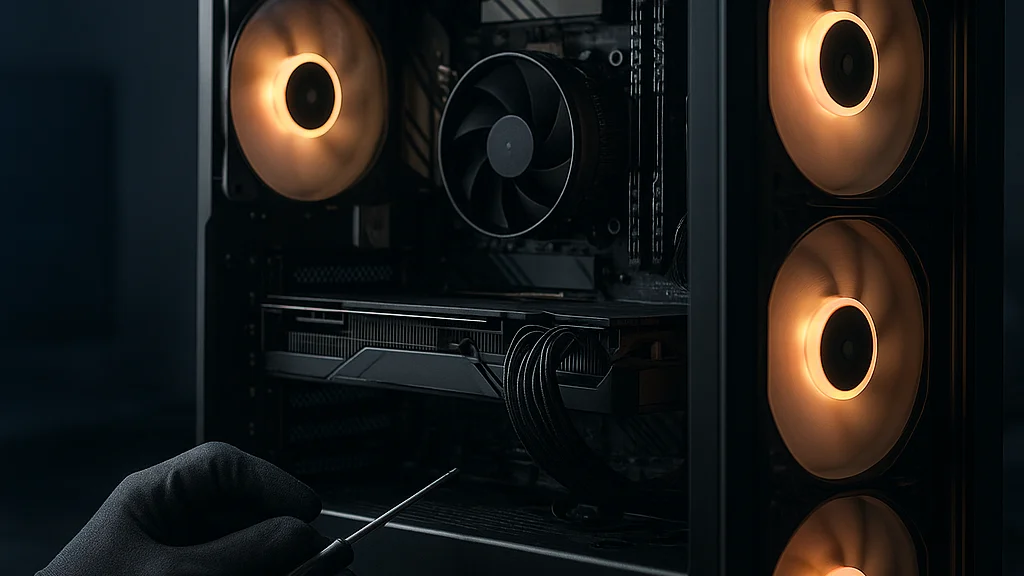
Cooling and case airflow deserve more respect than they usually get. You do not need a luxury chassis, but you do need a case that can move air. A cheap case with a mesh front and included fans is often better than a prettier closed-front case that traps heat. Thermal throttling destroys value because you paid for performance that the system cannot sustain.
The power supply is where budget builders must stay calm and avoid false economy. A reputable unit with enough headroom, modern protections, and decent efficiency is not optional. If a PSU fails badly, it can take other parts with it. Saving a small amount here is like bringing a paper umbrella into a typhoon. Please do not do it.
Storage has become simpler. A 1TB SSD is a strong starting point for many gamers because modern titles are large and patch sizes keep growing. If the budget is very tight, 500GB can work, but it becomes annoying quickly once you install a few major games. Fast load times are not just a luxury anymore; they shape the whole user experience.
How to build a balanced budget system at different price points
The cleanest way to approach a budget gaming PC is to think in tiers rather than exact universal parts lists, because prices move too often for static recommendations to age gracefully. Still, the logic behind each tier remains stable, and that is what builders should master.
Tier one: around $500 to $650. This is the survival zone for new builders. The goal is not max settings; it is competent 1080p gaming. You may need to buy a used GPU, choose a modest six-core CPU, and avoid cosmetic spending entirely. Cases should be functional, motherboards basic but reliable, and RAM should be 16GB if possible. This tier is excellent for esports and older AAA games, but heavy modern releases may require medium settings and intelligent upscaling use.
Tier two: around $700 to $850. This is where budget building starts to feel joyful. 1080p high settings become realistic across a broad range of games, and some 1440p play enters the conversation. This is the tier I recommend most often because it avoids the harshest compromises while staying far below premium territory. If I were helping a friend in Tokyo set up a first serious gaming rig after TGS excitement, this is the bracket I would target first.
Tier three: around $900 to $1,000. Here, the machine can be built around a genuinely strong mainstream GPU, a capable modern CPU, 16GB or 32GB of RAM depending on pricing, and a 1TB SSD without feeling squeezed. This is also the range most likely to remain satisfying for several years if the builder chooses a decent platform and power supply.
Some practical rules apply across all tiers:
- Use the stock CPU cooler if it is competent and the budget is tight.
- Skip RGB until the performance foundation is complete.
- Prefer one better GPU over several “premium” supporting parts.
- Check motherboard BIOS compatibility before purchase.
- Reserve a little money for extra fans or a better PSU if needed.
If you want a companion read focused on avoiding waste, Budget Gaming PC Build Guide for High FPS Without Waste pairs well with this strategy. Its central idea is exactly right: stronger frame rates often come from subtraction, not addition. Remove unnecessary spending, and the build gets better.
One more point from the field: monitor pairing changes everything. A budget PC connected to a 1080p 144Hz display can feel phenomenal in competitive games. The same PC pushed into unrealistic 1440p ultra expectations can feel disappointing. Performance is not only about the tower. It is also about choosing a target that suits the hardware.
Common budget-building mistakes that quietly ruin value
The most painful mistakes in budget building are rarely dramatic. They are small choices that stack up. A motherboard that is too expensive. A tiny SSD that forces constant uninstalling. A weak power supply. A fancy case with poor airflow. None of these sounds fatal in isolation, but together they can turn a good budget into a frustrating machine.
The first common mistake is overbuying the CPU. Many first-time builders spend heavily on a processor because benchmark charts and forum arguments make it feel “safe.” Then they end up with a weaker graphics card than they should have bought. In actual gameplay, especially above 1080p, that trade often hurts more than it helps. The second mistake is underestimating memory and storage. Games have become heavier, background applications are always present, and modern operating systems are not gentle with tiny drives.
The third mistake is treating used parts as either automatically dangerous or automatically brilliant. The truth is more nuanced. A used GPU can be a fantastic value if the seller is transparent, the card is tested, and the price reflects age and risk. A used power supply, by contrast, is much harder to recommend unless the source is extremely trustworthy. Risk should be evaluated part by part.
Another trap is ignoring the total system cost. Windows licensing, extra fans, Wi-Fi, a better CPU cooler, shipping, and taxes can all stretch the final bill. Budget builders should leave some breathing room. A parts list that barely fits on paper can become impossible at checkout.
This is where experience-focused resources are useful. Common Mistakes in a Budget Gaming PC Build Guide usefully outlines several pitfalls that hit first-time builders hard, especially around compatibility and spending priorities. I would add one more from personal observation: impatience. Buying the first acceptable part instead of waiting a week for a better deal can distort the whole build. Budget PC building rewards calm shopping more than almost any other consumer tech hobby.
And please, do not chase internet approval. A clean, quiet, affordable machine that runs your games beautifully is more satisfying than a flashy rig that empties your wallet and still stutters in the titles you care about.
What the market is saying in 2026
The 2026 budget PC conversation is shaped by three big realities. First, mainstream gamers are still overwhelmingly performance-per-dollar focused. Second, modern games are becoming more demanding in memory, storage, and VRAM behavior. Third, the used market remains a major force, especially when new GPU pricing becomes awkward.
Recent coverage reflects that tension. The Daily Illini’s sponsored overview of budget setups emphasizes avoiding overspending on prestige parts while maintaining enough headroom for current games, a theme echoed across enthusiast communities. BGR’s reporting similarly argues that sub-$1,000 builds remain viable, but only if buyers are strategic about where compromise happens. That is the key word: strategic. Random compromise creates a weak system. Strategic compromise creates a smart one.
Another 2026 development is the growing importance of platform longevity. Builders are asking not just, “What runs games now?” but also, “What can I upgrade in two years without replacing half the PC?” That question affects CPU socket choice, motherboard quality, PSU wattage, and case size. Even on a budget, upgrade path planning can save money later.
There is also more awareness now around frame generation and upscaling. These tools can be genuinely useful, especially on budget hardware, but they should support a good baseline, not excuse a bad purchase. If a card only feels acceptable because every demanding game needs aggressive assistance, that should factor into your value calculation.
In esports circles, the story remains bright. Games designed to scale well still allow affordable systems to shine. For players focused on Valorant, Rocket League, Dota 2, Street Fighter 6, or similar titles, a disciplined budget build can feel far more premium than its price suggests. That is one reason the entry and midrange market remains lively. Not everyone is chasing cinematic ultra presets. Many players just want speed, responsiveness, and no nonsense.
The smartest path forward for first-time builders
If you are building your first budget gaming PC now, the smartest move is to think like an editor, not a collector. Cut what does not serve the story. Keep what makes the experience stronger. Start with the resolution and games you actually play. Build around a GPU that suits that target. Choose a CPU that keeps up without hijacking the budget. Add 16GB or more of RAM, a 1TB SSD if possible, a sensible motherboard, and a power supply you can trust. Then stop. That is the heart of a good budget machine.
For many readers, the best build is not the cheapest one. It is the one that avoids replacement regret. Spending slightly more for a better GPU tier, a larger SSD, or a stronger PSU can be wise if it prevents a near-term upgrade. The trick is to distinguish between meaningful spending and decorative spending. Performance, thermals, storage comfort, and reliability are meaningful. Excess lighting, oversized coolers for low-power chips, and premium branding at the expense of the graphics card usually are not.
If you are unsure where to compromise, use this quick decision order:
- Protect the GPU budget first.
- Do not buy a poor-quality PSU.
- Keep at least 16GB of RAM.
- Use an SSD as the main drive.
- Trim aesthetics before trimming performance.
That formula sounds simple because it is simple. Budget building should not feel mystical. It should feel deliberate. There is real joy in turning a modest pile of parts into a machine that runs your favorite games smoothly. The first clean boot, the first benchmark, the first match with frame rates higher than your old system could dream of—it never gets old! I still feel that spark every time.
The final takeaway is clear. A budget gaming PC in 2026 is absolutely worth building if you approach it with discipline. Ignore the noise. Follow the performance hierarchy. Respect airflow and power quality. Match the machine to your games and monitor. Do that, and you will not just save money. You will build a system that feels smart, personal, and ready for many late-night sessions. That is the good stuff. Let’s enjoy!
























Sign in to leave a comment.