Building a Complete Power Protection Plan: Where a 50 kVA Three Phase Servo Stabilizer Fits Alongside Surge Protection, UPS and Earthing


A stabilizer is a powerful piece of protection, but it is not the only one. Power problems come in many forms: sustained sags and swells, imbalance, fast transients, outages and poor earthing. No single device solves all of them. The most reliable facilities build layers of protection, with each layer handling the problem it is best suited to. This guide explains how those layers work together and where a 50kVA Three Phase Stabilizer sits in the overall plan.
The Problem: Five Different Power Threats
Before choosing equipment, it helps to separate the threats.
| Threat | What it looks like | Typical duration |
|---|---|---|
| Sustained under-voltage or over-voltage | Supply stays low or high for minutes to hours | Long |
| Voltage imbalance | Phases differ from each other | Long |
| Sags and swells | Brief dips or rises, often from motor starting | Milliseconds to seconds |
| Transients and surges | Sharp spikes from lightning or switching | Microseconds |
| Outages | Complete loss of supply | Seconds to hours |
Each threat needs a different tool. Using a stabilizer to fight outages, or a UPS to fix chronic low voltage, wastes money and leaves gaps.
Layer 1: Good Earthing and Wiring
Every protection device depends on a sound foundation. Poor earthing makes surge protection less effective, makes stabilizer protections unreliable and creates safety hazards.
Basics to get right
- A low-resistance earth electrode, tested and recorded regularly
- Proper equipotential bonding of cabinets, trays and structures
- Correct neutral and earth separation in the distribution system
- Adequately sized cables with tight, clean terminations
- Balanced loading across the three phases wherever possible
Many persistent power quality complaints are traced not to the grid but to loose connections and weak earthing inside the facility. Fix these first.
Layer 2: Surge Protection
Surge protective devices handle very fast transients, which a stabilizer cannot respond to quickly enough. They divert surge energy to earth before it reaches sensitive equipment.
Where to fit them
- At the main incomer to protect the whole installation
- At distribution boards feeding sensitive loads
- Close to critical equipment, such as controllers and servers
This layer is especially valuable in lightning-prone areas and on overhead supply lines. Surge protection and stabilization are complementary: the surge device deals with the spike, and the stabilizer deals with the sustained voltage level.
Layer 3: Voltage Stabilization
This is where the servo stabilizer does its job. It addresses long-duration under-voltage, over-voltage and imbalance, the most common power problems for Indian industry and commerce.
A servo stabilizer monitors the output, and a servo motor adjusts a variable transformer to bring voltage back to the set value. A buck-boost transformer adds or removes the correction voltage. The result is smooth, stepless regulation that suits motors, compressors and electronics.
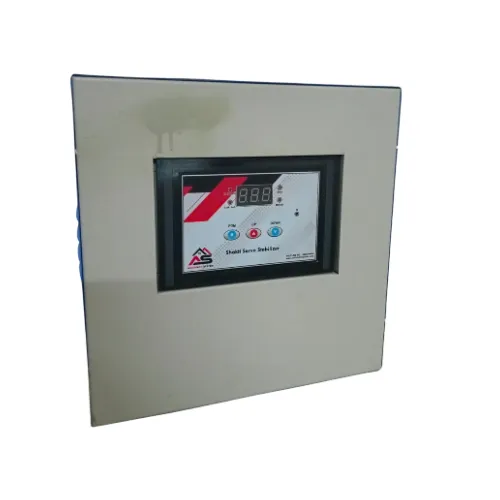
A 50kVA Three Phase Air Cooled Servo Stabilizer is a good fit for this layer in medium-capacity three phase installations, covering a plant section, a commercial floor or a group of critical machines.
What it handles well
- Seasonal and daily voltage swings
- Chronic low voltage at the end of long feeders
- Over-voltage during light-load periods
- Phase-to-phase imbalance (with independent phase correction)
- Protection against single phasing and phase reversal
What it does not handle
- Complete outages
- Extremely fast surges and spikes
- Harmonic distortion
- Poor power factor
Knowing these limits is what lets you complement it with the right devices.
Layer 4: Uninterruptible Power Supply (UPS)
A UPS supplies power from batteries when the mains fails and conditions the supply during the transfer. It is essential for loads that cannot tolerate even a brief interruption.
Where it is used
- Servers, network equipment and data storage
- Process controllers and safety systems
- Diagnostic and monitoring equipment
- Emergency lighting and communication
A UPS is usually sized for the critical load only, not the whole plant, because of battery cost. Feeding the UPS from a stabilized supply is a sound practice, since it reduces how often the UPS must switch to battery on low or high voltage, which in turn extends battery life.
Layer 5: Backup Generation
For longer outages, a generator takes over from the UPS. Generator output can itself be uneven, particularly when large loads switch on. A stabilizer downstream of a generator can help smooth voltage during load changes, provided the generator and stabilizer are properly coordinated in rating and start-up sequence.
Layer 6: Power Factor Correction and Harmonic Control
Poor power factor raises current for the same useful power, increasing losses and loading on cables and transformers. Capacitor banks and active filters address this and the harmonics produced by drives and electronic loads.
When planning a stabilizer, remember that power factor affects kVA demand. A load of 40 kW at a power factor of 0.8 requires 50 kVA, but improving the power factor to 0.95 reduces the required kVA to about 42. Better power factor can therefore give more headroom on your stabilizer and the rest of the electrical system.
How the Layers Work Together
A simple way to picture the arrangement is to follow the power from the grid to the machine:
- Utility supply enters the premises
- Incomer protection and surge protective device catch transients
- Stabilizer corrects sustained voltage level and imbalance
- Distribution boards with proper earthing and protective devices
- Power factor correction where needed
- UPS for critical loads that cannot tolerate interruption
- Equipment runs on clean, stable power
If a generator is present, it connects ahead of the stabilizer through a changeover arrangement, so the stabilizer conditions both mains and generator power.
Deciding What You Actually Need
Not every facility needs every layer. Use these questions to prioritize.
Is the voltage level unreliable?
If measurements show frequent deviations beyond plus or minus 10 percent, a stabilizer is the first priority.
Do you suffer from lightning or switching surges?
If so, add surge protection at the incomer and critical boards.
Can any loads not tolerate an interruption?
If yes, add a UPS for those loads.
Are outages long or frequent?
Consider a generator and a proper changeover scheme.
Is power factor low or are harmonics high?
Review correction equipment and consult a power quality specialist.
Is earthing poor or untested?
Fix this before anything else.
Example: A Mid-Sized Workshop
Consider a workshop with CNC machines, a compressor, welding sets and an office block, supplied through a long overhead feeder.
- Earthing: Test and improve the earth electrode, bond all machine frames
- Surge protection: Install a device at the incomer and at the CNC panel
- Stabilizer: Place a 50 Kva 3 Phase Air Cooled Servo Stabilizer on the production section to correct the feeder’s voltage swings
- UPS: Protect the office computers and the CNC controllers’ auxiliary supply
- Power factor correction: Fit a capacitor bank to reduce reactive demand
- Maintenance: Establish a calendar for inspection, testing and logging
Together these measures cover sags, swells, surges, short interruptions and efficiency, giving much better protection than any single device.
Sizing the Stabilizer Within the Plan
When the stabilizer is one layer among several, sizing still follows the same disciplined steps:
- List connected loads and convert to kVA using the power factor
- Allow for starting currents of the largest motors
- Decide which loads sit behind the stabilizer and which do not
- Add a margin of about 20 to 25 percent
- Confirm that the input range covers your measured extremes
- Check phase balance and redistribute if necessary
A correctly sized 3 Phase Stabilizer 50 Kva sits comfortably inside this plan and avoids operating at its limit.
Budgeting for Protection
When buyers begin planning, one of the first questions is Servo Stabilizer 50 Kva Price Three Phase. The answer depends on the specification: input range, output accuracy, winding material, protections and customization. Treat the stabilizer as one line in a protection budget alongside surge devices, earthing work, UPS capacity and power factor correction. Prioritize by the risk each addresses and the cost of the equipment it protects. A modest spend on the right layers often prevents losses many times larger.
Maintenance Across the Layers
Protection only works if it is maintained.
| Layer | Routine check |
|---|---|
| Earthing | Measure resistance annually, inspect connections |
| Surge protection | Check status indicators, replace after major events |
| Stabilizer | Clean vents, inspect brushes and winding track, test protections |
| UPS | Test batteries, review runtime, clean and inspect |
| Generator | Run on load periodically, service on schedule |
| Power factor equipment | Inspect capacitors, check contactors and controllers |
Keep a single log covering all layers so patterns and recurring problems stand out.
Common Mistakes in Protection Planning
- Expecting one device to do everything. Each device has a specific job.
- Ignoring earthing. It undermines every other protection.
- Undersizing the stabilizer. Running at the limit increases wear and risk.
- Forgetting starting currents. The running load does not tell the whole story.
- Skipping maintenance. Surge devices wear out and batteries age.
- Not logging data. Without records, problems repeat unnoticed.
- Choosing on price alone. Component quality and service matter over the long term.
Frequently Asked Questions
Do I need both a stabilizer and a UPS?
Often yes. The stabilizer corrects voltage level and imbalance, while the UPS covers outages for critical loads. Using both reduces battery wear and improves reliability.
Will a stabilizer stop lightning damage?
No. Lightning and fast transients need surge protective devices and proper earthing. The stabilizer handles sustained voltage problems.
Can I put the stabilizer before or after the UPS?
Commonly it is placed ahead of the UPS so the UPS receives conditioned input, but the right arrangement depends on your system, so ask the manufacturer for advice.
Does a stabilizer help with a generator supply?
It can smooth voltage variations from a generator, provided the units are properly rated and coordinated.
How do I begin a protection plan?
Start by logging your supply, testing earthing and listing critical loads. These steps show where the biggest risks lie.
Conclusion
Reliable power is built in layers: sound earthing, surge protection, voltage stabilization, backup power and efficient power factor. The stabilizer is the layer that deals with the most common everyday problem, sustained voltage deviation and imbalance. A well-specified 50kVA Three Phase Air Cooled Servo Stabilizer gives that layer a dependable foundation, and when combined with the other layers it creates protection that keeps your operation running through whatever the grid delivers.
To review specifications, discuss customization or request a quotation, visit the 50kVA Three Phase Stabilizer page at Shakti Servo.






Sign in to leave a comment.