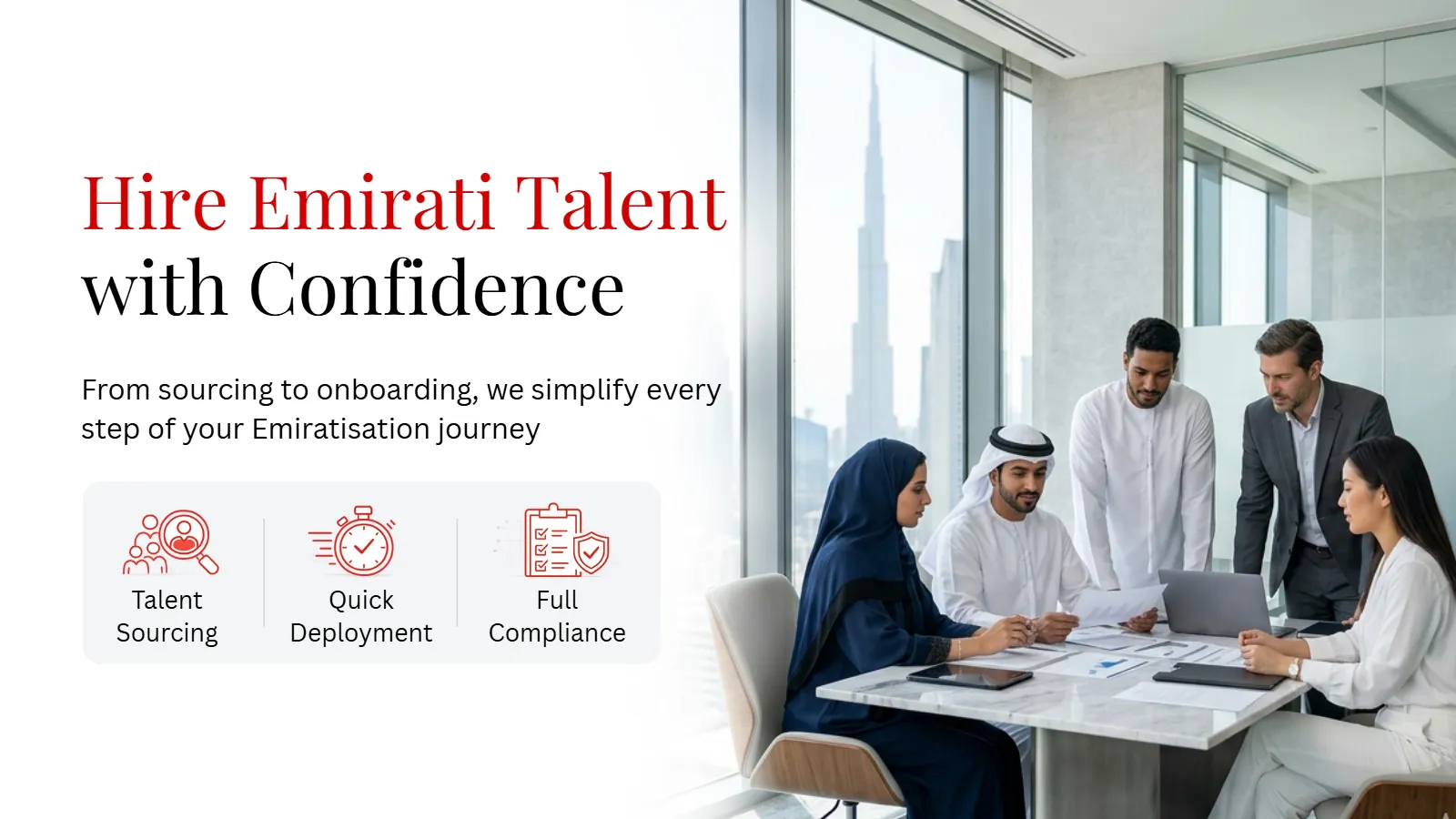

Emiratisation in the UAE has entered a new phase.
For private sector employers, hiring UAE Nationals is increasingly becoming part of long term workforce planning rather than a separate recruitment exercise.
The conversation is changing from how many Emirati professionals a company needs to hire to a much more important question.
How can businesses attract, develop, and retain Emirati talent in roles where they can build meaningful careers and contribute to long term growth
That shift matters.
As Emiratisation targets continue to shape private sector hiring in 2026, employers need a recruitment strategy that brings together compliance, talent quality, skills development, career progression, and retention.
This is making Emirati talent hiring in UAE an important part of workforce strategy for organizations across Dubai, Abu Dhabi, and the wider Emirates.
Emiratisation Is Becoming a Long Term Workforce Strategy
The UAE has spent years strengthening the participation of its citizens in the private sector.
Today, Emiratisation is closely connected to the country's broader economic ambitions.
The objective is not simply to create more jobs for UAE Nationals. It is to build a skilled national workforce capable of contributing across industries that are shaping the future of the economy.
Technology, financial services, healthcare, energy, engineering, manufacturing, professional services, logistics, tourism, and other sectors all present opportunities for Emirati professionals.
For employers, this means Emirati hiring in UAE should not be treated as a short term response to regulatory requirements.
It should become part of workforce planning.
Companies need to identify where Emirati talent can contribute today, which capabilities will become important tomorrow, and how career paths can be created around those opportunities.
Why 2026 Is Important for Private Sector Employers
The Emiratisation framework has progressively increased expectations for private sector organizations.
For larger employers, 2026 represents an important stage in this progression, with Emiratisation requirements reaching a significant milestone for skilled positions.
This makes workforce planning increasingly important.
Waiting until the end of a compliance period to begin recruitment can create unnecessary pressure.
Companies may find themselves competing for the same candidates, rushing interviews, or focusing more on completing a hire than finding someone who genuinely fits the role.
A better approach is to build Emirati recruitment into the annual workforce plan.
Employers can forecast upcoming positions, identify suitable career paths, develop candidate pipelines, and engage potential talent before a vacancy becomes urgent.
This turns Emiratisation recruitment from reactive hiring into strategic talent acquisition.
The Real Challenge Is Finding the Right Match
There is an important difference between filling a position and making a successful hire.
This becomes especially relevant in Emirati recruitment.
A candidate may meet the basic qualifications for a position but still need the right environment, career path, manager, and development opportunities to succeed.
Similarly, an employer may have a suitable vacancy but struggle to communicate why the role represents a meaningful career opportunity.
Effective Emirati recruitment services in UAE should help bridge this gap.
Recruiters need to understand both sides.
They need to know what the organization actually requires and what Emirati professionals expect from their careers.
When these expectations align, businesses have a better chance of achieving not only successful hiring but also stronger retention.
Skills Based Hiring Can Expand Emirati Talent Pipelines
The UAE labor market is becoming increasingly focused on skills.
Technology and artificial intelligence are changing job responsibilities across industries, while new professions are emerging in areas such as data, cybersecurity, digital transformation, advanced technology, sustainability, and automation.
This creates an opportunity to rethink how Emirati candidates are evaluated.
Employers should look beyond job titles and years of experience.
Practical capabilities, education, transferable skills, communication, adaptability, digital literacy, and learning potential can all provide a more complete picture of a candidate.
This is particularly important when recruiting early career Emirati professionals.
A candidate may not have years of industry experience but may possess the technical foundation and learning ability required to grow into a valuable employee.
Skills based Emirati hiring in UAE can therefore help organizations build broader talent pipelines instead of competing repeatedly for a narrow group of experienced candidates.
Young Emirati Talent Needs Visible Career Opportunities
Recruitment is only the beginning.
For Emiratisation to create sustainable results, UAE Nationals need to see where a position can take them.
A job description explains what someone will do today.
A career path explains what they could become tomorrow.
This distinction can have a major influence on attraction and retention.
Employers should think about progression from the beginning of the recruitment process.
What skills will the employee develop
What additional responsibilities could they take on
What training is available
Could the employee eventually move into specialist or leadership positions
Who will support their development
Clear answers to these questions can make an opportunity much more compelling.
This is especially important for businesses competing for talented Emirati graduates and early career professionals.
Retention Matters as Much as Recruitment
A successful Emiratisation strategy cannot be measured only by the number of UAE Nationals hired.
Retention matters.
When an employee leaves shortly after joining, the company loses recruitment time, onboarding investment, institutional knowledge, and momentum.
Repeated hiring also makes workforce planning more difficult.
Employers therefore need to understand why Emirati professionals stay.
Competitive compensation is part of the equation, but it is rarely the entire answer.
Meaningful responsibilities, career progression, supportive leadership, learning opportunities, workplace culture, recognition, and a clear sense of contribution can all influence retention.
Companies that invest in these areas can build a more sustainable Emirati workforce.
Emiratisation Should Not Mean Creating Artificial Roles
One of the most important principles behind sustainable Emirati talent hiring is authenticity.
A position should exist because the organization genuinely needs someone to perform meaningful work.
Creating roles simply to satisfy a numerical target does little for the employee or the business.
UAE Nationals should have real responsibilities, measurable objectives, appropriate compensation, and opportunities to develop.
This benefits everyone.
Employees gain meaningful professional experience.
Managers gain team members who contribute to business outcomes.
Organizations build a stronger pipeline of national talent.
Emiratisation becomes part of business performance rather than an administrative exercise.
Technology Is Creating New Opportunities for Emirati Professionals
The UAE is investing heavily in technology driven economic development.
Artificial intelligence, data, cybersecurity, cloud technology, digital services, automation, fintech, advanced manufacturing, and smart infrastructure are influencing workforce demand.
These areas also create new opportunities for Emirati professionals.
Businesses should consider how Emiratisation can support future skill requirements rather than focusing only on traditional roles.
For example, organizations may develop Emirati talent pipelines around data analysis, information security, digital operations, technology project management, financial technology, engineering, sustainability, and AI enabled business functions.
This creates a stronger connection between Emiratisation and future workforce planning.
The objective is not simply to fill today's vacancies.
It is to develop the capabilities the organization will need several years from now.
Graduate Hiring Can Build Long Term Talent Pipelines
Graduate recruitment can play an important role in Emiratisation.
Universities and colleges across the UAE are developing graduates with capabilities across business, technology, engineering, finance, healthcare, science, and other disciplines.
Companies that engage this talent early can build stronger pipelines.
Internships, graduate programs, structured training, mentoring, and entry level career pathways can help employers identify promising professionals before they become highly sought after in the market.
The important part is structure.
Graduate hiring should not mean placing someone into a role and expecting them to determine their own career direction.
Clear learning objectives and regular development conversations can help turn entry level recruitment into long term workforce development.
Experienced Emirati Professionals Require a Different Recruitment Strategy
Not every Emiratisation requirement involves graduates.
Many organizations need experienced UAE Nationals for specialist, managerial, and leadership positions.
Recruiting this talent requires a different approach.
Experienced professionals are often already employed and may not be actively applying for positions.
Traditional job advertising may therefore reach only part of the available talent pool.
Targeted sourcing, professional networks, candidate databases, referrals, and direct engagement become more important.
A recruitment agency specializing in Emirati talent hiring in UAE can help organizations identify professionals whose experience matches specific business requirements.
The conversation also needs to go beyond salary.
Experienced candidates will often consider responsibility, leadership opportunities, organizational reputation, career progression, workplace culture, and the long term value of making a move.
Candidate Experience Can Influence Employer Reputation
The Emirati professional community is highly connected.
Candidate experiences can influence how an employer is perceived in the talent market.
Slow communication, unclear job descriptions, repeated interview delays, or a lack of transparency can discourage candidates.
A professional recruitment experience creates a different impression.
Employers should communicate clearly about responsibilities, compensation, expectations, timelines, and next steps.
Candidates who are not selected should also be treated professionally.
Today's unsuccessful applicant could be the ideal candidate for another position in the future.
Strong Emirati recruitment is therefore partly about building relationships rather than simply processing applications.
Compliance Needs to Be Built Into the Recruitment Process
Emiratisation requirements continue to evolve, making compliance an important part of workforce planning.
Businesses need to understand which requirements apply to their organization, how targets are calculated, which positions qualify, and what documentation and employment practices are required.
The safest approach is to treat compliance as part of the recruitment process from the beginning.
Organizations should maintain accurate workforce information, monitor progress throughout the year, and ensure that Emirati employees are engaged in genuine roles under appropriate employment arrangements.
This reduces the pressure of trying to resolve workforce gaps close to a deadline.
It also creates a more sustainable approach to Emiratisation.
Why Businesses Use Emiratisation Recruitment Services
Finding qualified UAE Nationals can become challenging when several organizations are recruiting for similar skills at the same time.
Internal talent acquisition teams may also need to manage Emirati recruitment alongside broader workforce responsibilities.
Specialized Emiratisation recruitment services in Dubai and across the UAE can provide additional market reach.
An experienced recruitment partner can help with candidate sourcing, screening, talent mapping, pipeline development, and matching professionals with relevant opportunities.
The most valuable recruitment partners do more than provide resumes.
They help employers understand the available talent market and build a hiring strategy around realistic workforce needs.
What to Look for in an Emiratisation Recruitment Partner
Businesses selecting an Emiratisation recruitment agency in UAE should consider several factors.
The provider should understand the UAE labor market and the changing Emiratisation environment.
It should have access to Emirati talent across different experience levels, from graduates and early career professionals to specialists and senior professionals.
Industry knowledge is equally important.
Recruiting an Emirati software engineer requires a different talent network and screening process from recruiting a finance professional, healthcare specialist, engineer, or operations manager.
Employers should also consider recruitment quality, candidate experience, communication, sourcing capability, and the provider's understanding of long term retention.
The goal should not simply be to reach a hiring number.
It should be to build a workforce that lasts.
Emiratisation Recruitment with Net2Source UAE
Net2Source supports organizations with Emirati talent hiring in UAE by helping businesses identify, engage, and recruit UAE National professionals across different industries and skill levels.
Our Emiratisation recruitment services support businesses looking to strengthen their national workforce while creating meaningful employment opportunities for Emirati professionals.
From sourcing and screening to talent pipeline development and workforce planning, the focus is on connecting employers with candidates whose skills and career goals align with genuine business requirements.
For organizations managing Emirati hiring in UAE, the right recruitment strategy can make it easier to balance workforce requirements, talent quality, compliance, and long term employee development.
The Future of Emirati Hiring in UAE
The next phase of Emiratisation will be defined by more than numbers.
It will be shaped by skills.
It will be shaped by career development.
It will be shaped by the ability of private sector companies to create workplaces where UAE Nationals can build meaningful and successful careers.
As the UAE economy continues developing in technology, finance, healthcare, energy, advanced manufacturing, sustainability, professional services, and other sectors, Emirati professionals will have an increasingly important role to play.
Businesses that approach Emiratisation strategically will be better positioned to attract this talent.
Instead of asking how quickly they can meet a hiring target, employers should ask a more valuable question.
How can we build an Emirati workforce that grows with our business
That is where sustainable Emiratisation begins.



























Sign in to leave a comment.