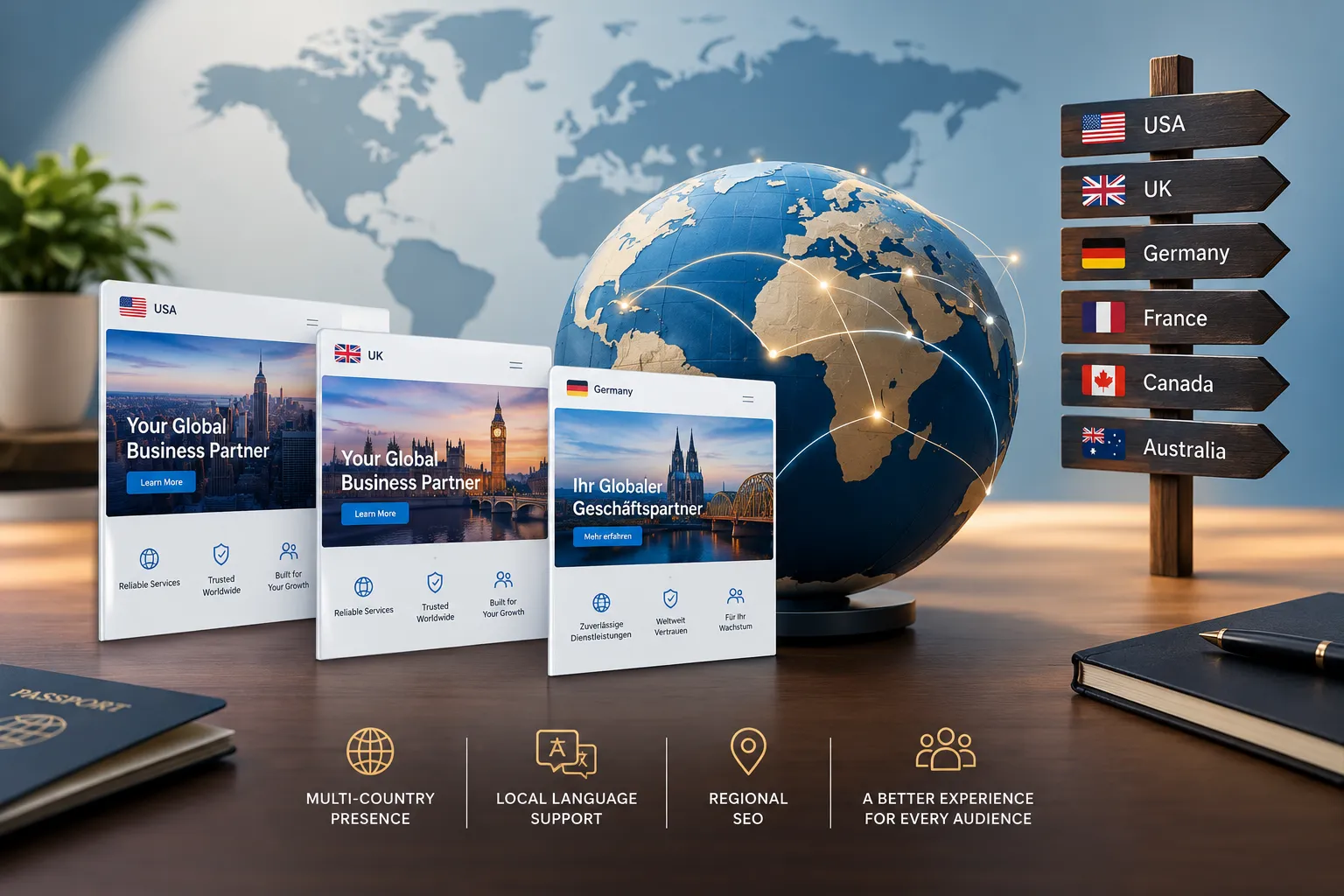

A website serving several countries needs more than translated text. What genuinely changes when a business expands online across borders.
Article:
Expanding a business into a new country is often accompanied by a straightforward assumption: translate the website, and the expansion is complete. Translation is the visible part of the work. Underneath it sit several decisions that, if left unmade, quietly undermine everything the translation was meant to achieve.
Translation and localisation are not the same task
A translated page conveys the same words in another language. A localised page conveys the same meaning in a way that fits the reader's own context: currency, units of measurement, date formats, regional spelling and cultural references that make sense locally rather than merely accurately. A price shown only in one currency, or a date written in a format the visitor does not use, can create doubt even when every word has been translated correctly.
Structure affects how a site is found
Search engines need to understand which version of a page is intended for which country and language, typically through address structure and a technical signal called hreflang. Handled poorly, this can result in the wrong version appearing in the wrong country's search results, or search engines treating translated pages as duplicates of one another, which can suppress both.
Decide what genuinely needs to change
Not every element requires rewriting. Core structure, navigation and design can often remain shared across markets, while pricing, legal notices, contact details and cultural references need country-specific attention. Establishing this distinction early prevents both unnecessary duplication of effort and the opposite mistake of applying one country's assumptions everywhere.
Plan for upkeep, not just launch
A multilingual site multiplies the effort involved in every future update, since a change made in one language must be considered for all the others. Before launch, it is worth deciding who is responsible for keeping each language version current, since neglected translations become visible quickly and reflect badly on the whole site.
Because the technical and linguistic aspects are closely connected, many businesses handle international expansion together with a provider of website development services, so that the structure supporting multiple markets is built correctly from the outset rather than adjusted after problems appear.
A website that speaks several languages well is not simply translated. It is built, from its address structure to its currency symbols, with more than one reader in mind.




























Sign in to leave a comment.