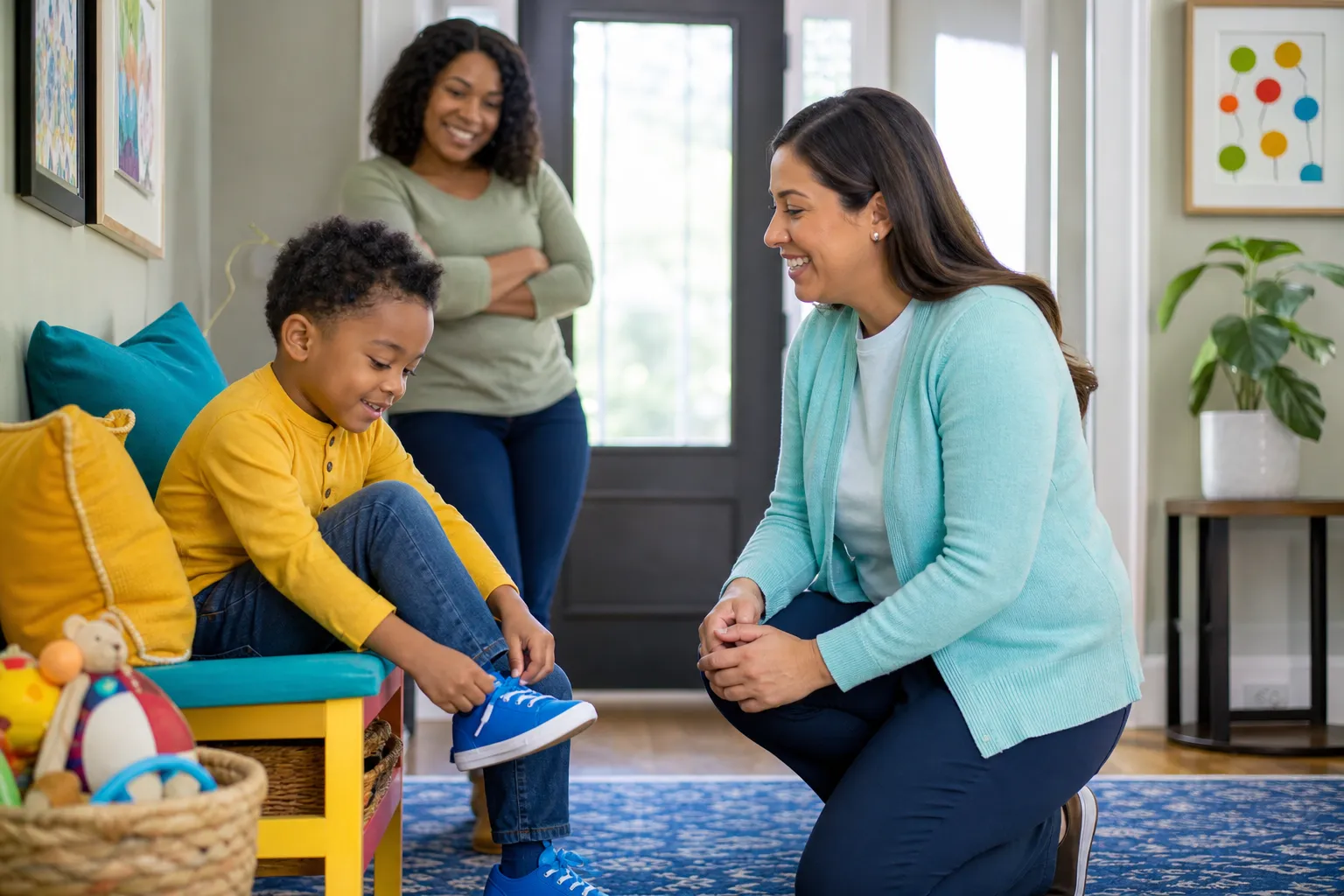

A mother in Joliet used to lay out her son's clothes every morning, button his shirt, tie his shoes, because it was faster than waiting for him to struggle through it himself before the school bus arrived. Six months into ABA therapy, she found herself standing in the hallway holding his shoes, watching him work the laces slowly, resisting the urge to step in and finish it for him. It took considerably longer than doing it herself. It was also the first time he had done it without her hands guiding his.
Independence in ABA rarely arrives as one dramatic milestone. It shows up as a string of small tasks a child used to need help with and now does not, dressing, brushing teeth, asking for something instead of grabbing it, waiting a turn without a meltdown. Each of those is its own treatment goal, broken down into smaller steps a BCBA can measure, and each one gets built through the same basic process: prompting a step, gradually reducing that prompt, and reinforcing the child for doing it with less help each time.
How a skill gets broken down into something teachable
A task like tying shoes looks simple to an adult and is anything but simple to a child learning it for the first time. A BCBA typically breaks it into a task analysis, a sequence of small steps such as crossing the laces, forming a loop, and pulling it tight, each one taught and reinforced individually before being chained together. This is also where prompting hierarchies come in: a therapist might guide a child's hands fully at first, then only touch their wrist, then only point, then say nothing at all, fading support in a deliberate order rather than removing it all at once.
Families curious about how this looks in an actual home session can find full details here on how a Joliet-based team structures a typical goal, since the process tends to make more sense once a parent sees the individual steps laid out rather than just the end result.
Why independence at home does not always look like independence anywhere else
A skill learned at home with one parent and one set of laces does not automatically transfer to a rushed morning with a different pair of shoes or a grandparent helping instead. Generalization has to be built in on purpose, practiced across different people, places, and materials, or a child can end up able to perform a skill only under the exact conditions it was originally taught in. This is one of the more counterintuitive parts of ABA for new parents: a skill that looks mastered in session still needs deliberate practice in the messier, less controlled conditions of actual daily life before it can be called reliable.
The National Institute of Child Health and Human Development notes that building adaptive daily living skills is one of the more consistent long-term goals across early behavioral intervention approaches, alongside communication and social development. That framing is useful for parents who might otherwise measure progress only by language milestones and overlook how much independence in ordinary routines is also being built session by session.
The mother in Joliet did not get her mornings back overnight. She got them back gradually, one shoelace at a time, and eventually noticed she was no longer laying out clothes at all, only checking that the choice her son had made on his own made sense for the weather.





























Sign in to leave a comment.