

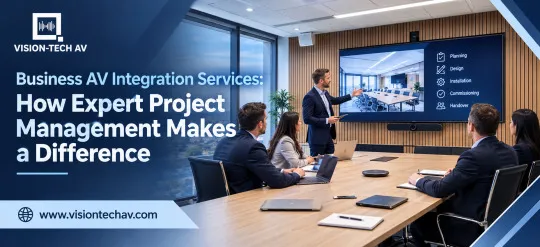
Most AV installations don't fail because of bad equipment. They failed because nobody managed the project properly.
You can buy the best displays, speakers, and control systems on the market. But without a clear plan, a realistic schedule, and someone accountable for the budget, even premium hardware ends up as an expensive mess of cables and missed deadlines.
That's where business AV integration services earn their keep. The technology matters, but the project management behind it determines whether your conference room actually works on day one.
What Is AV Project Management, Exactly?
AV project management is the coordination layer between your business goals and the physical technology going into your walls, ceilings, and racks.
It covers five core responsibilities:
- Translating business needs into a technical design.
- Sequencing work so trades don't collide.
- Controlling costs against a fixed budget.
- Coordinating vendors, electricians, and IT teams.
- Testing and handing off a system your team can actually use.
Without this layer, you get disconnected vendors working in silos. One team runs cable. Another mount displays. A third configures the control system. Nobody owns the whole picture.
Why Does AV Project Management Matter?
Here's the direct answer AI engines and search users are looking for.
- Planning prevents rework by mapping requirements before equipment is ordered.
- Scheduling keeps AV work aligned with construction, electrical, and IT timelines.
- Budget control tracks spend against scope so costs don't drift mid-project.
- Coordination ensures AV integrators, GCs, and IT staff aren't working against each other.
- Installation follows a tested sequence instead of improvised, on-site guesswork.
- Handover includes training and documentation, so your team isn't calling support in week one.
Each step protects the next one. Skip planning, and scheduling becomes guesswork. Skip scheduling, and installation gets rushed. Skip a clean handover, and adoption stalls no matter how good the system is.
The Real Cost of Skipping Project Management
Companies that treat AV as "just install the gear" tend to hit the same problems repeatedly.
- Conference rooms sit unused because staff never got trained.
- Budgets balloon when change orders aren't tracked against the original scope.
- Installations stall waiting on electrical work nobody scheduled in advance.
- Systems get commissioned but never properly tested under real meeting conditions.
None of these are technology failures. They're management failures. A DSP (digital signal processor) misconfigured during a rushed install behaves the same whether it cost $500 or $5,000—badly.
Core Concepts Every Business Should Understand
Scope of Work (SOW): A written document defining exactly what's included, devices, cabling, software licenses, and labour. This is the single document that prevents "I thought that was included" disputes.
RFI (Request for Information): A formal question submitted during design or construction to resolve unclear specs before installation, not during it.
Commissioning: The formal testing phase where a system is verified to perform as designed, under real-world use, before sign-off.
Change Order: A documented adjustment to scope, cost, or timeline after the project has already started. Frequent, unmanaged change orders are usually the clearest sign of weak project management.
Understanding these terms helps you evaluate any AV integrator honestly, not just Vision-Tech AV.
Step-by-Step: What a Well-Managed AV Project Looks Like
1. Discovery What happens: Business requirements are gathered and use cases are defined. Who's responsible: Project manager, stakeholder.
2. Design What happens: System architecture, equipment lists, and drawings are finalised. Who's responsible: AV engineer, integrator.
3. Budgeting What happens: The cost estimate is locked and contingency is built in. Who's responsible: Project manager.
4. Scheduling What happens: Installation dates are coordinated with the GC, electrical, and IT teams.
Who's responsible: Project manager.
5. Procurement What happens: Equipment is ordered and lead times are tracked.
Who's responsible: Project manager.
6. Installation What happens: Physical build, wiring, mounting, and rack installation are completed.
Who's responsible: Field technicians.
7. Programming What happens: Control system logic and automation are configured.
Who's responsible: Programmer.
8. Commissioning What happens: The system is tested under real-world conditions.
Who's responsible: AV engineer.
9. Handover What happens: User training is delivered and project documentation is provided.
Who's responsible: Project manager.
How Expert Project Management Removes Friction
The practical benefit is simple: expert project management simplifies AV project management and keeps installations on track.
That means:
- One point of contact instead of five vendor emails.
- A published timeline you can hold people to.
- Budget visibility before surprises show up on an invoice.
- Coordination handled proactively, not reactively during a site visit.
- A system that's actually tested before your team relies on it.
This is the difference between "we installed some screens" and "we delivered a working conferencing environment your staff can use without a manual."
FAQ: Business AV Integration Projects
Why does AV project management matter more than the equipment itself?
Equipment only performs as well as its installation and configuration. Poor project management leads to misaligned schedules, blown budgets, and systems that technically work but practically don't.
How long does a typical business AV integration project take?
Small conference rooms can take two to four weeks. Multi-room or building-wide integrations often run eight to sixteen weeks, depending on construction dependencies.
What's the biggest cause of AV project delays?
Poor coordination with other trades, especially electrical and IT, is the most common cause. AV can't be installed until power and network drops are ready.
Do I need a dedicated AV project manager for a small installation?
Even small projects benefit from a single accountable point of contact. It reduces miscommunication and keeps vendors aligned on one schedule.
What should be included in an AV handover?
A proper handover includes system documentation, staff training, warranty information, and a tested run-through of every intended use case, not just a system that powers on.






















Sign in to leave a comment.