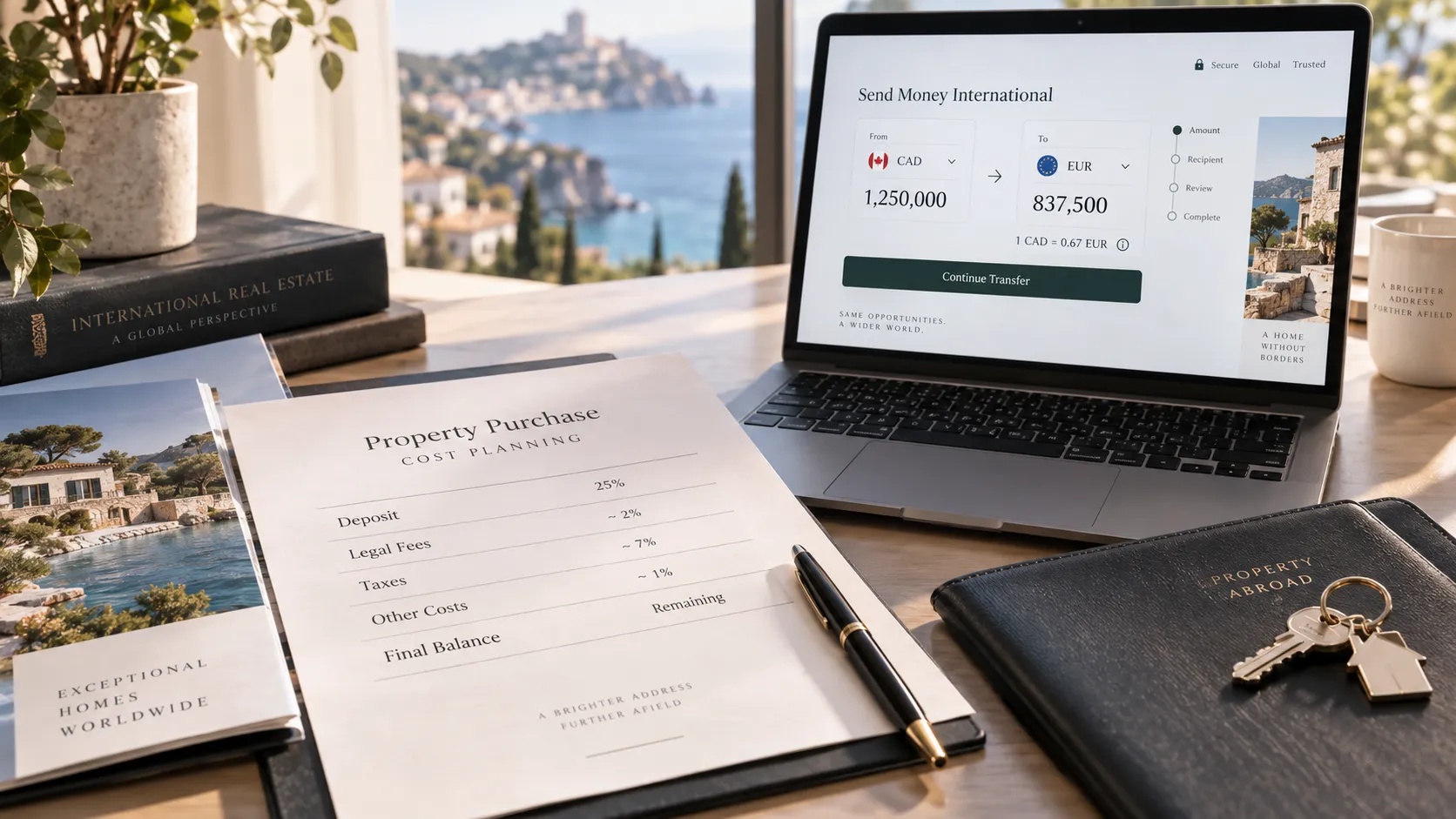

Buying property abroad is usually one of the largest foreign-currency transactions a Canadian will make. The purchase price may be fixed in euros, US dollars, pounds or another currency, while your funds are still in Canadian dollars. That means the exchange rate, transfer timing and payment instructions can materially affect the final CAD cost. A structured plan can make the process easier to manage from the first deposit through to the closing balance.
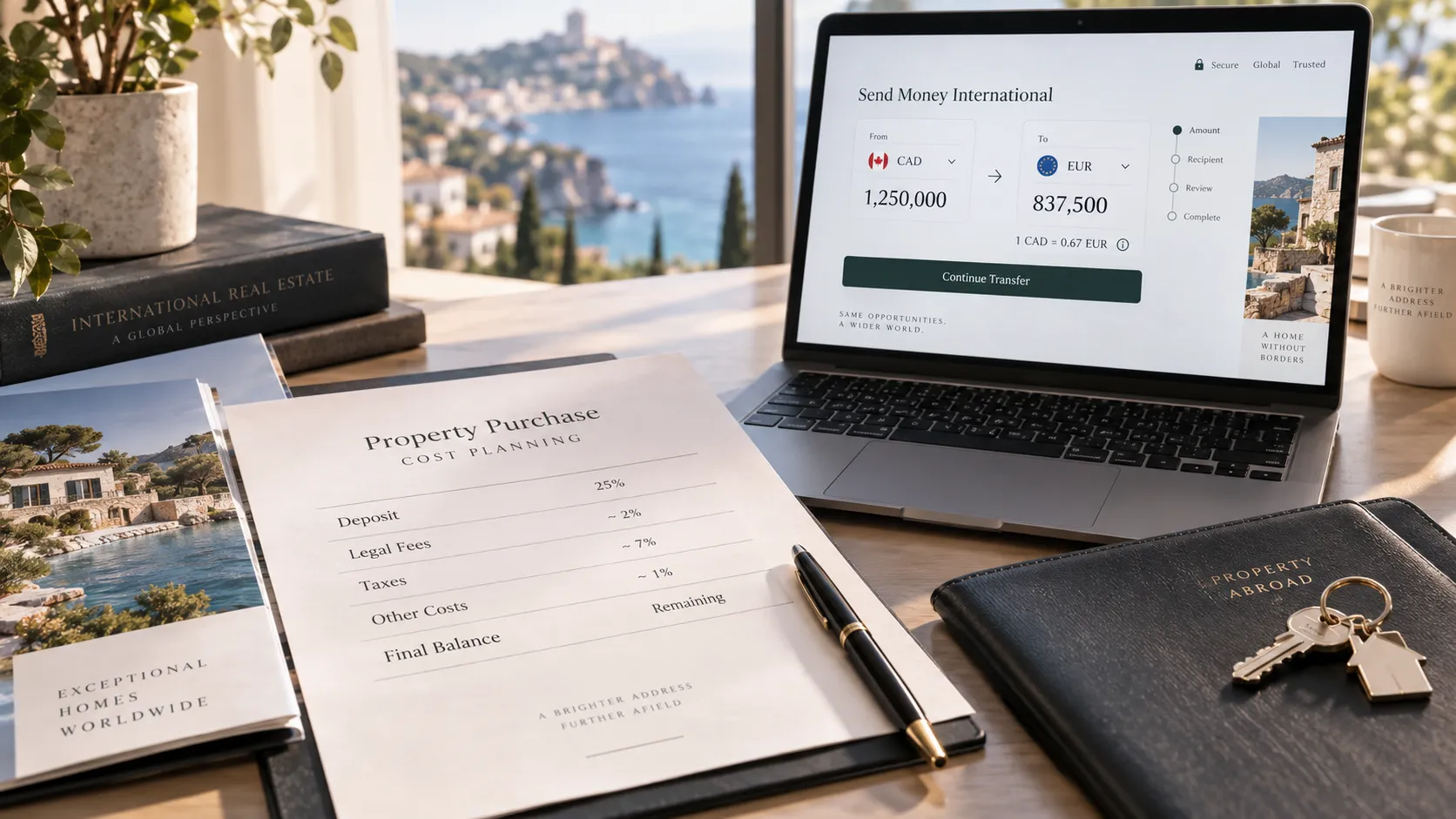
Start with the property payment schedule
Before arranging a transfer, map every payment connected to the purchase. Depending on the country and transaction, that may include a reservation payment, deposit, staged developer payments, legal or notary costs, taxes, mortgage-related payments and the final completion balance. The exact structure varies by jurisdiction and contract, so use the dates and amounts supplied by your lawyer, notary, developer, escrow provider or lender.
Once the schedule is clear, separate fixed foreign-currency obligations from costs that are still estimates. This tells you how much foreign currency you actually need and when. It also gives you time to prepare documents, compare rates and avoid leaving a large CAD to foreign currency transfer until the closing deadline.
Why the exchange rate matters more on a large property transfer
On a property purchase, even a small change in the CAD rate can move the cost by thousands of dollars. The useful comparison is not simply whether a provider charges a transfer fee. Compare the rate you can actually transact at, the total CAD amount you will pay and the foreign-currency amount expected to reach the beneficiary.
ILLUSTRATIVE EXAMPLE: A €300,000 completion payment costs about C$441,176 at 0.6800 EUR per CAD, but about C$444,444 at 0.6750. That 0.0050 rate difference changes the CAD requirement by roughly C$3,268. This is an illustration only, not a current rate or quote.
Match the transfer strategy to the purchase stage
| Purchase stage | What matters most | Practical payment control |
| Reservation or deposit | Deadline and exact beneficiary | Verify instructions independently and allow time for account funding and compliance checks. |
| Stage payments | Known dates and foreign-currency amounts | Plan conversions around milestones rather than treating every payment as a last-minute transaction. |
| Final balance | Large amount and fixed closing date | Prepare documents early, confirm the recipient account and obtain a transaction-specific quote before release. |
| Post-purchase costs | Recurring mortgage, tax or property expenses | Keep payment instructions organized and review the exchange rate before each recurring conversion. |
A six-step process for sending money for an overseas property
- Confirm the payment obligation. Use the signed purchase agreement and instructions from the relevant professional to confirm the amount, currency, recipient and due date.
- Open and verify your transfer account early. Large transfers can involve identity, payment-purpose and source-of-funds checks. Completing these before the deadline leaves time to resolve questions.
- Verify the beneficiary independently. Property fraud can involve changed bank instructions. Confirm the account with your lawyer, notary, developer, escrow provider or lender through a trusted contact method before sending.
- Compare the total conversion cost. Use the exact foreign-currency obligation. Review the transaction rate, any transfer costs and the expected recipient amount rather than relying only on a public mid-market benchmark.
- Decide when to convert. If the payment is weeks or months away, you may use rate alerts, staged conversions or discuss a rate lock-in where suitable and available. No strategy guarantees a better outcome, so keep the contractual deadline as the priority.
- Send early enough to protect the closing date. Funding, compliance reviews, bank cut-offs, weekends and the receiving institution can affect timing. Track the transfer and keep confirmation for your property file.
How MTFX supports overseas property payments
MTFX supports Canadians buying property abroad with large international transfers for deposits, stage payments and final balances. The current overseas-property service includes transaction-specific quotes, payment tracking, access to 50+ currencies and transfers to 190+ countries, along with specialist support for large and time-sensitive payments.
Most property transfers are described by MTFX as arriving within 1–2 business days, although actual timing depends on the payment route, destination, funding and any required checks.
Keep tax and legal requirements separate from the transfer
Sending money abroad from Canada is only one part of the purchase. Ownership rules, taxes, registration requirements and closing procedures vary by country, so local legal and tax advice should sit alongside your payment plan. In Canada, CRA foreign-property reporting also depends on how the property is used.
Personal-use property can be excluded from Form T1135 reporting, while income-producing foreign property may be treated differently. If reporting applies, the property's cost amount is not reduced simply because part of the purchase was financed with a mortgage.
Frequently asked questions
How do I send a property deposit overseas from Canada?
Confirm the exact beneficiary and amount with the professional handling the transaction, obtain a current CAD to foreign currency transfer quote, fund the transfer and send early enough to meet the contractual deadline.
What information is normally needed for an overseas property transfer?
You typically need the beneficiary name, bank, account number or IBAN, SWIFT/BIC details, beneficiary address, payment currency and a clear payment reference. Requirements vary by destination and recipient.
Can I lock in an exchange rate before completion?
Depending on your needs and eligibility, MTFX can discuss rate lock-in options for a future payment. This can provide budget certainty, but the terms should be understood before committing.
How early should I prepare a large property transfer?
Start as soon as the payment amount and deadline are known. Early preparation gives you time for verification, source-of-funds documentation, rate planning and correction of any beneficiary-detail issues.
Is a personal overseas property reported on Form T1135?
CRA says personal-use property is excluded from specified foreign property reporting. Income-producing use can change the treatment, so obtain tax advice for your circumstances.
Plan the money before the closing date
Buying property abroad becomes easier to manage when the transfer plan is built alongside the purchase timeline. Confirm each obligation, verify the beneficiary, prepare documentation early and compare the total CAD cost before converting. For a major purchase, planning the currency side in advance can reduce last-minute pressure and help keep the deposit, stage payments and final balance on schedule.
Ready to plan your transfer? Speak with MTFX about your overseas property payment.




























Sign in to leave a comment.