

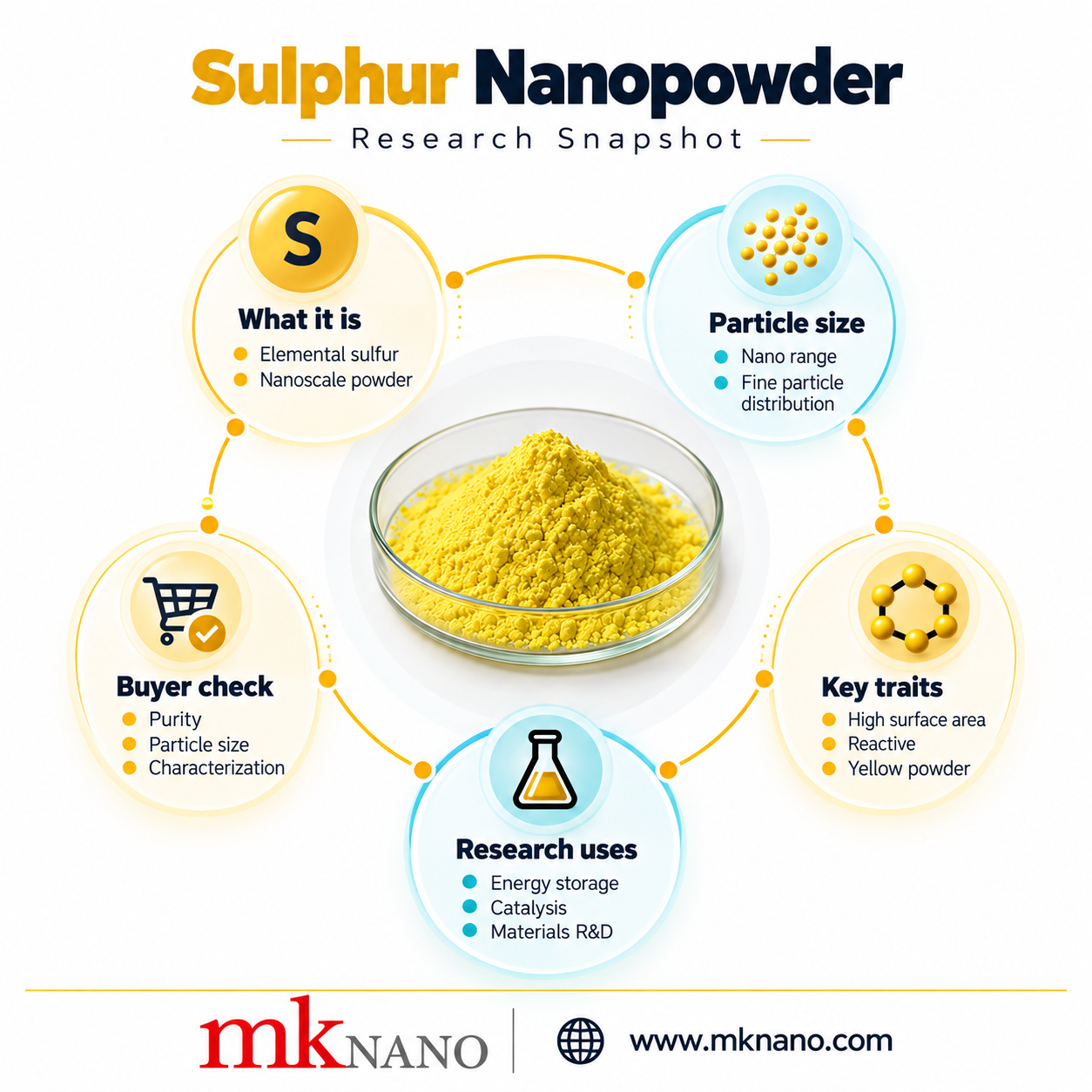
A practical guide for researchers, RD teams and technical buyers in the U.S. and Canada
Sulphur nanopowder is being explored in areas such as energy storage, coatings, environmental research and advanced material formulations.
But not every sulphur nanopowder is the same. Commercial grades can differ in particle size, purity, morphology, surface area, agglomeration and available characterization data. These differences can affect how the material behaves in a real experiment or formulation.
For example, two sulphur nanopowders may both be described as nanoscale materials while having different reported particle-size ranges and measurement methods. A product listed as having an average particle size below 60 nm should not automatically be compared with another product described only as having particles smaller than 100 nm. Researchers should check whether the reported values were obtained using microscopy, particle-size analysis or another characterization method before treating the specifications as equivalent.
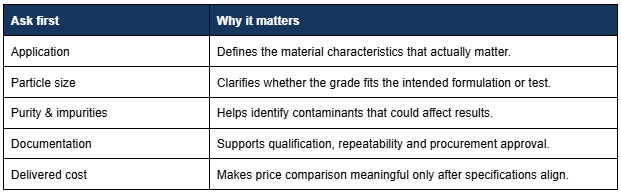
So when researchers search “buy sulphur nanopowder,” the most useful starting point is not price alone. It is this: What material characteristics does my application actually require?
Once that is clear, comparing suppliers, specifications, documentation and cost becomes much more meaningful.
Start With the Application, Not the Price
Define the application first. A battery-development team, a coatings lab and an environmental-research group may all buy nanoscale sulphur, but they may not need the same grade.
What Does the Particle-Size Number Actually Mean?
Particle size is often the first specification buyers notice, but the wording matters. “100 nm,” “APS 60 nm,” and a stated size range do not automatically mean the same thing. One value may be an average, another an upper limit, and neither describes the full particle population.
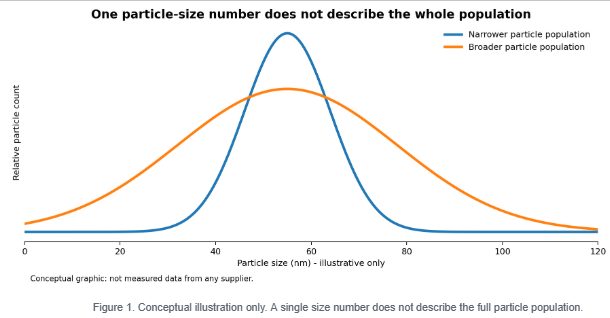
Before ordering, ask: Is the value an average, maximum or range? How was it measured? Does it describe primary particles or aggregates? Is distribution data available?
Purity Needs Context Too
A higher purity percentage is not automatically the best choice for every project. Ask which impurities could interfere with the experiment, and review the Certificate of Analysis, impurity information and lot consistency.
For example, MKnano currently lists a sulphur nanopowder grade at 99.9% purity with APS 60 nm. That specification is useful only when it is compared with another grade using the same questions about size definition, purity, documentation and intended use.
Powder Form Can Change Usability
Two powders with similar chemistry can still differ in morphology, surface area, agglomeration and dispersion behaviour. These differences can affect mixing into an electrode slurry, coating, liquid formulation or other matrix. Chemical formula + purity + one size number is rarely enough for a research purchase.
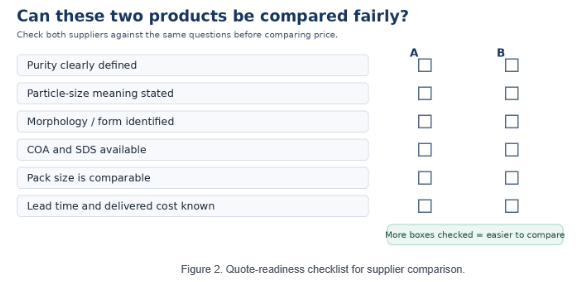
Can These Quotes Be Compared Fairly?
Use the same checklist for every supplier before comparing price. A quotation becomes more useful when it clearly states the material specification and the evidence behind it.
Consider a researcher developing a sulphur-containing electrode formulation. In this case, particle size alone may not answer whether a powder is suitable. The researcher may also need to examine purity, morphology, dispersion behaviour, surface characteristics, available characterization data and the consistency of the supplied material. A supplier that provides these details can make it easier to compare materials objectively and determine whether the selected grade matches the experimental requirements.
Why the 2026 Research Context Matters
Recent work continues to explore sulphur nanomaterials beyond one application. A 2025 Royal Society of Chemistry review discusses mechanochemical routes to functional sulfur nanomaterials for areas including sensing, catalysis and energy conversion. A 2026 review in Next Nanotechnology examines sulfur nanoparticles in antimicrobial research. For buyers, the useful lesson is simple: the “right” sulphur nanopowder depends on what the research is trying to achieve.
For U.S. and Canadian Buyers, Compare Delivered Cost
The quoted material price is only part of the purchase. Pack size, lead time, shipping, cross-border costs where applicable, documentation and repeat-supply needs can all affect the practical cost of a project.
A 30-Second Buying Check
- What particle-size range does my application actually require?
- What purity level is necessary, and which impurities matter?
- What morphology or agglomeration information is available?
- Can I review the COA, SDS and relevant characterization data?
- Am I comparing the same quantity, lead time and delivered cost?
Before You Buy Sulphur Nanopowder, Check:
- Purity: What purity level is reported?
- Particle size: Is it an average, range or upper limit?
- Measurement method: How was particle size determined?
- Morphology: Is microscopy or morphology information available?
- Agglomeration: Does the supplier provide information about particle aggregation?
- Documentation: Is a Certificate of Analysis available?
- Pack size: Does the quantity match the planned experiments?
- Supply: Can the same specification be supplied for future batches?
A More Useful Way to Buy Sulphur Nanopowder
When researchers search “buy sulphur nanopowder,” the most reliable sequence is to define the application, match the specification, review the supporting data, confirm supply conditions and only then compare price. The best buying decision is not based on one number; it comes from understanding whether the material is actually suitable for the work being planned.





















Sign in to leave a comment.