Can a Solicitor Certify Documents? 10 Common Questions Answered

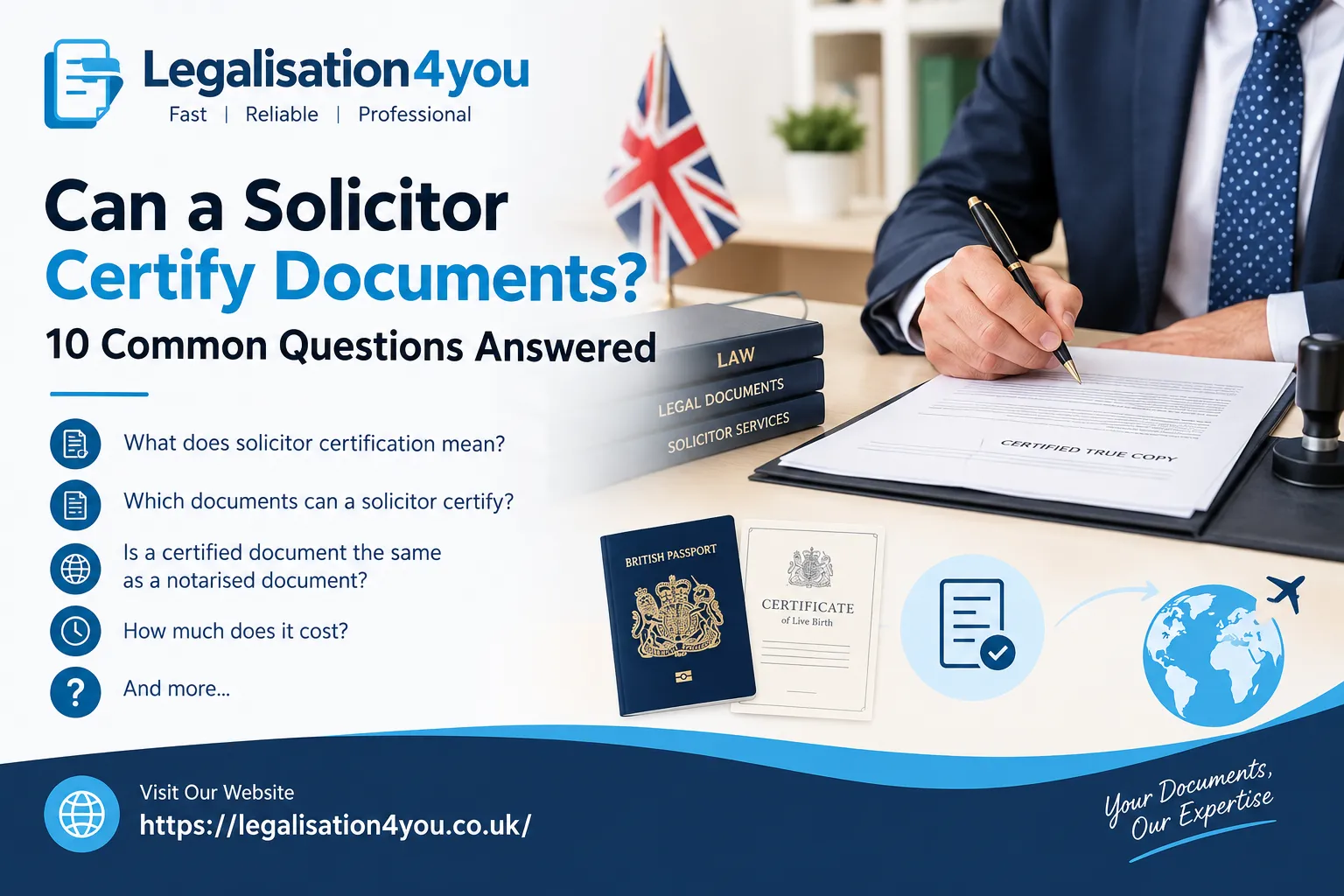
When you are applying for a visa, opening a bank account, buying property, dealing with an overseas authority or preparing documents for international use, you may be asked to provide a certified copy of an original document.
This often raises an important question: can a solicitor certify documents, and if so, what does the process involve?
In the UK, a solicitor can certify certain documents as true copies of originals, provided the relevant organisation accepts solicitor certification. GOV.UK confirms that solicitors and notaries are among the professionals who may certify copies of documents. However, the exact requirements can vary depending on the organisation requesting the paperwork.
Certification can also be part of a wider process when UK documents are being prepared for use overseas. In some situations, a document may need certification before it can be legalised and receive an apostille.
Below are 10 common questions about solicitor certification and what you should know before arranging the service.
1. Can a Solicitor Certify Documents?
Yes. A solicitor can certify a copy of an original document as a true copy when the relevant organisation accepts solicitor certification.
GOV.UK explains that documents such as passports, photocard driving licences, government letters, bank statements, utility bills and certain medical letters may be certified by an appropriate professional. Solicitors and notaries are specifically included among the professionals who may offer this service.
The solicitor normally needs to see the original document before certifying the copy. This allows them to compare the copy with the original and confirm that it accurately reproduces the document.
It is important to remember that certification does not necessarily confirm that the information contained in the document is true. Instead, it generally confirms that the copy corresponds to the original document that was presented.
2. What Does a Solicitor Certification Mean?
A certified copy is essentially a copy that has been formally confirmed as a true copy of the original.
The wording used can vary depending on the purpose and organisation requesting the document. GOV.UK gives the example wording:
“Certified to be a true copy of the original seen by me.”
The person certifying the copy should normally sign and date it, print their name and provide their occupation, address and telephone number.
However, you should not assume that this wording is suitable for every situation. Some organisations have their own certification requirements and may specify exactly who must certify the document or what information must appear on the copy.
This is why checking the recipient's instructions before arranging certification is important.
3. Which Documents Can a Solicitor Certify?
A solicitor may be able to certify copies of many different types of documents, depending on the purpose and the requirements of the organisation receiving them.
Common examples include:
- Passports
- Driving licences
- Proof of address
- Bank statements
- Utility bills
- Government correspondence
- Academic certificates
- Certain legal documents
- Identification documents
- Business documents
- Powers of attorney
GOV.UK specifically lists passports, photocard driving licences, government letters, bank and building society statements, credit card statements, utility bills and certain letters from healthcare professionals among documents that can be certified.
However, some documents have special rules. For example, GOV.UK provides separate procedures for certifying lasting powers of attorney.
For documents such as birth, marriage and death certificates, you should also check whether the organisation wants the original certificate rather than a certified photocopy. HM Passport Office guidance, for example, says that certified copies of General Register Office certificates should not be used as a replacement where replacement certificates are available.
4. Why Would You Need a Solicitor-Certified Document?
There are many reasons an organisation may request a certified copy.
For example, you might be asked for one when:
- Applying for a visa
- Proving your identity
- Opening a bank account
- Applying for a mortgage
- Buying or selling property
- Registering with an overseas authority
- Starting a business abroad
- Handling international legal matters
- Applying to an educational institution
- Providing documents for compliance checks
The purpose of certification is often to allow an organisation to accept a copy while having additional assurance that the copy matches the original.
Some organisations may accept certification from several types of professionals, while others may specifically require a solicitor, notary or another authorised person.
Therefore, always read the instructions provided by the organisation before arranging certification.
5. Do I Need the Original Document?
Generally, yes, if a solicitor is being asked to certify that a copy is a true copy of the original, the solicitor needs to inspect the original.
The process usually involves taking both the original document and the copy to the solicitor. The solicitor compares the two and, if satisfied, certifies the copy.
This is particularly important because the certification is based on the professional having seen the original.
If the original is unavailable, do not simply create a photocopy and assume it can be certified. Ask the organisation requesting the document what alternatives it accepts.
In some circumstances, you may need to obtain a replacement document from the issuing authority instead.
6. Is a Certified Copy the Same as a Notarised Document?
No. Although the terms are sometimes used interchangeably in everyday conversation, certification and notarisation are different services.
A solicitor may certify that a copy is a true copy of an original document.
A notary, meanwhile, performs notarial acts that may involve authenticating signatures, documents or other matters for use in legal or official transactions.
The correct service depends on what the receiving organisation requires.
For international documents, the distinction can be especially important. GOV.UK explains that if you need a certified copy of a UK document specifically so that it can be legalised, you will need to use a UK notary.
This means you should establish the complete document route before arranging certification.
7. Can a Solicitor Certify Documents for International Use?
A solicitor can certify certain documents, but whether that certification will be accepted overseas depends on the destination and the requirements of the organisation receiving the document.
Some international procedures require a UK document to be certified by a particular professional before it can be legalised.
GOV.UK explains that certain documents, including powers of attorney, contracts, qualification certificates and copies of passports or driving licences, can be legalised when they have been certified by a UK public official such as a notary or solicitor.
However, the process is not identical for every country.
Before sending your document overseas, check:
- Whether the original or certified copy is required.
- Whether a solicitor or notary must certify it.
- Whether an apostille is required.
- Whether embassy or consular legalisation is needed.
- Whether a translation is required.
- Whether the translation itself needs certification.
Getting these details right at the beginning can help prevent delays.
8. Does a Certified Document Need an Apostille?
Not necessarily.
An apostille is generally required when an overseas authority specifically asks for a UK document to be legalised.
The UK Legalisation Office checks eligible documents and, where appropriate, attaches an apostille confirming that the relevant signature, stamp or seal matches its records.
Some documents can be submitted directly for legalisation because they already contain an acceptable signature, stamp or seal. Other documents may need certification first.
For example, GOV.UK states that documents such as contracts, powers of attorney and qualification certificates can be legalised when they have been appropriately certified by a UK public official.
Therefore, certification and apostille should not be treated as automatically required together. The correct process depends on the document and its intended use.
9. How Much Does Solicitor Certification Cost?
There is no single standard price for document certification across all solicitors.
The cost can depend on factors such as:
- Number of documents
- Number of pages
- Type of document
- Whether the original needs to be examined
- Whether additional legal services are required
- Whether the document needs further certification
- Whether apostille or legalisation is also required
- Whether an urgent service is requested
A simple one-page certified copy may require less work than a large document containing several pages.
If you need multiple documents certified, ask for the total cost before proceeding. It is also worth confirming whether the quoted price includes additional services or only the certification itself.
10. How Do I Choose the Right Person to Certify My Documents?
Start by checking the requirements of the organisation requesting the document.
If it specifically says that a solicitor must certify the copy, make sure you use an appropriate practising solicitor. The Law Society's Find a Solicitor service allows people to search for solicitors in England and Wales and filter results according to location and services.
You should also check:
- Whether the solicitor offers document certification
- Whether they handle documents for overseas use
- Whether they can assist with notarisation if required
- Whether they understand apostille requirements
- What identification you need to bring
- Whether you need an appointment
- The expected turnaround time
- The full cost
If your document is intended for international use, it is particularly useful to establish the entire route before starting. A simple certified copy may not be sufficient if the destination authority also requires legalisation or embassy attestation.
What Is the Usual Process for Certifying a Document?
Although procedures can vary, the basic process is usually straightforward.
Step 1: Check the Requirements
Find out exactly what the organisation requesting the document wants. Do not assume that any certified copy will automatically be accepted.
Step 2: Prepare the Original
Take the original document with you. The solicitor generally needs to inspect it before certifying the copy.
Step 3: Prepare a Clear Copy
The copy should be complete and easy to read. If the document contains multiple pages, check whether every page needs certification.
Step 4: Meet the Solicitor
The solicitor compares the copy with the original and confirms whether it is suitable for certification.
Step 5: Certification Is Added
The solicitor signs and dates the copy and provides the relevant certification details.
Step 6: Arrange Further Legalisation if Necessary
If the document is intended for overseas use, determine whether it needs an apostille, embassy attestation or another authentication step.
This final stage is particularly important because certification alone does not automatically mean that a document will be accepted by a foreign authority.
Need Help With Document Certification?
Getting documents ready for official or international use can involve several steps, and the correct procedure depends on the document and destination.
Whether you need help with certify documents solicitor requirements, document certification, notarisation, apostille or legalisation, it is important to establish the correct route before submitting your paperwork.
Legalisation4you provides document-related services designed to help individuals and businesses prepare UK paperwork for official and international use.
Visit to learn more about the available services and get assistance with your document requirements.





Sign in to leave a comment.