Can an AI Code Detector Tell If You Used AI?

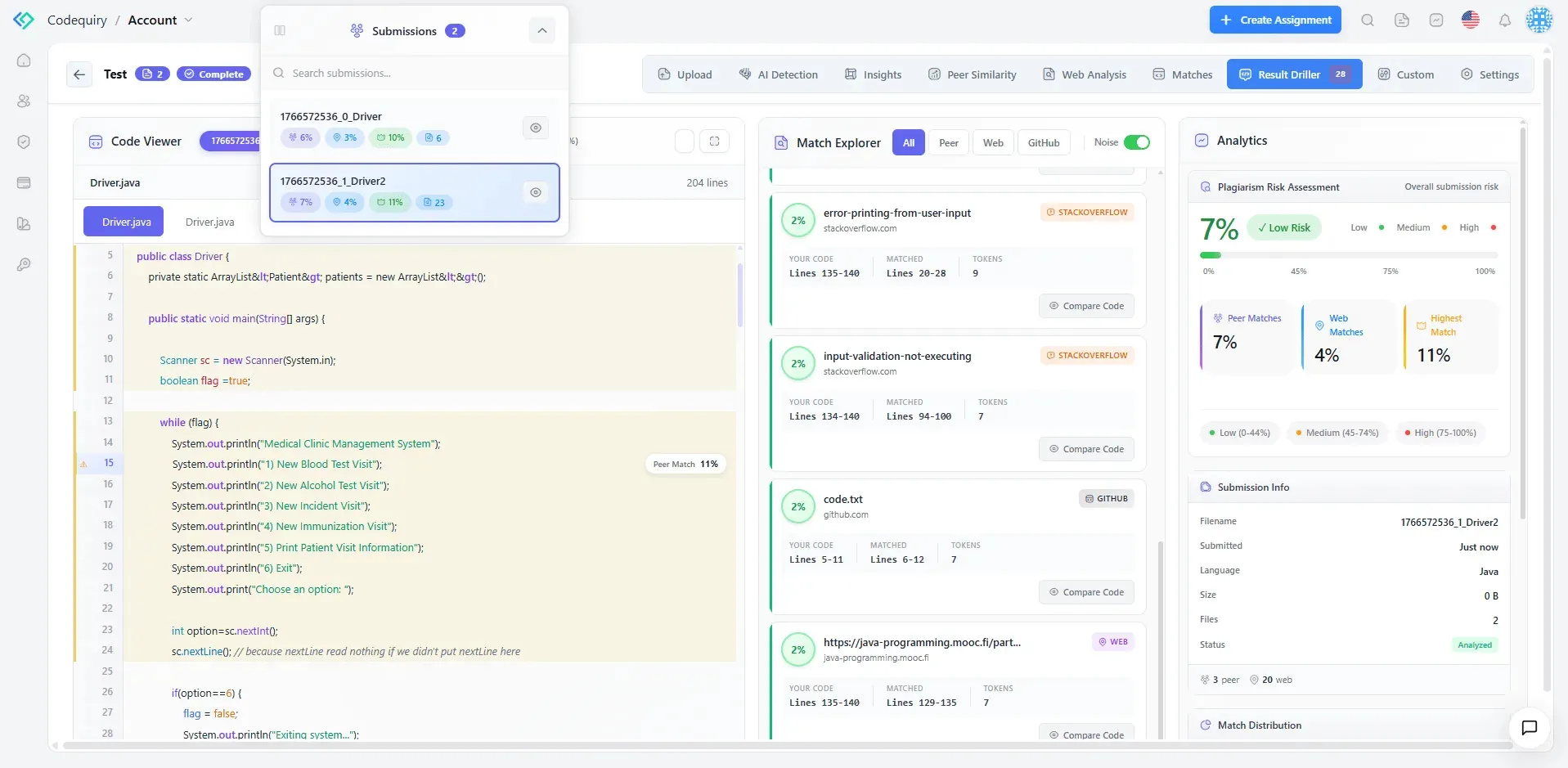
AI coding tools can write functions, explain errors, suggest fixes and even generate complete programs. But that creates a difficult question for educators:
Can an AI Code Detector tell exactly how much AI was used to create a student's code?
Not reliably.
An AI Code Detector can identify patterns commonly associated with machine-generated code. It cannot look at a finished program and reconstruct exactly who wrote each line, how the code was developed or how much help a student received.
That distinction matters because asking AI to explain an error is very different from asking it to write an entire assignment.
What counts as AI-assisted code?
AI assistance exists on a spectrum.
Imagine you are learning Python and cannot get a function to work. You ask an AI tool why your loop is returning the wrong result, understand the explanation and fix your own code.
Now imagine asking the same tool to write the function for you. You change a few variable names and add it to your assignment.
Both examples involve AI, but the level of assistance is very different.
A submission could therefore be:
- Human-written: The student writes the code independently.
- AI-assisted: AI helps explain errors or suggest an approach.
- AI-generated and edited: AI produces part of the code and the student modifies it.
- Mostly AI-generated: AI produces most of the solutions with limited human changes.
The challenge is that a detection system sees the final source code, not the process that created it.
How does AI code detection work?
An AI Code Detector does not simply search for a hidden "AI signature".
Detection systems can analyse characteristics within source code, including how code is structured, how functions are organised, naming patterns and other behaviours associated with known examples of AI-generated code.
Some systems use machine-learning classifiers. In simple terms, a classifier learns from examples of human-written and AI-generated code. When it receives a new submission, it compares the observed patterns with what it has learned.
Think of it like recognising handwriting. Seeing thousands of handwriting samples can help you identify patterns, but one short sentence cannot always tell you exactly who wrote it.
AI detection has a similar limitation.
Research has found that existing AI-generated code detectors can struggle to generalise across different types of code and can produce both false positives and false negatives.
Why is mixed code harder to detect?
Human editing changes the evidence available to an AI code checker.
Suppose an AI generates this function:
def calculate_average(numbers):
return sum(numbers) / len(numbers)
A student might rewrite it as:
def find_average(scores):
- total = sum(scores)
- count = len(scores)
- return total / count
The purpose is the same, but the structure and presentation have changed.
Now imagine that a student writes 90% of an assignment independently and uses AI for one function. The final submission contains mostly human-written code.
The detector cannot see that history.
Research on AI-generated code detection has found that detection performance can change when human-written and AI-generated code are combined or when generated code is modified.
This is why an AI Code Detector should not be treated as a tool that can calculate exactly what percentage of an assignment was written by AI.
Can detection prove who wrote the code?
No. Detection and authorship attribution are different technical problems.
A detector may identify patterns associated with AI-generated code. That does not automatically mean:
"This student used ChatGPT."
It means the submitted code contains patterns that the system considers relevant to AI generation.
Research into code stylometry makes this distinction particularly important. Identifying whether code was generated by an LLM is different from determining which author created or edited the code.
The same principle applies to other forms of source analysis.
A source code plagiarism checker may find similarities between two submissions, but similarity alone does not explain why those similarities exist. Students may have worked from the same starter code, followed the same tutorial or implemented a standard solution.
Context is still required.
What should educators do with a detection flag?
A detection result should start a review, not end one.
Suppose an AI code checker flags a Java assignment. An instructor can then examine several other signals.
Does the code match the course material?
A submission using techniques that have not been covered may deserve closer attention.
Does it resemble previous work?
A sudden change in coding style can provide useful context, although it is not proof of AI use.
Can the student explain the code?
Students should generally be able to explain the logic, functions and design decisions in work they submit.
What does the assignment policy allow?
AI may be permitted for some assignments and restricted for others. A detector cannot decide whether a particular use violated those rules.
Vanderbilt University recommends considering contextual indicators such as differences from previous work and inconsistencies with course material, while treating those indicators as prompts for further inquiry rather than automatic conclusions.
Is an AI detection result proof?
No.
This is the most important point.
An AI Code Detector produces a technical signal. It does not establish intent or misconduct by itself.
Cornell University notes that current AI detection technologies have significant margins of error and should not be used as the sole basis for an academic-integrity violation.
That is particularly important in programming, where students routinely work with documentation, tutorials, libraries, examples and development tools.
A good review therefore asks why a signal appeared, rather than simply asking whether one appeared.
What is the better detection workflow?
A practical workflow has four steps.
First, scan the submission.
Use an AI Code Detector to identify code that may warrant closer examination.
Second, inspect the flagged sections.
Look at the actual functions and coding patterns rather than relying only on an overall result.
Third, compare the available evidence.
Consider previous assignments, course material, development history and assignment
requirements.
Finally, apply the AI policy.
Determine whether the student's use of AI was permitted, restricted or required to be disclosed.
This approach gives educators more context and reduces the risk of treating an automated prediction as a final judgement.
What should students remember?
For students, the lesson is simple.
Using AI does not automatically mean an entire program is "AI-generated". But if your course requires AI use to be disclosed, follow that requirement.
More importantly, understand the code you submit.
If an AI tool gives you a function, read it, test it and understand why it works. You may need to debug it later or explain it to your instructor.
AI can support learning, but understanding the resulting code remains your responsibility.
What should educators remember?
An AI Code Detector is most useful as an evidence-gathering tool, not an automated verdict.
Research shows that AI-generated code detection faces false positives, false negatives and difficulties with human-AI collaboration.
The strongest workflow is therefore straightforward:
Detecting the signal. Examine the code. Check the context. Apply the policy.
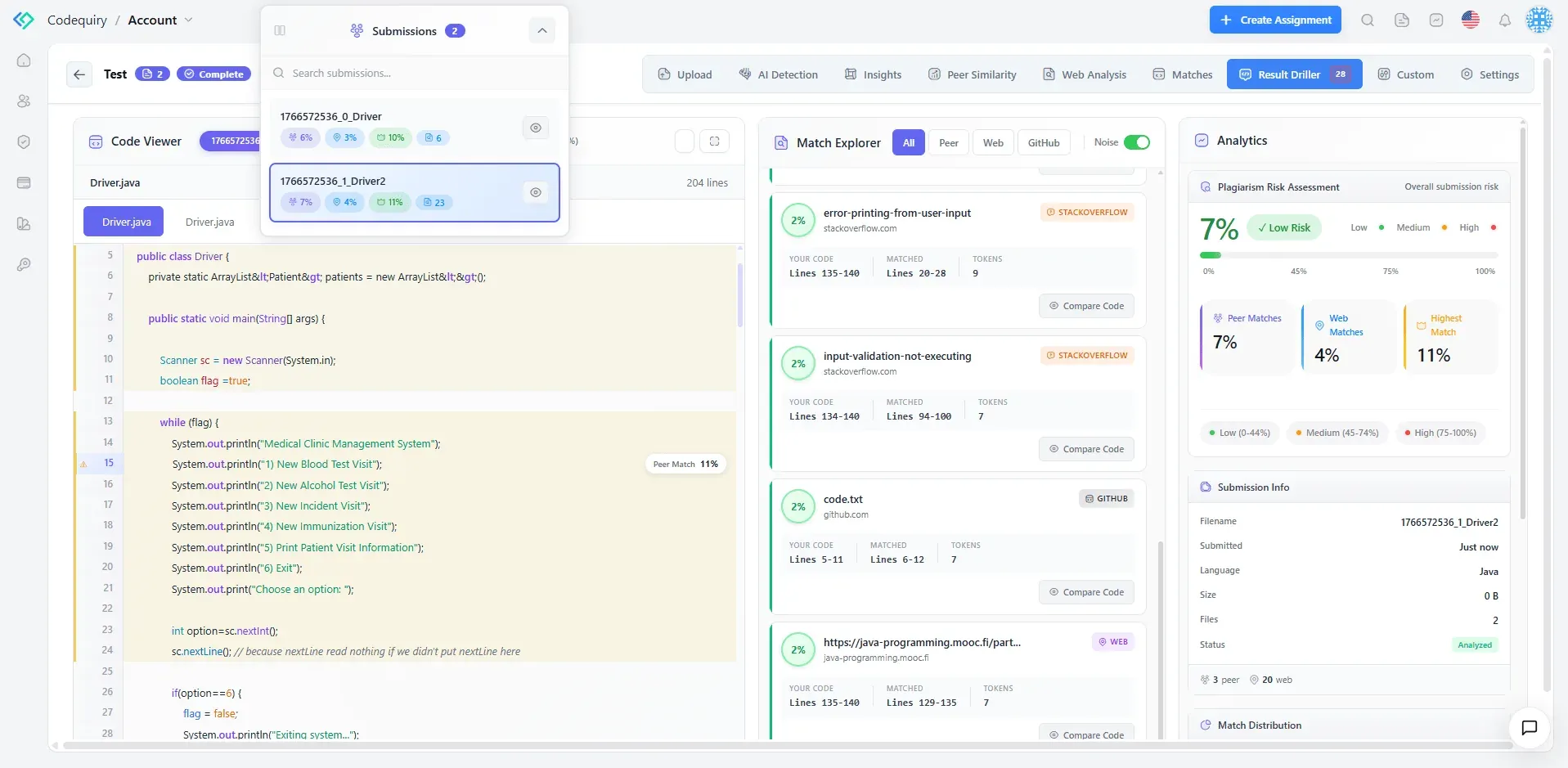
Codequiry's AI Code Detector helps educators identify AI-related signals in student code so those results can be considered alongside the wider evidence.
Run a comprehensive scan with Codequiry and make AI detection one part of an evidence-based academic-integrity workflow.





Sign in to leave a comment.