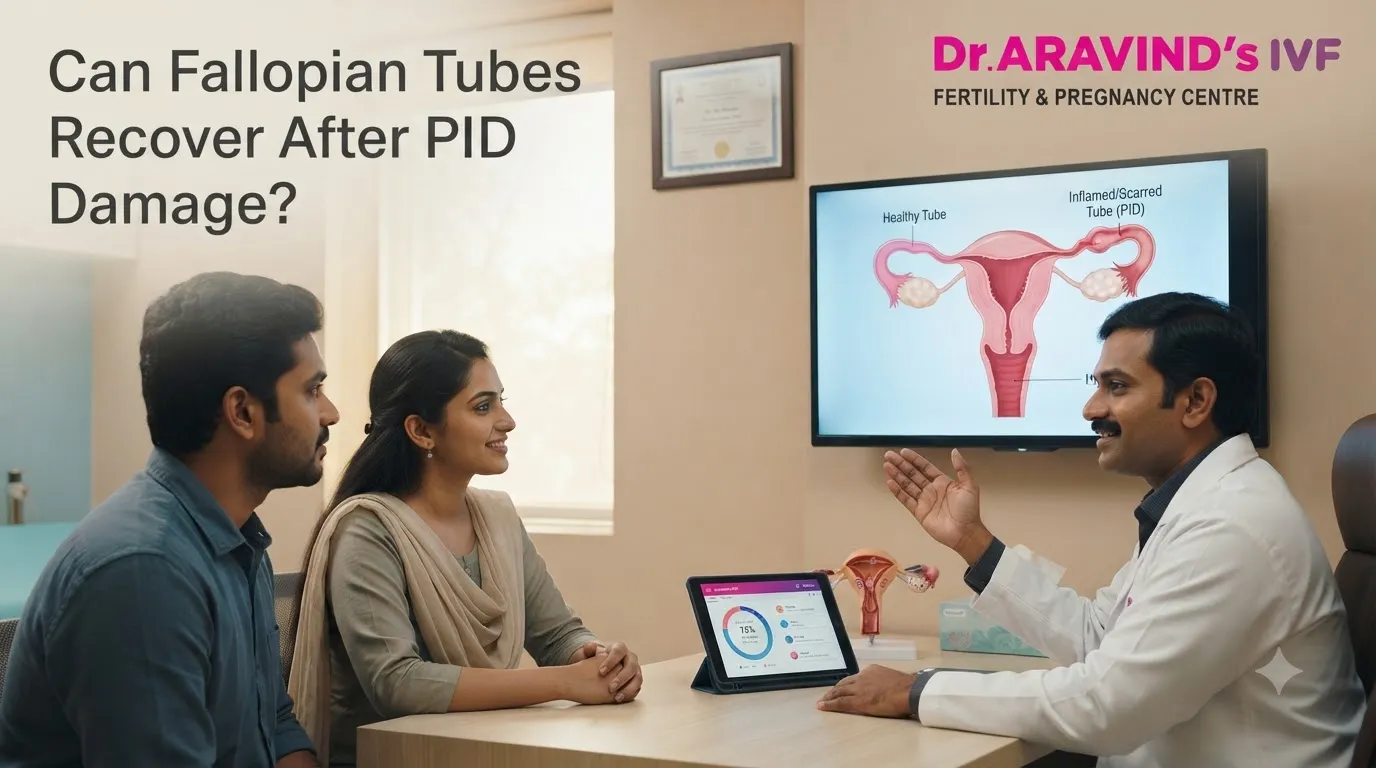

Pelvic inflammatory disease (PID) can affect the reproductive organs and, in some cases, leave behind inflammation, scarring, or adhesions around the fallopian tubes. This naturally raises an important question: can damaged fallopian tubes recover after PID?
The answer depends on the type and severity of the damage. Active inflammation from PID can be treated, but established scar tissue or permanent tubal blockage does not usually return to normal on its own. Some women may have mild inflammation without significant lasting damage, while others can develop narrowing or complete blockage.
If you are concerned about fertility after PID, a proper assessment is more useful than assuming that the tubes are permanently damaged. People researching the best fertility hospital in Coimbatore may benefit from understanding how tubal damage is assessed before considering treatment.
How Does PID Damage the Fallopian Tubes?
The fallopian tubes are narrow passages that help transport an egg from the ovary toward the uterus. They also provide the usual location where sperm and egg meet during natural fertilization.
During PID, infection can cause inflammation in the uterus, fallopian tubes, and surrounding tissues. If the inflammation is significant, healing may result in scar tissue or adhesions.
This damage can:
- Narrow the inside of a fallopian tube
- Cause partial or complete blockage
- Affect the normal movement of the egg
- Create adhesions around the reproductive organs
- Lead to fluid collection inside a damaged tube
The extent of damage is not the same for everyone. Early treatment of PID can help reduce the risk of complications, but treatment of the infection cannot necessarily reverse established scarring.
Can Mild Tubal Damage Improve?
Not every woman who has PID develops permanent tubal damage.
If inflammation is identified and treated before significant scarring develops, the reproductive organs may recover without major structural problems. However, once substantial scar tissue has formed, it generally does not disappear simply because the infection has been treated.
This distinction is important. Treating PID and treating the consequences of previous PID are not always the same thing.
A doctor may recommend fertility testing when there is a history of PID and difficulty conceiving. The goal is to understand the actual condition of the reproductive organs rather than assume the extent of damage from the previous infection.
What Are the Symptoms of Tubal Damage?
Fallopian tube damage often causes few or no specific symptoms. Some women may experience pelvic discomfort, painful periods, pain during intercourse, or symptoms related to an underlying pelvic condition.
The commonly searched fallopian tube blockage symptoms are not specific enough to confirm tubal damage. Many women with blocked tubes do not experience noticeable symptoms at all.
This is why the signs fallopian tube blockage should be viewed as reasons to discuss fertility evaluation rather than as a way to diagnose a blockage at home.
A history of PID, previous pelvic surgery, endometriosis, or certain infections may increase the reason to investigate tubal health.
How Do Doctors Check for Permanent Damage?
Doctors can use several tests to assess whether the fallopian tubes are open.
Hysterosalpingography (HSG)
HSG uses contrast material and X-ray imaging to examine the uterus and determine whether the contrast passes through the fallopian tubes. It can help identify possible blockage and provide information about the uterine cavity.
Ultrasound-Based Testing
Some fertility evaluations use ultrasound-based methods to assess tubal patency. These tests can also provide information about the uterus and ovaries.
Laparoscopy
In selected cases, laparoscopy may be considered. This minimally invasive procedure allows doctors to directly examine the reproductive organs and surrounding adhesions. A dye test may also be performed during the procedure to assess whether the tubes are open.
The appropriate test depends on the individual's history, age, fertility goals, symptoms, and previous medical findings.
Can Blocked Tubes Be Repaired?
Treatment depends on the location and severity of the tubal damage.
In selected cases, tubal surgery may be considered. However, surgery is not appropriate for every type of blockage. Extensive scarring or damage may make repair less suitable, and there can also be a risk of future ectopic pregnancy after certain forms of tubal disease or repair.
When both fallopian tubes are severely damaged or blocked, IVF may be discussed. IVF does not require the sperm and egg to meet inside the fallopian tubes because fertilization takes place outside the body before an embryo is transferred to the uterus.
People comparing the best IVF centre in India should consider the quality of fertility assessment, medical expertise, laboratory facilities, treatment planning, and clear communication rather than focusing on a single claim or number.
Can You Still Get Pregnant After PID?
Yes. A previous PID infection does not automatically mean that pregnancy is impossible.
If at least one fallopian tube remains open and functional, natural conception may still be possible. Other factors—including ovulation, ovarian reserve, age, sperm health, and the condition of the uterus—also influence fertility.
If both tubes are severely damaged, IVF may provide another pathway to pregnancy.
A fertility hospital in Coimbatore can evaluate the different factors involved rather than looking at tubal health in isolation.
Conclusion
Fallopian tubes may recover from the effects of mild inflammation after PID, particularly when the infection is treated early. However, established scar tissue and significant structural damage generally do not reverse on their own.
The most useful step after PID-related fertility concerns is to determine whether the tubes are actually open and how much damage has occurred. If treatment is needed, Dr.Aravind's IVF center can help evaluate tubal health and other fertility factors. For people researching the best fertility hospital in Coimbatore, an individualized assessment can help clarify which fertility options may be appropriate.
Frequently Asked Questions
1. Can fallopian tubes heal after PID?
Mild inflammation may resolve after appropriate treatment, but established scar tissue and significant structural blockage generally do not reverse on their own.
2. Does everyone with PID develop blocked fallopian tubes?
No. The risk depends on factors such as the severity and duration of the infection and whether treatment was started promptly.
3. How can I know if PID damaged my fallopian tubes?
Doctors may use tests such as HSG, ultrasound-based tubal assessment, or, in selected cases, laparoscopy to evaluate tubal health.
4. Can I get pregnant naturally after PID?
Yes. Natural pregnancy may still be possible if at least one fallopian tube remains open and other fertility factors are favourable.
5. Is IVF possible if PID has blocked both tubes?
Yes. IVF may be considered when both fallopian tubes are severely damaged or blocked because fertilization takes place outside the tubes.























Sign in to leave a comment.