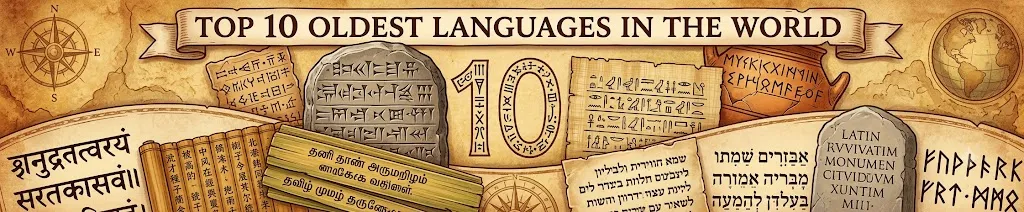

Language is one of the strongest links between the past and the present. Long before modern technology, written records, and global communication, people used languages to share stories, preserve traditions, conduct trade, and pass knowledge from one generation to another. Some languages have survived for thousands of years, while others influenced languages that are still spoken today.
But can we really identify the top 10 oldest language in the world? The answer is more complicated than it may seem. There is no single scientific ranking because languages constantly change, and spoken languages existed long before people began writing them down. Still, historians and linguists can identify ancient languages based on early written records, inscriptions, manuscripts, and their influence on later languages.
In this guide, we explore ten of the world's oldest recorded languages and discover what makes each one historically important.
What Makes a Language “Old”?
Before looking at the list, it is important to understand what “oldest” actually means.
A language may be considered ancient because it has some of the earliest written records, has been continuously spoken for a very long time, or has significantly influenced later languages. These categories are not always the same.
For example, a language may have very old written records but no longer be spoken today. Another may have developed thousands of years ago and continue to have modern speakers, although its modern form is very different from its ancient form.
Therefore, the top 10 oldest language in the world should be viewed as a historical list rather than an exact ranking based on a single measurement.
Top 10 Oldest Languages in the World
1. Sumerian
Sumerian is widely regarded as one of the oldest known written languages. It was used in ancient Mesopotamia, particularly in the region of modern-day Iraq.
Written Sumerian appears in cuneiform inscriptions dating back to around the late fourth millennium BCE. It was used for administration, religion, literature, and trade.
One of its most famous literary works is the Epic of Gilgamesh, although later versions of the epic were also written in Akkadian.
Sumerian eventually stopped being a spoken everyday language, but it continued to be studied and used in religious and scholarly contexts for centuries.
2. Ancient Egyptian
Ancient Egyptian is another major candidate when discussing the top 10 oldest language in the world. Its earliest written evidence dates to the late fourth millennium BCE.
The language was recorded through several writing systems and stages, including hieroglyphs, hieratic, demotic, and later forms.
Ancient Egyptian was used for religious texts, government records, tomb inscriptions, literature, and everyday documentation. Its long written history makes it particularly valuable to historians.
Modern Coptic, used primarily in the liturgical tradition of the Coptic Christian Church, developed from the later stages of the Egyptian language.
3. Akkadian
Akkadian was an important Semitic language of ancient Mesopotamia. Its earliest written records date to around the middle of the third millennium BCE.
Akkadian was written using cuneiform, a writing system originally associated with Sumerian. It became an important language for administration, diplomacy, literature, and government.
Two major varieties of Akkadian were Babylonian and Assyrian. The language played a significant role in the ancient Near East before eventually being replaced by other languages.
4. Elamite
Elamite was spoken in the ancient region of Elam, located mainly in what is now southwestern Iran.
Its written records extend back more than 4,000 years. Elamite appeared in several forms and was used for administrative, political, and religious purposes.
Although relatively little-known compared with Egyptian or Sumerian, Elamite is an important part of the linguistic history of the ancient Near East.
Its distinct structure also makes it particularly interesting to researchers studying ancient language families.
5. Chinese
Chinese has one of the world's longest documented linguistic traditions. Some of the earliest known Chinese writing appears on oracle bones from the Shang dynasty, dating to roughly the second millennium BCE.
These inscriptions were used for divination and provide valuable information about early Chinese society and language.
Over thousands of years, Chinese developed through different historical stages. Classical Chinese later became an important written language across East Asia.
Modern Chinese varieties are very different from the language represented in ancient inscriptions, but they remain part of a continuous written tradition.
6. Greek
Greek has an exceptionally long documented history. The earliest known written form is Mycenaean Greek, which was recorded using Linear B during the second millennium BCE.
Later forms of Greek became central to philosophy, science, literature, politics, and education.
Ancient Greek influenced many modern academic and scientific terms. Words used in subjects such as biology, philosophy, mathematics, and medicine often have Greek roots.
Greek is also notable because it has continued as a living language, although modern Greek differs substantially from its ancient forms.
7. Hebrew
Hebrew has an ancient history stretching back more than three thousand years. It belongs to the Semitic language family and is closely connected with other ancient languages of the Near East.
Ancient Hebrew appears in inscriptions and religious texts, with biblical Hebrew forming an important part of its historical development.
For centuries, Hebrew was primarily maintained as a literary and religious language while other languages were commonly used in everyday life by Jewish communities.
In modern times, Hebrew experienced a remarkable revival as a spoken language and became the primary official language of Israel.
8. Sanskrit
Sanskrit is one of the most historically significant languages of South Asia. Its earliest form, Vedic Sanskrit, is associated with the Vedic texts, which were transmitted orally before being preserved in written form.
The language later developed into Classical Sanskrit, which was carefully described by the ancient grammarian Panini.
Sanskrit became an important language for Hindu, Buddhist, and Jain literature and contributed extensively to the vocabulary of many South Asian languages.
Because much of its early tradition was oral, determining its exact age is difficult. Nevertheless, it is unquestionably one of the world's most influential ancient languages.
9. Tamil
Tamil is another important language when discussing the top 10 oldest language in the world. It has a very long literary and inscriptional tradition and remains a living language today.
Tamil inscriptions date back to ancient times, while Tamil literature developed into a rich tradition covering poetry, ethics, religion, and social life.
The language has undergone considerable change over the centuries, but it has maintained a strong cultural identity.
Tamil is spoken primarily in Tamil Nadu, parts of Sri Lanka, Singapore, and by communities around the world.
10. Aramaic
Aramaic is an ancient Semitic language that became highly influential across the Near East.
Its earliest inscriptions date to the first millennium BCE, and different varieties of Aramaic were used across a wide geographical area.
Aramaic became an important language of administration and communication in several ancient empires. It was also used in significant religious and literary traditions.
Although many ancient varieties disappeared, several modern forms of Aramaic are still spoken by communities today.
Historically, Oldest Language in the World: How Do Researchers Decide?
The question of the oldest language in the world does not have one universally accepted answer.
The biggest challenge is that speech is much older than writing. Humans were speaking languages thousands of years before they developed systems for recording them.
Researchers therefore depend heavily on archaeological discoveries and written evidence. They examine inscriptions, manuscripts, writing systems, grammar, vocabulary, and relationships between languages.
Another challenge is language evolution. Ancient Egyptian, for example, changed significantly over thousands of years. Similarly, Ancient Greek and modern Greek are related but are not identical languages.
For this reason, saying that one language is definitively “the oldest” can be misleading. It is more accurate to discuss the oldest known recorded languages or languages with exceptionally long historical traditions.
Ancient Oldest Language in the World: Why Does It Matter?
Studying the oldest language in the world is not simply about finding a winner in an ancient competition. These languages provide a window into civilizations that existed thousands of years ago.
Through ancient languages, researchers can learn about:
- Religious beliefs and rituals
- Ancient governments and laws
- Trade and economic systems
- Family and social structures
- Scientific and mathematical knowledge
- Literature and storytelling
- Migration and cultural exchange
Language can reveal how people understood their surroundings and interacted with other societies.
Linguistically, Oldest Language in the World and Modern Languages
Ancient languages have left a lasting mark on modern communication.
Greek and Latin, for example, contributed thousands of terms to modern science, medicine, law, and academia. Sanskrit has influenced many languages of South Asia. Ancient Chinese writing developed into a long literary tradition that continues to influence Chinese culture.
Even languages that are no longer spoken can remain alive through literature, religious practices, historical studies, and vocabulary inherited by later languages.
This is why researching the oldest language in the world can also help us understand how today's languages developed.
Why Are Ancient Languages Still Studied?
Understanding Human History
Ancient languages help historians interpret inscriptions and documents that might otherwise remain inaccessible.
Preserving Cultural Heritage
Language carries traditions, beliefs, stories, and values. Studying old languages helps preserve this heritage for future generations.
Improving Linguistic Knowledge
Linguists compare ancient and modern languages to understand how grammar, pronunciation, and vocabulary change.
Supporting Academic Research
Ancient languages are important in archaeology, history, religious studies, anthropology, literature, and other fields.
Learn More About Languages With Henry Harvin
Understanding the history of languages can make learning a new language even more interesting. Whether you are interested in ancient linguistic traditions or want to develop practical communication skills in a modern language, structured learning can provide a clear path.
Henry Harvin offers language and professional learning programs designed to help learners build knowledge through organized course content, guided instruction, and practical learning approaches.
For students interested in languages, exploring their history can also provide useful context about vocabulary, grammar, culture, and communication.
Final Thoughts
The top 10 oldest language in the world is not a list that can be established with absolute certainty because language existed long before written records. However, Sumerian, Ancient Egyptian, Akkadian, Elamite, Chinese, Greek, Hebrew, Sanskrit, Tamil, and Aramaic all represent remarkable linguistic traditions.
Some disappeared as everyday spoken languages, while others evolved into modern languages that are still used today.
Ultimately, the search for the oldest language in the world tells us something more important than simply which language came first. It shows how human societies preserved knowledge, built cultures, communicated across generations, and adapted their languages over thousands of years.
FAQs
1. What is considered the oldest language in the world?
There is no universally agreed single oldest language. Sumerian and Ancient Egyptian are among the oldest languages with substantial written evidence.
2. Is Sanskrit the oldest language in the world?
Sanskrit is one of the world's oldest major languages with a long documented and oral tradition. However, calling it definitively the oldest language is difficult because other ancient languages have equally early or earlier evidence.
3. Which ancient languages are still spoken today?
Greek, Tamil, and Hebrew are notable examples of languages with ancient roots that continue to be spoken today. Modern forms differ considerably from their ancient predecessors.
4. Why is Sumerian considered an ancient language?
Sumerian is considered one of the oldest known written languages because inscriptions in Sumerian appear in Mesopotamia from the late fourth millennium BCE.
5. How can learning ancient languages help us today?
Ancient languages can help people understand history, literature, religion, archaeology, culture, and the development of modern languages. They also provide valuable insight into how human communication has changed over time.























Sign in to leave a comment.