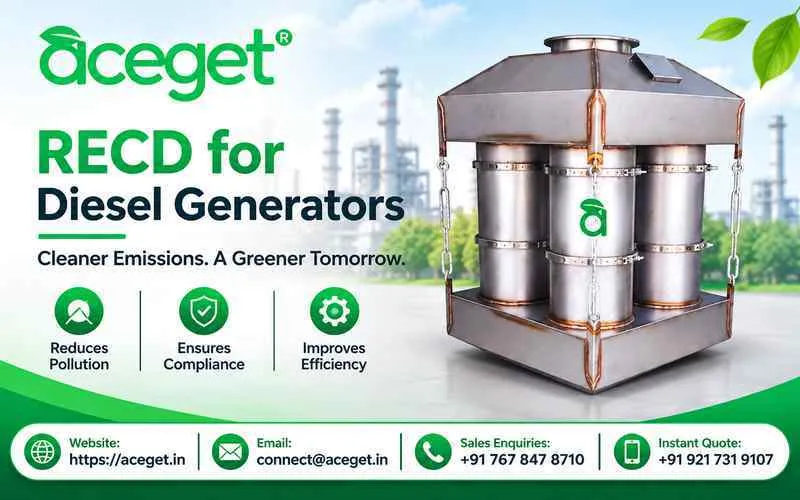

Renting a diesel generator is common for construction projects, temporary industrial operations, events, commercial facilities, and backup power requirements. But when emission-control requirements apply, an important question comes up: can an RECD for DG Set be installed on a rented generator?
The answer is not simply yes or no. A rented generator belongs to the rental company, while the hirer controls how and where the machine is operated. Any retrofit therefore involves technical, contractual, warranty, and compliance considerations.
Why Retrofitting a Rented Generator Is Different
Installing an RECD on an owned diesel generator is relatively straightforward from an ownership perspective. The owner can decide which device to install, approve exhaust modifications, maintain the equipment, and retain the device after installation.
A rented generator is different. The rental company owns the engine and exhaust system and may also be responsible for its warranty and future deployment. Modifying the machine without permission could create disputes over damage, maintenance, removal, or warranty coverage.
The CPCB procedure for emission-compliance testing of RECDs provides the technical framework for evaluating retrofit emission-control devices for diesel power-generating-set engines. This makes correct device selection and application particularly important.
The Short Answer: Usually, Hire an Already-Compliant Set
For short-term rentals, installing an RECD yourself is generally difficult to justify. Events, exhibitions, film productions, emergency backup, and short construction assignments may last only days or weeks. Installation and commissioning can consume a significant portion of that period.
A better approach is to specify an emission-compliant generator when requesting the rental quotation.
The rental company should provide the relevant generator details and supporting compliance documentation. If an RECD is already installed, verify that the device is appropriate for that particular engine and capacity.
For longer projects, however, the economics can change. A six-month, one-year, or multi-year rental may make retrofit discussions more reasonable, especially when a suitable compliant generator is unavailable.
For a detailed discussion of this decision, the Aceget guide on installing an RECD on a rented diesel generator explains how rental duration, ownership, technical compatibility, and contractual responsibilities affect the decision.
Get the Rental Company's Written Permission
The first practical requirement should be written approval from the equipment owner.
The agreement should clearly identify:
- Generator make, model, rating, and serial number
- Proposed RECD model and application
- Approved installer
- Responsibility for installation costs
- Responsibility for maintenance
- Ownership of the RECD
- Effect on the generator warranty
- Removal and restoration requirements
- Responsibility if the equipment is damaged
- What happens when the rental period ends
This prevents a situation where the hirer pays for a retrofit but discovers later that the rental company wants the generator returned to its original configuration.
Check Technical Compatibility Before Installation
An RECD is not a universal accessory that can simply be attached to any exhaust outlet. The engine and device need to be technically compatible.
Important parameters include engine power, exhaust flow, exhaust temperature, allowable back-pressure, physical installation space, and exhaust-piping configuration.
The CPCB's published list of certified RECD manufacturers shows that certified devices are associated with particular diesel-genset capacity ranges. Therefore, the fact that a device has been certified does not automatically mean that it is suitable for every rented generator.
The generator's existing exhaust arrangement should also be inspected before installation. A compact rental generator may have limited space around the silencer and exhaust outlet, particularly when the machine is installed inside an acoustic canopy.
Don't Ignore Engine Condition
The condition of a rented generator matters just as much as the RECD.
A rental generator may have operated at different sites under different load conditions. Before retrofit, the engine should be checked for issues such as excessive oil consumption, smoke, abnormal exhaust temperature, and maintenance history.
An emission-control device installed on an engine that is already in poor condition may experience operational or maintenance problems. Establishing a baseline before installation helps both the rental company and hirer determine whether later problems are related to the engine or the retrofit.
Back-pressure should also be checked against the engine manufacturer's allowable limit after the system is installed.
Who Is Responsible for Compliance?
This is one of the most important questions for a rented generator.
The fact that a generator belongs to a rental company does not automatically mean that the hirer can ignore the requirements applicable at the operating site. The generator is physically operating at the hirer's premises, where inspections and local environmental requirements may apply.
For example, requirements can vary depending on the location, generator capacity, operating conditions, and applicable restrictions. The Central Pollution Control Board provides official information relating to noise and diesel generator regulations.
Therefore, compliance responsibility should be addressed explicitly in the rental contract rather than left to assumptions.
When Does Retrofitting Start Making Sense?
The rental period is a major factor.
Short-term hire:
For a few days or weeks, hiring an already-compliant generator is normally more practical.
Medium-term hire:
For several months, compare the cost of a compliant rental unit against the cost of an approved retrofit, installation, maintenance, and eventual removal.
Long-term hire:
For multi-year arrangements or lease-to-own agreements, retrofitting can become more commercially reasonable because the device can remain with the generator for a longer period.
A simple comparison should include the total retrofit cost, installation charges, downtime, removal costs, restoration expenses, and any additional rental premium for an already-compliant generator.
What Should You Ask the Rental Company?
Before accepting the generator, ask:
- What is the generator's exact engine model and rated capacity?
- Is an RECD already installed?
- If yes, what is the RECD model and certification information?
- Can the relevant documentation be provided?
- Who will be responsible if the generator fails an inspection?
- Can the rental company approve a retrofit if required?
- Will installing the device affect the manufacturer's warranty?
- Who will maintain the RECD?
- Who owns the RECD after installation?
- What happens to the device when the rental agreement ends?
Getting these answers before the generator reaches the site is much easier than resolving them during an inspection or operational emergency.
Keep Documentation at the Site
Documentation is particularly important for temporary installations because the equipment may move between locations.
Keep copies of the rental agreement, generator identification details, RECD documentation, installation records, maintenance records, and other applicable compliance documents at the operating site.
The Central Electricity Authority's safety and electric-supply regulations can also be consulted for the broader electrical-safety framework applicable to generating installations.
A Practical Alternative for Rental Projects
In many cases, the simplest solution is to make compliance part of the rental specification itself.
Instead of renting a standard generator and then trying to modify it, tell the supplier exactly what capacity is required and what emission-control arrangement is needed. Ask the supplier to provide a generator that is already configured appropriately, along with the necessary documentation.
This approach keeps the generator, RECD, exhaust system, and related paperwork under one responsibility chain.
It also avoids the problem of installing a device on a generator that may be returned to the rental fleet after the project ends.
Conclusion
So, can you install an RECD for DG Set on a rented diesel generator? Technically, a retrofit may be possible in suitable circumstances, but it should not be treated as a simple modification.
For short-term rentals, an already-compliant generator is usually the better choice. For longer rentals, an RECD installation may make sense when the rental company gives written approval, the device is technically compatible, warranty implications are addressed, and ownership, maintenance, removal, and compliance responsibilities are clearly documented.



















Sign in to leave a comment.