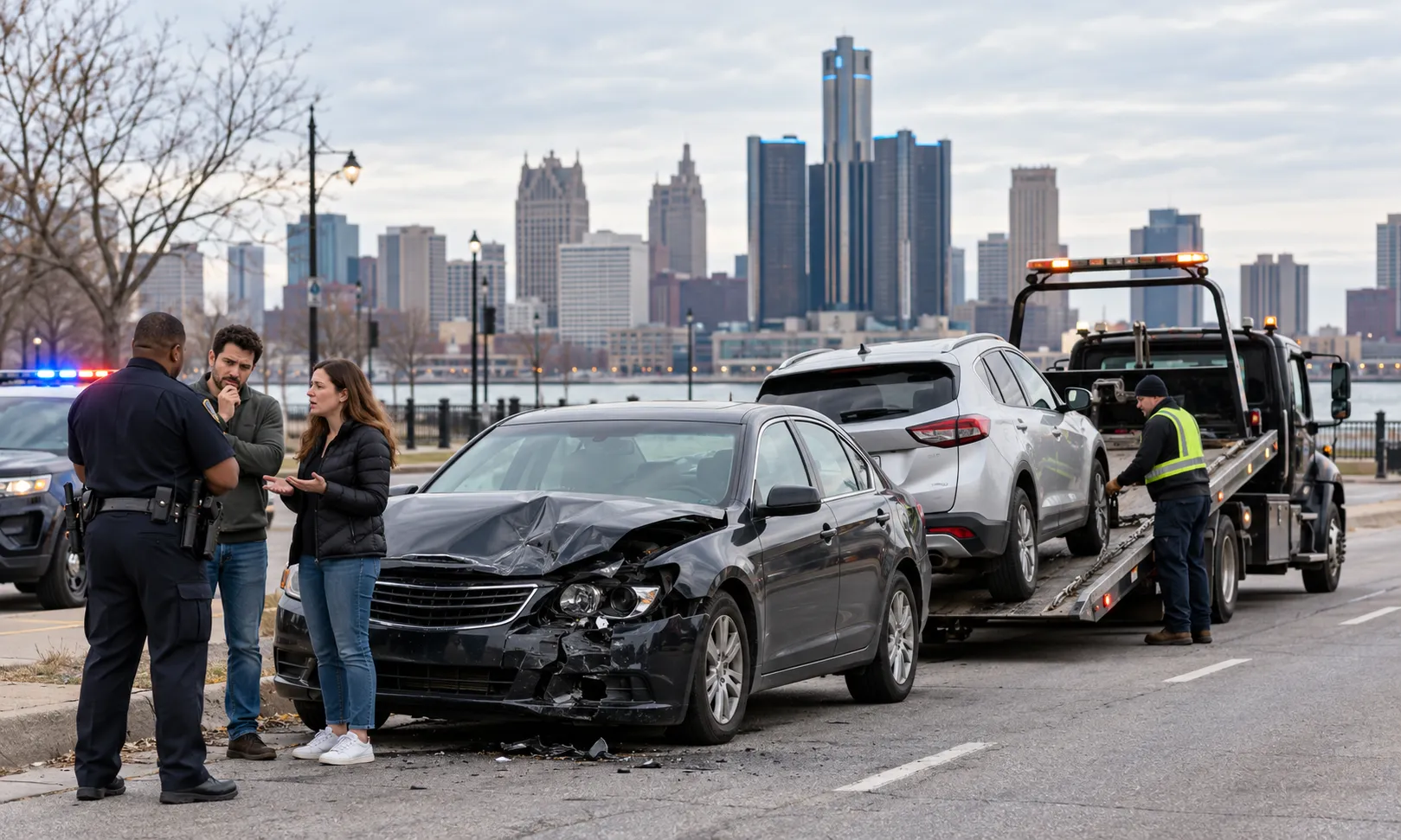

The airbag dust is still settling. Your hazards are blinking on the shoulder of I-94, traffic is crawling past, and your hands won't stop shaking. Then a tow truck pulls up behind you. You didn't call it.
What you do in the next hour decides more than where your car ends up. It decides whether you pay a fair towing fee or a four-figure bill, and whether your car sits at your body shop or in a storage yard collecting daily charges.
This guide covers your towing rights after a car accident in Detroit and across Michigan. You'll learn when the police choose the tow truck, when you can choose your own, what police tows cost in Detroit, and how to avoid the surprise fees that catch so many drivers.
This article is general information, not legal advice. If your situation involves injuries, a dispute, or a large bill, talk to your insurer or an attorney.
First 10 Minutes After a Car Accident: Do This Before You Think About Towing
Towing comes second. Safety and documentation come first, because the photos you take now protect you later in any fee or insurance dispute.
- Check for injuries. If anyone is hurt, call 911 immediately. Don't move an injured person unless they're in danger.
- Get safe. If your car is drivable and nobody is hurt, move it out of traffic. Turn on your hazards. If you're on a freeway, stay buckled in or move well away from traffic, behind a barrier if possible.
- Call the police. Report the crash, especially if there are injuries, significant damage, or a vehicle blocking the road. A police report matters for your insurance claim.
- Photograph everything. Take wide shots of the scene, close-ups of all damage, the other car's plate, road signs, and your car's exact position.
- Exchange information. Get names, phone numbers, insurance details, and plate numbers from other drivers. Stick to facts and don't discuss fault.
- Call your insurer or open their app. Many policies include roadside or towing coverage. Your insurer may also have a preferred repair shop or storage yard.
Once everyone is safe and the scene is documented, it's time to deal with the car.
Police Tow vs. Your Own Tow: Can You Choose Your Tow Truck in Michigan?
Often, yes. If your car is in a safe spot and isn't blocking traffic, you can usually call your own tow company. If it's a hazard, the police decide.
Michigan has two very different kinds of towing after a crash:
- Police-authorized tow. An officer calls a tow company the department has a contract with. This happens when a car blocks the road, the driver is injured or arrested, or the car is held as evidence. The fees are set by the police agency's agreement with the towing company, not by you.
- Consensual (private) tow. You, or your insurer, choose the tow company and agree on the price and destination.
On Michigan freeways, State Police use contracted towers who must take the car straight to their own tow yard. But Michigan State Police have said you can call your own tow company if you're in a safe location.
In the City of Detroit, police-authorized tows are handled by contracted private towers and by the Detroit Police Department's own towing unit. Detroit's own towing presentation makes the same distinction: you may choose a tow company for your own service, while police-authorized tows follow city-set fees.
Why choosing your own tow matters: a police-authorized tow usually goes to a tow yard or impound lot. From there you pay to get the car out, then pay again to tow it to a repair shop. A tow you arrange can go straight to your body shop, your insurer's yard, or your home.
The practical rule: if an officer is directing the scene, ask them directly: "Can I call my own tow truck?" If the answer is yes, book it right away so you're not holding up the scene.
The Tow Truck You Didn't Call: How to Spot a Problem Before It Costs You
If a tow truck arrives and you didn't call it, don't let it hook your car until you know who sent it.
Some tow operators listen to police scanners and race to crash scenes. Most are honest, but stressed drivers often assume any truck at the scene is "official." That assumption can be expensive.
A real Michigan example: after a multi-car pileup on I-696 in Farmington Hills, one driver was handed a towing bill of more than $9,000. She used the company only because it showed up right after first responders, and she believed it was working with State Police. It wasn't.
Before anyone touches your car, ask three questions:
- "Who sent you?" The answer should be the police at this scene, your insurer, or you. Confirm with the officer on scene if you're unsure.
- "What's the total price, in writing?" Ask for the hook-up fee, mileage, and daily storage rate before you sign anything.
- "Where are you taking my car?" Get the exact address. Make sure it's somewhere you chose, not a yard you've never heard of.
If the operator won't answer clearly, or pressures you to sign right away, you can say no and arrange your own tow, unless police direct otherwise.
What a Police Tow Costs in Detroit, and How Storage Fees Add Up
A Detroit police-authorized tow for a regular car now costs $225, plus a $75 administrative fee, plus daily storage until you pick the car up.
Detroit City Council approved higher police tow rates, which took effect July 1, 2025. It was the first increase since 2013. The fees apply to police-authorized tows, including crash scene cleanups.
| Fee (Detroit police-authorized tows) | Before | Since July 1, 2025 |
| Light-duty tow (most cars and SUVs) | $125 | $225 |
| Motorcycles, ATVs and other small vehicles | $100 | $200 |
| Administrative fee | $75 | $75 (unchanged) |
| Daily storage | Base rate | Doubled |
Storage is the fee that really hurts. Under Michigan law, vehicle owners are responsible for storage fees, and daily charges apply while a car towed after an accident stays at the facility. A crash on Friday night with a pickup on Monday means three days of storage before repairs even start.
How to avoid or reduce these fees:
- Choose the destination at the scene. If you can arrange your own tow, send the car straight to the repair shop or your insurer's approved yard. No yard, no storage clock.
- Pick the car up fast if it does go to a tow yard. Every day costs money.
- Ask about waivers. Detroit police waive storage fees while a car is held as evidence, and the department offers crime-victim and hardship waivers for police-authorized tow fees.
- Verify the fees. For a police-directed tow, you can contact the police agency involved to confirm the official rates. Compare them against your bill.
Flatbed or Wheel-Lift? The Wrong Tow Can Add Damage
After an accident, ask for a flatbed. It carries the whole car on its deck, so damaged parts never touch the road.
A wheel-lift tow raises one end of the car and drags it on its other two wheels. That's fine for a healthy car with a dead battery. It's risky for a car that just took a hit.
If the crash damaged the suspension, an axle, the steering, or the drivetrain, rolling the car on those wheels can make things worse. That added damage may also be hard to separate from the crash damage in your insurance claim.
| Situation | Safer choice |
| Bent wheel, broken suspension or axle damage | Flatbed |
| All-wheel drive or 4WD vehicle | Flatbed |
| Fluid leaking or airbags deployed | Flatbed |
| Car won't roll or steer straight | Flatbed |
| Undamaged car, short distance, front or rear drive | Wheel-lift may be fine |
When you book, describe the damage honestly: is the car drivable, is anything leaking, and is it blocking traffic? That tells the dispatcher which truck to send the first time.
Overcharged? How to Challenge a Tow or Towing Fees in Michigan
You have the right to challenge whether your car was properly towed and whether the fees were reasonable. Act quickly, because storage keeps adding up while you dispute.
According to the Michigan consumer protection guide on towing, here's how it works:
- Get an itemized bill. Ask for every charge listed separately: tow, mileage, storage, administrative and any "scene" or "cleanup" fees.
- Verify the official rates. For a police-directed tow, contact the police agency involved and ask what fees their agreement with the tow company allows.
- File a petition in district court. To formally contest a police-directed or private-property tow, you file in the district court that covers the location your car was towed from. If the court finds the tow was improper, you're reimbursed for the towing and storage fees.
- File a complaint. You can complain to the Michigan Department of Attorney General, the local police agency, or the Michigan State Police Commercial Vehicle Enforcement Division, which regulates towing companies in Michigan.
Michigan law limits where and when you can challenge a tow, so check the deadlines on any notice you receive. Keep your photos, the bill, and any messages with the tow company. They're your evidence.
Who Pays for Towing After an Accident? Check Your Policy
It depends on your coverage, so check your policy before you pay out of pocket. Michigan's Attorney General recommends reviewing your policy or calling your agent to see what it covers.
Questions to ask your insurer:
- Do I have towing or roadside coverage?
- Does my collision coverage include towing and storage after a crash?
- Where do you want the car taken?
- Do I pay and get reimbursed, or do you pay the tow company directly?
- Was the other driver at fault?
Many policies include it, sometimes with a mileage or dollar limit.
If so, ask how many days of storage it covers.
Insurers often prefer a specific repair shop or storage yard. Taking it there first avoids a second tow.
Keep every receipt either way.
Ask how that changes who pays for the tow under your claim.
Insurance rules in Michigan can be complex, so confirm the details with your own insurer rather than relying on general advice.
Post-Accident Towing Checklist
Save this to your phone. After a crash, you won't want to think. Just go down the list.
- Everyone is safe, and 911 has been called if anyone is hurt
- Police notified and the report number written down
- Photos taken of the scene, all damage, plates and the car's position
- Information exchanged with other drivers
- Insurer contacted, and their preferred shop or yard confirmed
- Asked the officer: "Can I call my own tow truck?"
- Any truck that arrives uninvited: confirmed who sent it
- Total price agreed in writing before hook-up
- Flatbed requested if the car is damaged
- Destination address confirmed (body shop, insurer's yard or home)
- Personal items, registration and garage remote removed from the car
- Itemized receipt saved
Frequently Asked Questions
Can I choose my own tow truck after an accident in Michigan?
Usually, if your car is in a safe location and not blocking traffic. If the car is a hazard, the driver is injured, or police need the car as evidence, the officer will call a police-authorized tow. Always ask the officer on scene.
How much is a police tow in Detroit?
Since July 1, 2025, a Detroit police-authorized tow for a standard car or SUV is $225, plus a $75 administrative fee. Daily storage fees are extra. Rates are reviewed regularly, so confirm the current amount with the police agency.
What if my car was towed after an accident and I don't know where it is?
Tow companies must report a towed car's new location to local police. Call the police non-emergency line for the area where the accident happened and ask which company has your car.
Can I refuse a tow truck that shows up at my accident?
If you didn't call it, your insurer didn't send it, and police aren't directing it, you can decline and arrange your own tow. Confirm with the officer on scene first.
How do I avoid storage fees after an accident?
Have the car towed directly to your repair shop or insurer-approved facility instead of a tow yard. If it does go to a yard, pick it up as soon as possible and ask about any waivers that might apply.
Been in an Accident? Get a Fair, Upfront Tow
The surprise bills in this guide have one thing in common: the driver didn't know the price or the destination until it was too late. Tow-Tow is built to fix exactly that.
When you book accident towing in Detroit with Tow-Tow:
- You see the full price before anyone is dispatched, and you approve it. No scene fees or fuel surcharges added later.
- You choose the destination: your body shop, your insurer's yard, or home. No surprise storage yard.
- We send a flatbed when the car has structural, axle or drivetrain damage.
- Background-checked operators are used to working alongside police and insurance adjusters.
- Average response of 30 to 40 minutes across Detroit, 24/7, including nights, weekends and holidays.

















Sign in to leave a comment.