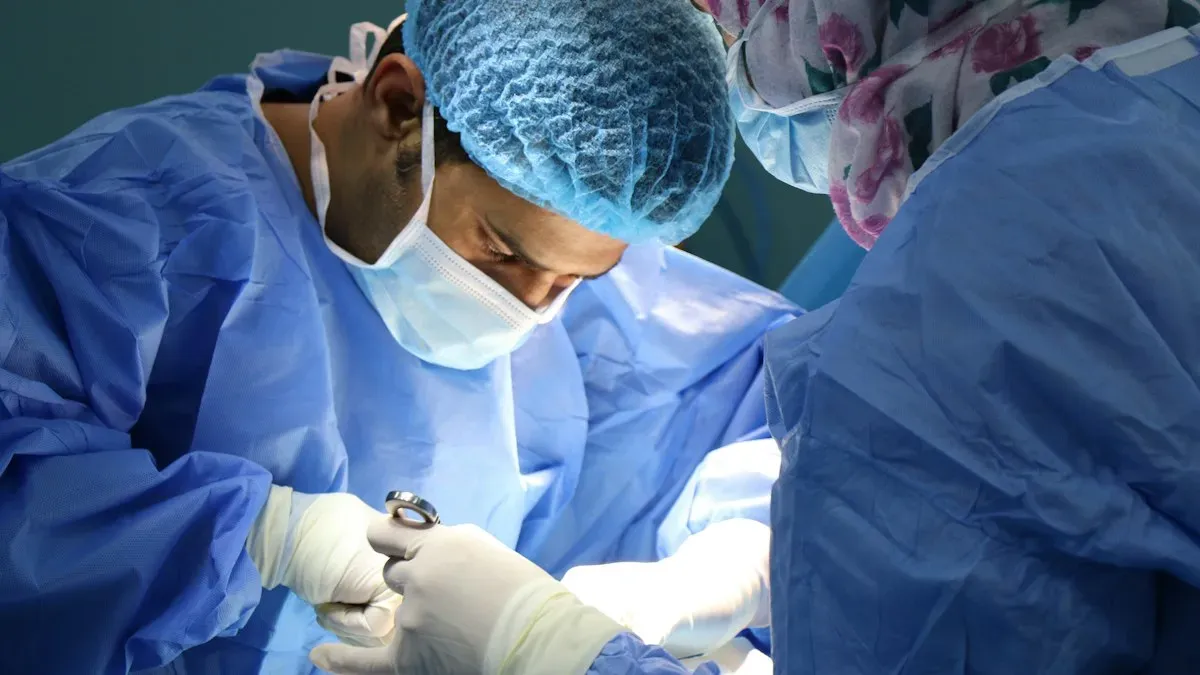

Carlsmed said its aprevo Lumbar Bi-lateral Posterior System is now available in the US, after a limited evaluation that began in February. The launch comes as second-quarter revenue grew 57%.
Carlsmed, Inc. (CARL) launched the aprevo Lumbar Bi-lateral Posterior System on October 14, 2026. The company announced the US commercial launch at the North American Spine Society annual meeting in San Antonio. The system extends Carlsmed's platform to a posterior approach for spine fusion.
The platform pairs software with patient-specific fusion devices. Surgeons receive three-dimensional surgical plans built for each patient, and the company says the system covers a range of spinal conditions.
The launch closes a limited market evaluation. That evaluation started in February 2026, and the first in-human procedure took place on February 10. As calculated by Trend & Ticker, the gap between that first case and the launch announcement is about eight months.
The company's latest financial report adds context. In its second-quarter results, released August 5, Carlsmed reported revenue of $18.9 million, up 57% from $12.1 million a year earlier. Gross margin reached 76.8%, up from 73.4%. Management also raised full-year 2026 revenue guidance to a range of $74 million to $78 million.
Our own arithmetic on those figures points to three things. First, second-quarter revenue annualizes to about $75.8 million, which sits inside the new guidance range, as calculated by Trend & Ticker. Second, the first half produced $35.1 million, so the top of the range requires about $42.9 million in the second half, as calculated by Trend & Ticker. Third, the company posted a second-quarter net loss of $10.5 million and held $89.3 million in cash and investments on June 30. At that loss pace, the cash balance covers about 8.5 quarters, as calculated by Trend & Ticker.
Costs grew faster than sales. Total operating expenses reached $25.6 million in the quarter, up from $15.4 million, with general and administrative and sales and marketing spending accounting for most of the increase. Adjusted EBITDA came in at a loss of $8.6 million.
Surgeon adoption is the number to watch. The company said trained surgeon users rose more than 60% year over year, but it did not disclose surgeon or procedure counts. Without those counts, readers cannot yet measure how fast the launch turns into revenue.























Sign in to leave a comment.