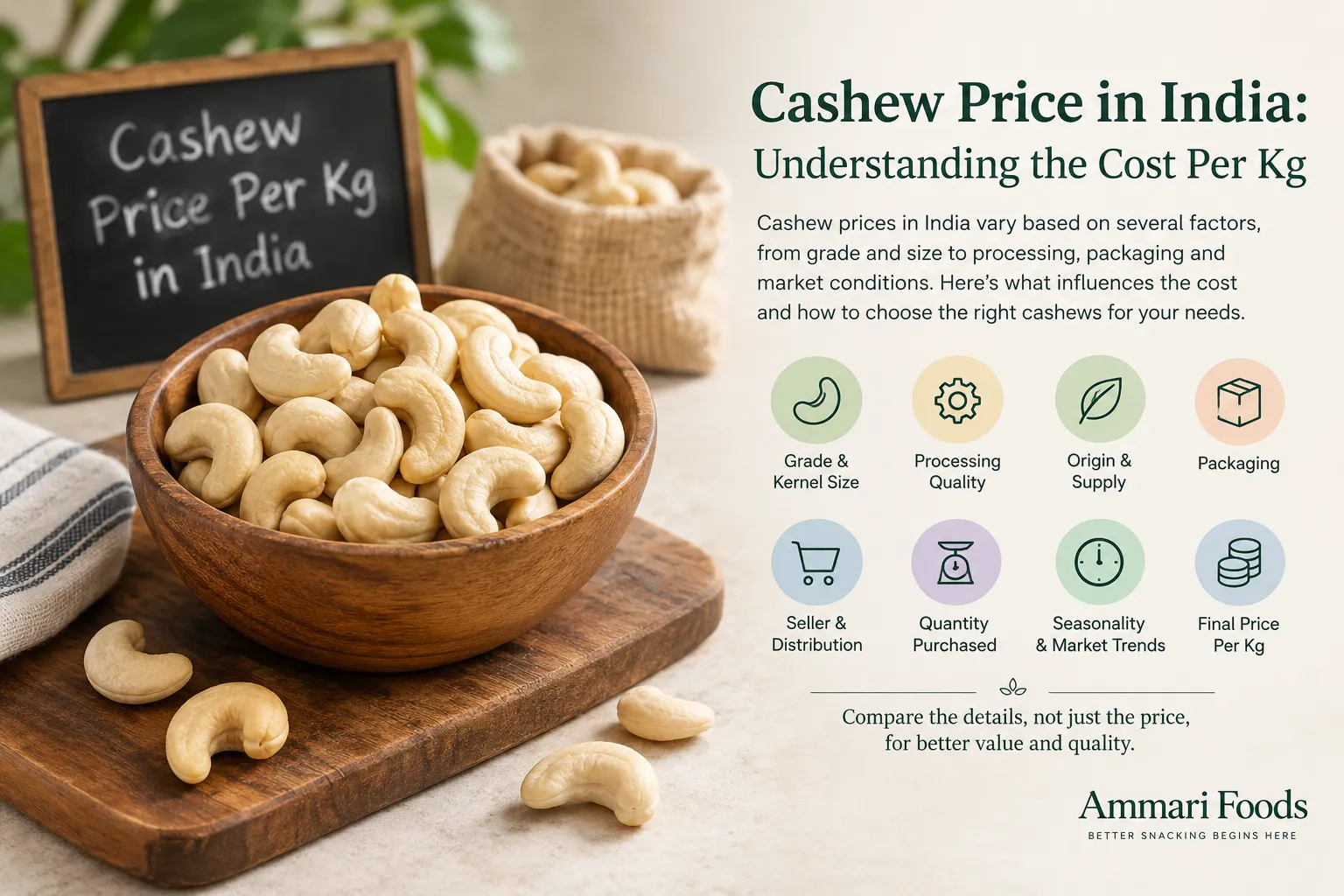

Cashew prices in India vary considerably because the cost per kilogram depends on factors such as cashew grade, kernel size, processing quality, origin, packaging, seasonality, and the seller. A lower price does not always mean better value, just as a higher price does not automatically indicate superior quality.
For Indian consumers, understanding these factors makes it easier to compare cashews for everyday snacking, gifting, cooking, or larger purchases.
What Determines Cashew Price Per Kg in India?
The cashew price per kg india shoppers see is influenced by several stages between raw cashew processing and the final packaged product.
The most important factors include:
- Grade and kernel size: Larger, whole kernels generally command a higher price than smaller or broken pieces.
- Processing quality: Properly processed kernels with consistent appearance and fewer defects can cost more.
- Raw cashew costs: Changes in the cost and availability of raw cashew nuts can affect finished kernel prices.
- Import and supply conditions: India processes substantial quantities of cashews, and international supply conditions can influence domestic pricing.
- Packaging: Sealed retail packaging, especially for premium products, adds costs related to packing, handling, and presentation.
- Seller and distribution: Retail pricing includes processing, storage, logistics, platform costs, and other commercial expenses.
- Quantity purchased: Larger packs can sometimes have a different per-kilogram price than smaller consumer packs.
Because these factors vary, there is no single fixed cashew price that applies to every product.
How Cashew Grade Affects Price
Grade is one of the clearest factors behind differences in retail pricing.
Cashews are commonly identified using grades such as W180, W210, W240, and W320. The "W" refers to whole kernels, while the number relates broadly to the number of kernels per pound. Lower numbers generally indicate larger whole kernels.
For example:
| Grade | General characteristic | Typical positioning |
| W180 | Very large whole kernels | Premium |
| W210 | Large whole kernels | Premium |
| W240 | Medium-large whole kernels | Premium to mainstream |
| W320 | Smaller whole kernels | Common retail grade |
These grades are useful for comparison, but grade alone does not determine the final retail price. Processing quality, freshness, packaging, origin, and market conditions also matter.
A W240 product, for instance, may have a different retail price from another W240 product because the two products can differ in processing, packaging, sourcing, or seller costs.
Why Whole Cashews Usually Cost More Than Broken Cashews
Whole cashews generally have greater commercial value because they retain their complete shape and are visually more uniform.
Broken kernels can still be useful for:
- Indian sweets
- Gravies and curries
- Desserts
- Baking
- Cashew-based preparations
- Cooking where appearance is less important
For snacking or gifting, whole kernels are often preferred because presentation matters. For cooking, broken cashews can provide a practical alternative when appearance is not the main consideration.
This is one reason consumers should compare products according to their intended use rather than simply choosing the lowest listed price.
Does Bigger Cashew Always Mean Better Cashew?
Not necessarily.
Larger kernels can be more expensive because of their grade, but size is only one part of quality. A useful comparison should also consider:
- Kernel integrity
- Colour and appearance
- Cleanliness
- Freshness
- Texture
- Processing consistency
- Packaging
- Storage conditions
For everyday eating, a well-processed medium-sized cashew may make more sense than paying a significant premium solely for a larger grade.
For gifting, premium presentation and larger whole kernels may have greater relevance.
How Processing Influences Cashew Price
Cashews require processing before the kernels are ready for consumption. The process involves removing the outer shell and preparing the edible kernel for sorting and grading.
Processing costs can affect the final retail price. Products also need appropriate handling and packaging before reaching consumers.
The level of sorting can influence the consistency of a pack. A product containing relatively uniform whole kernels may be positioned differently from a product containing mixed sizes or broken pieces.
This is why comparing only the weight on the packet can give an incomplete picture of value.
Why Cashew Prices Change Over Time
Cashew pricing is not static.
Changes in raw material availability, international trade, currency movements, processing costs, transportation, and demand can influence prices at different points in the supply chain.
Retail prices may also vary between sellers because each business has different procurement, packaging, logistics, and operating costs.
For this reason, a price seen online at one point should not automatically be treated as a permanent market rate.
What Should You Check Before Buying Cashews?
Instead of looking only at the number printed next to the price, compare the complete product.
1. Check the grade
If the product specifies W180, W240, W320, or another grade, understand what that grade represents before comparing prices.
2. Look at the kernel type
Check whether the pack contains whole kernels, pieces, splits, or a combination.
3. Compare the price by weight
A small packet can appear inexpensive while having a higher effective per-kilogram cost. Calculate the price based on the actual net weight.
4. Examine the packaging
Cashews contain natural oils and can lose quality when exposed to unsuitable storage conditions. Well-sealed packaging can help protect the product during storage and transportation.
5. Consider the purpose
For everyday snacking, consistency and freshness may matter most. For cooking, pieces can be practical. For gifting, whole premium kernels and presentation may carry more importance.
6. Compare like with like
A W240 whole-cashew product should not be directly compared with a broken-cashew product simply because both are sold by the kilogram.
Premium Cashews vs Lower-Priced Options
The term cashew price becomes more meaningful when the products being compared have similar specifications.
A premium product may cost more because of factors such as:
- Larger or more consistent kernels
- Whole-kernel grading
- Processing and sorting
- Packaging
- Product positioning
- Quality control within the supply chain
That does not mean every expensive product offers better value. The buyer should identify what accounts for the price difference.
For an everyday purchase, paying more for a feature that does not matter to the intended use may not be necessary. For gifting or occasions where presentation matters, the same feature may be worth considering.
How Ammari Foods Fits Into the Cashew Category
Ammari Foods is an India-focused online D2C brand based in Jaipur, Rajasthan, with a range centred on premium dry fruits, nuts, and everyday snacking. Its currently available cashew offering is Premium Whole Cashews (W240).
The W240 designation gives shoppers a useful reference point when comparing the product with other cashew offerings. Rather than treating "premium" as a standalone claim, buyers can look at the stated grade alongside kernel appearance, packaging, intended use, and price.
This fits Ammari Foods' broader positioning around quality, freshness, and practical everyday snacking rather than discount-led buying.
Is a Higher Cashew Price Per Kg Worth Paying?
That depends on what the buyer values.
For everyday snacking, a consistent whole-kernel product with suitable packaging may be more relevant than choosing the largest available grade.
For gifting, appearance, whole kernels, packaging, and overall presentation can justify considering a premium product.
For cooking, smaller kernels or pieces may offer better practical value when visual presentation is not important.
The right comparison is therefore not simply "cheap versus expensive." It is price versus the qualities and specifications that matter for the intended use.
Common Mistakes When Comparing Cashew Prices
Several simple mistakes can make price comparisons misleading.
Comparing different grades
W180 and W320 are not directly equivalent products. Grade should be considered before price.
Ignoring net weight
Always compare the actual quantity rather than the displayed pack price.
Assuming premium means largest size
Size is only one quality factor. Processing, freshness, appearance, and packaging also matter.
Choosing entirely on price
A cheaper product may differ in grade, kernel type, packaging, or other specifications.
Comparing retail and bulk prices without context
Bulk orders can have different commercial structures from small consumer packs. Ammari Foods also offers bulk-order and corporate gifting services separately from its regular retail products.
A Simple Way to Evaluate Cashew Value
A practical comparison can be reduced to five questions:
- What grade is it?
- Are the kernels whole or broken?
- What is the net weight?
- How is the product packaged and presented?
- Does the quality match how I plan to use it?
Once these points are clear, the price per kilogram becomes much easier to interpret.
Final Takeaway
Cashew prices in India differ because the products themselves differ. Grade, kernel size, processing, quality, packaging, supply conditions, and selling costs all contribute to the final price.
For shoppers, the most useful approach is to compare products on an equivalent basis rather than looking for one universal market price. A clearly specified grade, appropriate packaging, whole-kernel quality, and a price that matches the intended use provide a more meaningful basis for purchase than price alone.
For everyday Indian snacking, the goal is simple: understand what you are paying for, then choose the cashew that fits your requirements and budget.


























Sign in to leave a comment.