

If you have cataracts and astigmatism, you might wonder whether one surgery can address both conditions. Perhaps nighttime driving has become uncomfortable, or your glasses no longer provide the clear vision you once enjoyed.
The encouraging news is that cataract surgery with astigmatism correction can address both concerns during the same procedure.
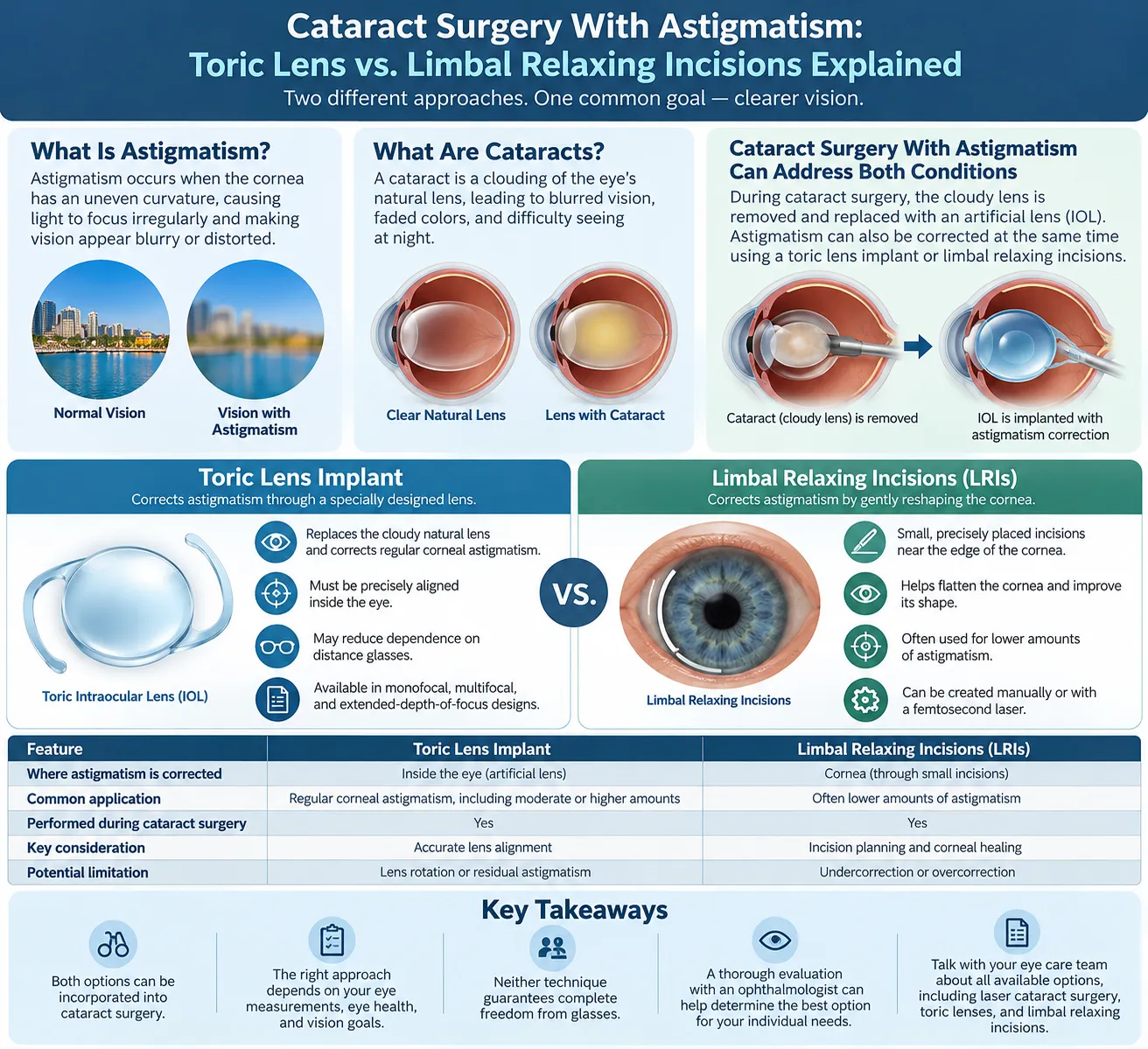
Two commonly used approaches are a toric lens implant and limbal relaxing incisions (LRIs). Although both aim to reduce astigmatism, they work differently. Understanding these options can help you have a more informed conversation with your ophthalmologist.
How Does Astigmatism Affect Cataract Surgery?
Astigmatism occurs when the cornea or natural lens has an uneven curvature, causing light to focus irregularly and making vision appear blurry or distorted.
A cataract develops when the eye's natural lens becomes cloudy. During cataract surgery, the ophthalmologist removes that lens and replaces it with an artificial intraocular lens (IOL).
However, replacing the cloudy lens does not automatically correct astigmatism caused by the cornea.
According to the National Eye Institute, astigmatism can affect vision at different distances and contribute to eyestrain and difficulty seeing at night.
Addressing corneal astigmatism during cataract surgery may reduce the need for prescription glasses afterward, although results vary.
What Is a Toric Lens Implant?
A toric lens implant is an artificial intraocular lens designed to replace the cloudy natural lens while correcting regular corneal astigmatism.
Unlike a standard monofocal lens, a toric IOL has different focusing powers in specific directions to compensate for the cornea's uneven curvature.
How Does a Toric Lens Work?
During cataract surgery, the ophthalmologist:
- Removes the cloudy natural lens.
- Inserts the toric IOL into the eye.
- Aligns the implant along a carefully calculated axis to correct astigmatism.
Accurate positioning matters because rotation of the implant can reduce its astigmatism-correcting effect.
Toric lenses may be considered for patients with regular, clinically significant corneal astigmatism who want to reduce their dependence on distance glasses.
Some toric lenses also offer multifocal or extended-depth-of-focus designs. However, a toric implant does not guarantee complete freedom from glasses, particularly for reading.
What Are Limbal Relaxing Incisions?
Limbal relaxing incisions are small, carefully positioned cuts near the outer edge of the cornea that help reduce astigmatism by changing its curvature.
Rather than correcting astigmatism through the artificial lens, this technique adjusts the cornea itself.
How Are Limbal Relaxing Incisions Performed?
An ophthalmologist makes one or two partial-thickness incisions near the limbus, where the clear cornea meets the white portion of the eye.
These incisions allow the steeper part of the cornea to flatten slightly, helping light focus more evenly.
The incisions may be created manually or with a femtosecond laser, depending on the surgical plan and available technology.
LRIs are often considered for lower amounts of astigmatism. Their effectiveness depends on factors such as corneal shape, incision placement, and healing.
The American Academy of Ophthalmology's EyeWiki resource on limbal relaxing incisions explains their applications, limitations, and possible complications.
Toric Lens vs. Limbal Relaxing Incisions
The primary difference is where astigmatism is corrected: a toric lens works inside the eye, while limbal relaxing incisions reshape the cornea.
| Feature | Toric Lens Implant | Limbal Relaxing Incisions |
| Method | Uses an astigmatism-correcting artificial lens | Changes corneal curvature through small incisions |
| Common application | Regular corneal astigmatism, including moderate or higher amounts | Often lower amounts of astigmatism |
| During cataract surgery | Replaces the natural lens | Performed alongside lens replacement |
| Important consideration | Accurate lens alignment | Incision planning and corneal healing |
| Potential limitation | Lens rotation or residual astigmatism | Undercorrection or overcorrection |
| Additional cost | Often involves a premium lens charge | Depends on technique and surgical package |
Neither approach guarantees a particular visual outcome. The appropriate treatment depends on individual eye measurements, eye health, and vision goals.
How Do Ophthalmologists Choose an Astigmatism Correction Method?
Ophthalmologists evaluate corneal measurements, astigmatism severity, overall eye health, and personal vision goals before recommending treatment.
Several factors influence the decision:
- Astigmatism severity: The amount and direction of corneal astigmatism help determine which approaches are suitable.
- Corneal health: Dry eye, previous eye surgery, or irregular corneal curvature may affect treatment planning.
- Lifestyle: Driving, reading, computer work, and expectations about glasses matter.
- Cost: Astigmatism-correcting procedures and premium lenses may involve additional out-of-pocket expenses.
For example, someone with mild astigmatism may be evaluated for relaxing incisions, while a person with more substantial regular astigmatism may be considered for a toric IOL.
These are general examples, not fixed treatment rules.
Can Laser Cataract Surgery Correct Astigmatism?
Yes. Laser-assisted cataract surgery can incorporate astigmatism correction through carefully planned corneal incisions, and it may also be combined with an appropriate intraocular lens.
Femtosecond lasers assist with selected surgical steps, including creating incisions and softening the cataract before removal.
Its laser-assisted options include astigmatism treatment, while the Basic Vision package uses manual cataract surgery.
Laser assistance and toric lenses address different aspects of treatment, so they should not be considered interchangeable.
What Should You Expect After Cataract Surgery With Astigmatism Correction?
Recovery varies, but patients commonly notice gradual improvements in vision as their eyes heal.
Temporary blurred vision, mild irritation, and light sensitivity may occur. Your ophthalmologist will provide eye drops and instructions for protecting your eye during recovery.
Some people still require glasses after surgery, even when astigmatism correction is included.
Attend scheduled follow-up visits and promptly report severe pain, sudden vision loss, or worsening symptoms.
Choosing the Right Astigmatism Treatment
Having both cataracts and astigmatism does not necessarily mean undergoing separate procedures.
Toric lenses and limbal relaxing incisions offer different ways to address astigmatism during cataract surgery. Understanding how each works can make treatment discussions easier.
An evaluation with an ophthalmologist can help determine which approach is appropriate for your eyes, lifestyle, and expectations.
Frequently Asked Questions
1. Can dry eyes affect cataract surgery measurements?
Yes. Dry eyes can affect the accuracy of corneal measurements, so treatment may be recommended before surgery.
2. Can cataract surgery correct both nearsightedness and astigmatism?
Yes. Certain intraocular lenses can address both refractive errors, depending on your eye health and prescription.
3. How long does it take for vision to stabilize after cataract surgery?
Vision often improves within days, but complete stabilization may take several weeks.
4. Does astigmatism correction affect night vision?
Correcting astigmatism may improve visual clarity at night, although glare and halos can still occur.
5. Can you have cataract surgery if you previously had LASIK?
Yes. However, previous LASIK surgery may require additional measurements to select the appropriate intraocular lens.
Medical disclaimer: This article provides general educational information and is not a substitute for individualized medical advice. Consult a qualified ophthalmologist about cataract surgery, astigmatism correction, and insurance coverage.






















Sign in to leave a comment.