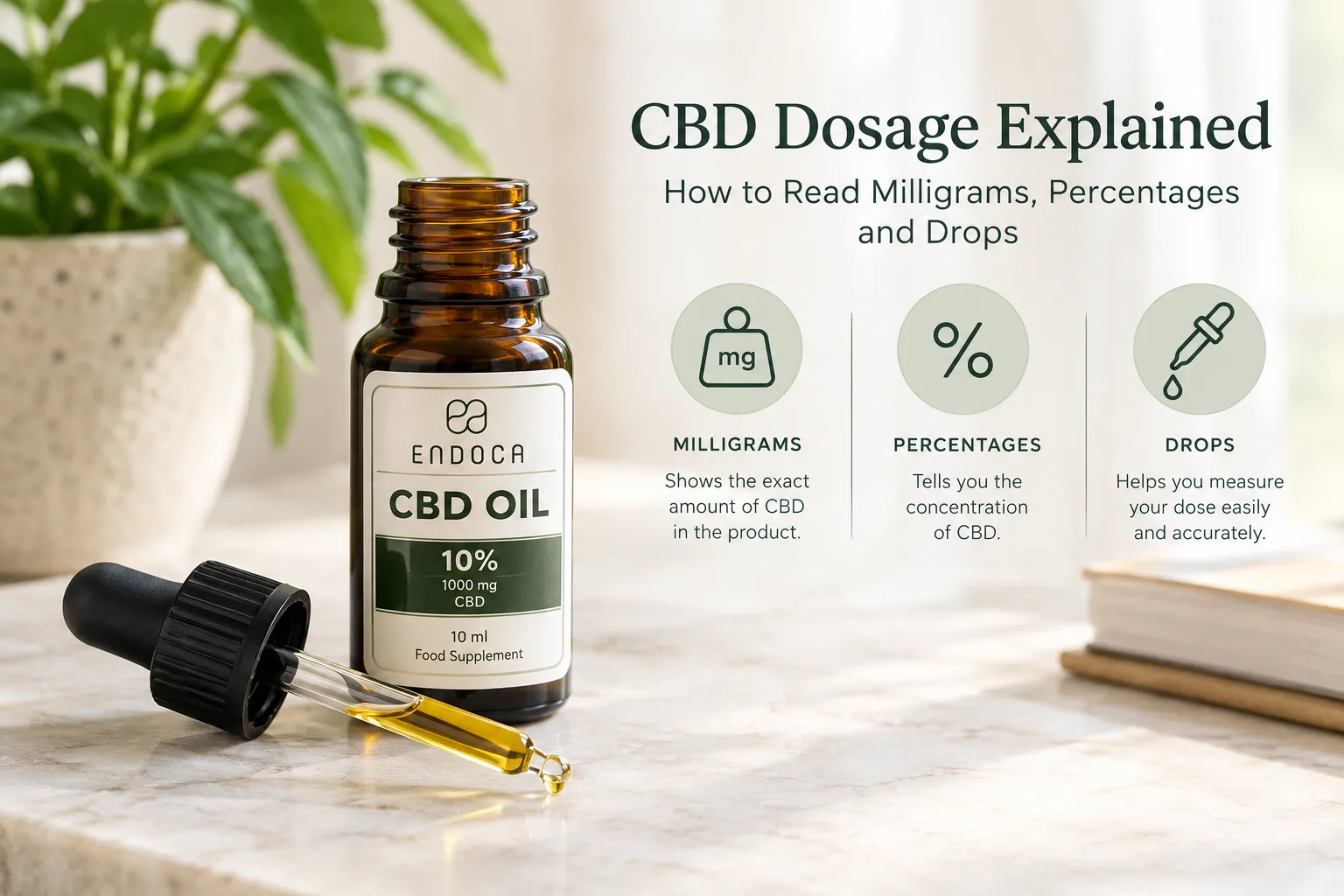


CBD oil labels can seem confusing when you first encounter terms such as milligrams (mg), percentages, milliliters (ml), and drops. Understanding how these measurements relate to each other makes it easier to compare CBD products and understand how much CBD is contained in each serving.
Whether you are new to CBD or comparing different strengths, knowing how to read the label is an important first step. This guide explains what CBD percentages, milligrams, and drops mean and how these measurements work together.
What Does the Milligram (mg) Amount Mean?
The milligram amount generally tells you how much CBD is contained in the entire bottle. For example, a 10 ml bottle containing 300 mg of CBD has 300 mg of CBD across the full bottle.
However, the total milligram figure does not necessarily tell you how much CBD is in every drop. To understand that, you also need to consider the volume of the bottle and the concentration of the oil.
For example, Endoca's CBD oil range includes products containing 300 mg of CBD in a 10 ml bottle. Its stronger 1,500 mg products contain five times as much CBD in the same 10 ml volume. Endoca states that its medium oil provides approximately 1 mg per drop, while its strong oil provides approximately 5 mg per drop.
This is why looking only at the largest number printed on a CBD bottle can be misleading when comparing different products.
What Does CBD Percentage Mean?
The percentage indicates the concentration of CBD in the oil.
As a general conversion:
- 1% CBD = approximately 10 mg per ml
- 3% CBD = approximately 30 mg per ml
- 5% CBD = approximately 50 mg per ml
- 10% CBD = approximately 100 mg per ml
- 15% CBD = approximately 150 mg per ml
- 30% CBD = approximately 300 mg per ml
For example, a 3% CBD oil contains approximately 30 mg of CBD per milliliter, while a 15% CBD oil contains approximately 150 mg per milliliter.
Endoca's CBD oil collection includes different strengths and both raw CBD + CBDa and heat-activated CBD options. The product range also provides drop information to make it easier to understand the amount contained in each serving.
The percentage therefore tells you about concentration, while the total milligram figure tells you about the quantity contained in the bottle.
How Many Milligrams Are in One CBD Drop?
The amount of CBD in one drop depends on the concentration of the oil and the dropper being used.
A simple calculation is:
CBD per drop = CBD per ml ÷ number of drops per ml
For example, if an oil contains 30 mg of CBD per ml and produces approximately 30 drops per ml:
30 mg ÷ 30 drops = 1 mg per drop
For a 150 mg/ml oil:
150 mg ÷ 30 drops = 5 mg per drop
Endoca's product information states that its medium 300 mg, 10 ml heated CBD oil contains approximately 1 mg of CBD per drop, while its strong 1,500 mg, 10 ml heated CBD oil contains approximately 5 mg per drop.
Because droppers can vary, the number of drops produced from one milliliter may not be identical between products. When a manufacturer provides a specific mg-per-drop figure, use that information rather than assuming every dropper produces exactly the same amount.
For a more detailed explanation of how CBD drops are measured and taken, see Endoca's CBD Drops: How to Take CBD Oil Under the Tongue.
Why Does Bottle Size Matter?
Two CBD oils can contain the same total amount of CBD but have different concentrations.
Imagine two products:
- Product A: 1,000 mg CBD in 10 ml
- Product B: 1,000 mg CBD in 30 ml
Both products contain 1,000 mg of CBD in total, but Product A has a higher concentration because the same amount of CBD is contained in a smaller volume.
This is why it is useful to look at total CBD, bottle size, concentration, and CBD per drop when comparing products.
The same principle applies when comparing different Endoca CBD oils. Looking at the product's total milligrams alongside its volume gives you a clearer picture of its concentration.
How Do You Calculate a CBD Serving?
Once you know how much CBD is contained in one drop, calculating the amount in a serving becomes straightforward.
For example, if one drop contains 1 mg of CBD:
- 1 drop = 1 mg
- 3 drops = 3 mg
- 5 drops = 5 mg
- 10 drops = 10 mg
If one drop contains 5 mg:
- 1 drop = 5 mg
- 2 drops = 10 mg
- 3 drops = 15 mg
- 5 drops = 25 mg
This demonstrates why stronger oils can provide more CBD in fewer drops.
There is no universal CBD serving size that is appropriate for everyone. Individual factors and product formulations can affect how people use CBD. Endoca's CBD dosage guide discusses keeping track of CBD intake and gradually finding a routine that suits your individual circumstances.
If you take prescription medication, speak with a doctor or pharmacist before adding CBD to your routine.
CBD vs. CBDa: Does the Label Change?
You may also see products containing CBDa alongside CBD. CBDa, or cannabidiolic acid, is the acidic precursor to CBD naturally found in hemp.
Raw CBD products can contain both CBD and CBDa because they retain more of the plant's original cannabinoid profile. Endoca offers both raw CBD + CBDa oils and heat-activated CBD oils.
This means it is important to check whether the milligram figure on a product refers to CBD alone or to combined CBD and CBDa content.
For example, Endoca's RAW CBD + CBDa Oil 150 mg (Strong) is listed as a 15% full-spectrum CBD + CBDa formula and provides 5 mg of CBD + CBDa per drop.
Understanding this distinction helps you compare raw and heated products more accurately.
What Should You Look for on a CBD Label?
When shopping for CBD oil, don't rely on just one number. Look for:
Total CBD: The total amount of CBD or CBD + CBDa contained in the bottle.
CBD concentration: Usually expressed as a percentage or milligrams per milliliter.
CBD per drop: Useful when the product is measured with a dropper.
Bottle size: Usually shown in milliliters and important when comparing concentrations.
Cannabinoid profile: Check whether the product contains CBD, CBDa, or other cannabinoids.
Testing information: A certificate of analysis can provide additional information about cannabinoid content and testing.
Endoca publishes laboratory information for its products, allowing consumers to examine cannabinoid profiles and other testing information.
Final Thoughts
CBD labels become much easier to understand once you know the difference between milligrams, percentages, milliliters, and drops. Remember that percentage describes concentration, total milligrams describe the amount in the bottle, and milligrams per drop tell you approximately how much CBD or cannabinoid content is delivered in an individual drop.
For example, a 3% oil corresponds to approximately 30 mg per ml, while a 15% oil corresponds to approximately 150 mg per ml. From there, the manufacturer's stated CBD-per-drop information can help you understand the amount contained in each drop.
Taking a few moments to read these measurements can make it easier to compare CBD oils and choose a product format and strength that fit your preferences. For additional information about using CBD oil, Endoca's guide to taking CBD oil covers different ways to incorporate CBD oil into a routine.













Sign in to leave a comment.