

When selecting hostel furniture, factors like durability, safety, comfort, and budget are taken into account. Look for steel or solid wood frames, anti-scratch surfaces and stackable or multi-functional designs in student accommodation. Choose furniture that is safe, can withstand the wear and tear of daily use and fits well into the room's configuration. Buying systematically can save you money and reduce how often you need to replace items.
If you manage a school hostel, college dormitory, or student residence in Malaysia, getting the furniture decision right from the start matters more than most administrators realise. Poor choices lead to frequent repairs, student complaints, and unexpected replacement costs within just a few years.
This guide walks you through every key consideration — from materials and safety to budgeting and local sourcing — so you can make confident, informed decisions.
Why Hostel Furniture Decisions Are More Complex Than They Look
A dormitory is not a hotel. Students use furniture far more intensively than guests in a short-stay environment. A single bed frame in a student hostel may be used continuously for five to seven years, across multiple occupants, with minimal downtime.
That changes the criteria entirely. Aesthetic appeal matters, but structural integrity, ease of cleaning, resistance to moisture and pests, and stackability for housekeeping efficiency all carry equal or greater weight.
Administrators who treat dormitory furniture purely as a cost line — rather than a long-term asset — often end up spending more over time through reactive replacements and maintenance.
Key Factors to Evaluate Before You Buy
1. Material Quality and Durability
In Malaysia's humid, tropical climate, material choice is critical. Moisture causes untreated wood to warp, metal to rust, and laminates to peel. The most reliable materials for student hostel furniture in this environment include:
- Powder-coated steel: Rust-resistant, highly durable, and easy to maintain. Ideal for bed frames and locker units.
- Solid rubberwood or engineered wood with moisture-resistant coating: Offers a warmer look while resisting humidity better than raw timber.
- High-pressure laminate (HPL) surfaces: Excellent for study desks and wardrobe panels — scratch-resistant and easy to wipe clean.
- Polypropylene or heavy-duty plastic components: Used for chair seats, handles, and drawer runners for added longevity.
Ask suppliers directly about the material grade and finish specifications. A reputable supplier of hostel furniture Malaysia will provide technical datasheets, not just product photos.
2. Load-Bearing Capacity and Structural Safety
Student accommodation furniture must meet realistic load standards. Bunk beds, in particular, are a safety-critical item. Look for:
- Bunk beds with a minimum static load rating of 150–200 kg per bunk level
- Full-length guardrails on the upper bunk — a height of at least 160 mm above the mattress surface is the general safety benchmark
- Ladder steps that are wide, non-slip, and firmly anchored
- Welded or bolted joints rather than clip-in connectors, which weaken over time
In Malaysia, the Department of Standards Malaysia (DOSM) publishes guidelines under MS standards for furniture safety. When procuring for government-linked institutions, verifying compliance with these standards is both a safety and audit requirement.
3. Space Efficiency and Room Layout
Most student hostel rooms range from 9 to 14 square metres per occupant when shared. Every centimetre of space counts. Student hostel furniture should be chosen with room dimensions in mind, not in isolation.
Consider furniture that combines multiple functions:
- Loft beds with integrated study desks — frees up floor space significantly
- Under-bed storage drawers — eliminates the need for a separate storage unit
- Wall-mounted shelving — keeps the floor clear and reduces clutter
- Stackable chairs — practical for multi-purpose common areas
Work with suppliers who can provide layout planning support. Many experienced dormitory furniture suppliers in Malaysia offer this as a standard part of the procurement process.
4. Comfort and Student Wellbeing
Comfort directly affects academic performance. A study by Universiti Teknologi MARA (UiTM) on student living environments highlighted that poor sleep quality and inadequate study setups significantly impact student focus and grades.
When evaluating comfort, look at:
- Mattress support: Slatted bases with adequate slat width (minimum 50–60 mm) provide better spinal support than flat sheet bases
- Chair ergonomics: Study chairs should support a 90-degree seated posture with adjustable height options where budget allows
- Desk height: Standard study desk height of 720–750 mm suits most secondary and tertiary students
- Wardrobe depth: A minimum depth of 500 mm accommodates hanging garments without compression
5. Ease of Maintenance and Hygiene
Hostel managers deal with frequent room turnovers. Furniture that is difficult to clean adds to operational costs and creates hygiene risks. Specify:
- Smooth, non-porous surface finishes that can be wiped with standard disinfectants
- Minimal crevices or ornate detailing where dust and mould can accumulate
- Removable mattress platforms for deep cleaning access
- Lockable storage units to reduce unauthorised access and damage
Comparing Common Hostel Furniture Materials
| Material | Durability | Moisture Resistance | Maintenance | Cost Range
|
|---|---|---|---|---|
| Powder-coated steel | Excellent | High | Low | Medium–High |
| Solid rubberwood | Good | Medium | Medium | Medium |
| Engineered wood (HPL) | Good | Medium–High | Low | Low–Medium |
| Particle board (uncoated) | Poor | Low | High | Low |
| Aluminium frame | Excellent | Very High | Very Low | High |
Budgeting for Dormitory Furniture: A Practical Framework
Budget planning for dormitory furniture should be approached per-bed-set rather than per-item. A complete student room setup typically includes a bed frame, mattress, study desk, chair, wardrobe, and bookshelf or overhead storage unit.
When budgeting, factor in these often-overlooked costs:
- Delivery and installation: Especially significant for multi-storey hostel blocks without lifts
- Spare parts availability: Confirm the supplier can provide replacement slats, handles, or hinges for at least five years post-purchase
- Warranty terms: A minimum two-year structural warranty is reasonable; five years is the benchmark for quality suppliers
- Volume discounts: Procurement of 50 units or more typically qualifies for negotiated pricing — always get at least three quotations
For public institutions in Malaysia, procurement must typically follow Ministry of Finance (MOF) guidelines under the government procurement framework. Private school owners and college administrators have more flexibility but should still document selection criteria for governance purposes.
What to Ask Your Hostel Furniture Supplier
The supplier relationship matters as much as the product itself. Before committing to a purchase, ask these questions:
- Can you provide material specification sheets and load test certifications?
- Do you offer room layout planning or site measurement services?
- What is your lead time for bulk orders, and do you have stock for immediate delivery?
- Is customisation available for colour, size, or branding requirements?
- What after-sales support do you provide, and what does the warranty cover?
A supplier who hesitates or cannot answer these questions clearly is a red flag, regardless of pricing.
Common Mistakes Hostel Managers Make When Buying Furniture
Even experienced administrators make avoidable errors during procurement. The most common ones include:
- Prioritising upfront cost over lifecycle cost: Cheaper furniture that lasts two years costs more per year than quality furniture lasting eight years.
- Ignoring room dimensions: Ordering furniture without a measured room plan leads to poor fit, wasted space, and student complaints.
- Skipping load testing data: Especially dangerous for bunk beds. Never assume — always verify with the supplier's documentation.
- Overlooking ventilation around beds: Poor airflow leads to moisture build-up and mould under mattresses. Slatted bases and gap clearance from walls matter.
- Choosing style over function: Ornate or design-heavy pieces look impressive in catalogues but are harder to maintain and more prone to damage in high-occupancy settings.
Finding the Right Hostel Furniture Supplier in Malaysia
In Malaysia, the market for student accommodation furniture has grown significantly alongside the expansion of private colleges, international schools, and government-linked hostels. This growth has brought both quality suppliers and low-grade importers into the same market.
Look for suppliers who specialise in institutional furniture — not general home furniture retailers. The product specifications, understanding of compliance requirements, and after-sales support are fundamentally different categories.
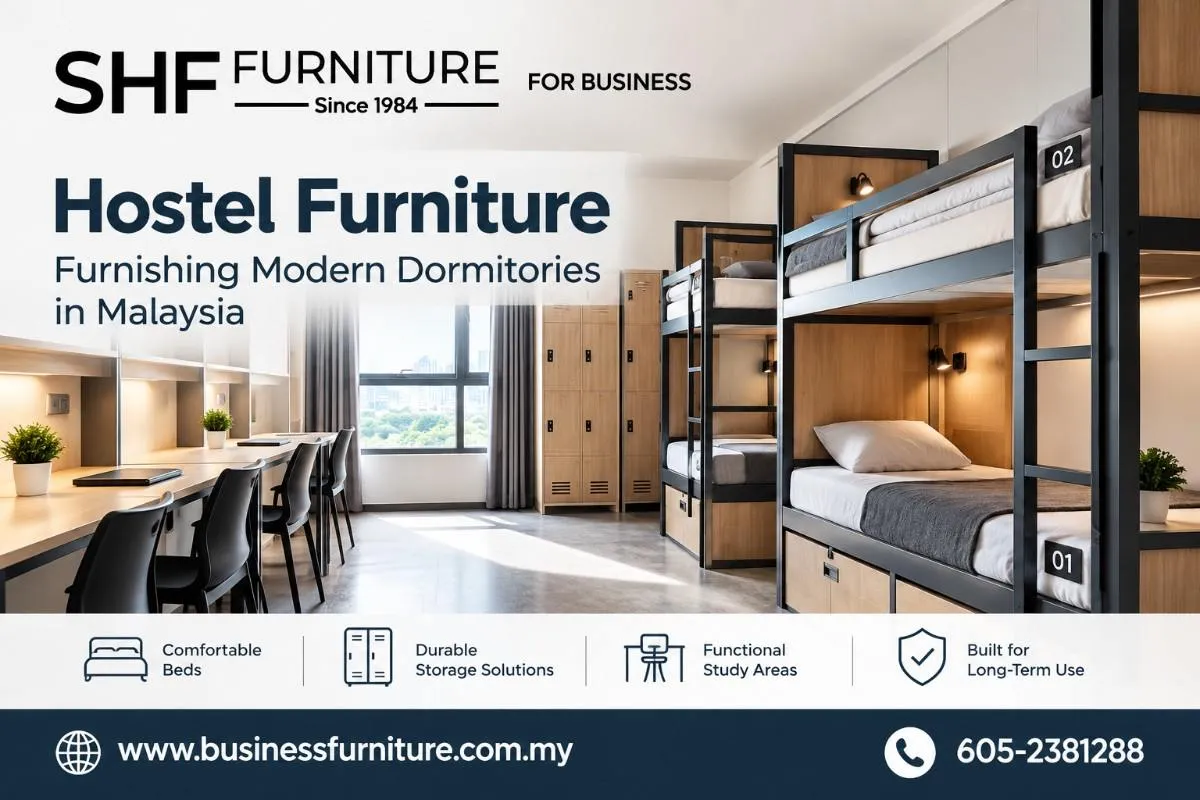
For administrators looking for a reliable starting point, Business Furniture offers a dedicated range of hostel furniture designed specifically for student accommodation environments in Malaysia. Their product range covers complete room sets — from bed frames and study desks to wardrobes and lockers — built for institutional use. Visit the SHF Furniture to explore their full range of commercial and institutional furniture solutions.
Frequently Asked Questions
What type of bed frame is best for student hostels?
The most practical choice for student hostels is powder coated steel bunk beds. They are durable, rust-proof and easy to maintain. Frame must have minimum load rating of 150 kg per bunk level. Full length guard rails on upper bunk for safety compliance.
How long should hostel furniture last before replacement?
Quality institutional hostel furniture should last between seven to ten years under normal student use. Cheaper alternatives may require replacement within two to three years. Choosing furniture with a structural warranty of at least two to five years is a good indicator of build quality and supplier confidence.
What is the standard study desk height for student accommodation?
The height of the study desk for student hostels is 720 mm to 750 mm Most secondary and tertiary students, seated in a standard upright position, are within this range. Choosing the right desk height and ergonomically appropriate chair will help to reduce fatigue and help you concentrate better while studying.
Is it necessary to comply with Malaysian furniture safety standards for hostel procurement?
In Malaysia for the institutions associated with the government, the compliance to Department of Standards Malaysia (DOSM) guidelines is a must. It is also highly recommended that private schools and colleges follow the same standards. Compliance keeps students safe from harm, limits liability for administrators and guaranties furniture will perform as specified for its intended life span.
How do I calculate the furniture budget for a student hostel?
Budget for a complete bedding set, which usually includes a bed, mattress, study table, chair, wardrobe and a storage unit. Add delivery and installation, plus a contingency for replacement parts. Obtain quotes from at least three vendors and compare based on total cost of ownership, not just initial unit price.
What furniture is essential for a basic student hostel room?
A functional student hostel room should include a bed frame with mattress support, a study desk, a chair, a wardrobe with hanging and shelf space, and a personal storage unit or locker. Optional but good additions are overhead shelves, a bedside shelf, and a mirror panel incorporated into the wardrobe door.























Sign in to leave a comment.