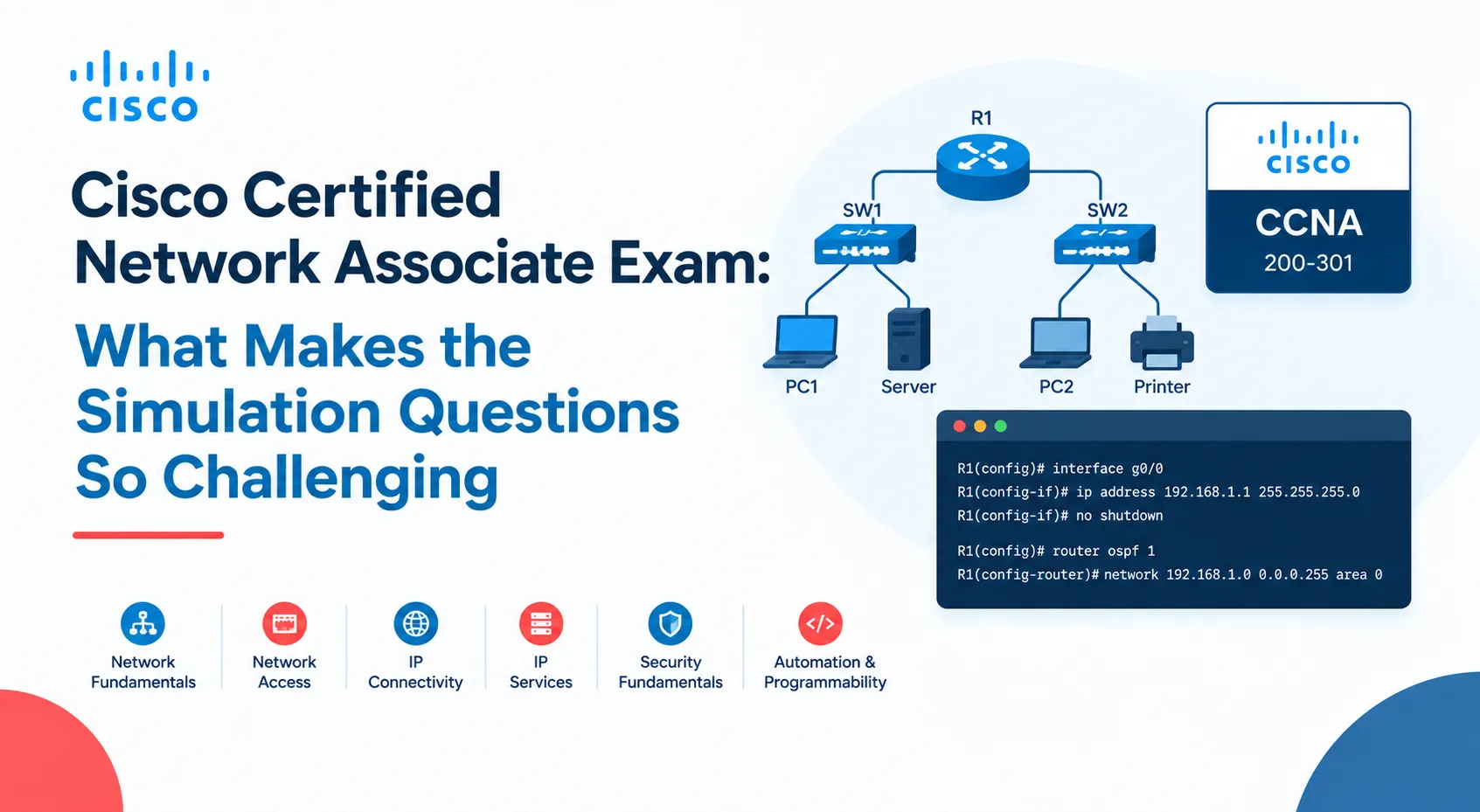

The Cisco Certified Network Associate exam isn't just multiple choice. It includes hands-on lab simulations where you actually configure routers and switches. If you're new to networking, this format can catch you off guard. This article breaks down what these simulation questions actually test, why they're harder than they look, and how to prepare for them properly.
What Makes the Cisco Certified Network Associate Exam Different?
Most entry-level IT certifications stick to multiple choice. The Cisco Certified Network Associate 200 301 test doesn't. You will be doing simulation tasks like configuring static routing, subnetting the network, and setting up VLANs and trunks on virtual machines. These are not just theory-based questions. You are provided with the topology, requirements, and console access, and you have to make the network work. This alone sets the CCNA exam apart from certifications that only test recall.
Why the Certified Network Associate Exam Punishes Fuzzy Thinking
The Cisco Certified Network Associate certification exam tests individuals who are able to troubleshoot problems all the way through to completion. It is made up of fundamental concepts such as switch address learning, router path selection, and the consequences of just one bad subnet mask. A test taker who only knows something about VLANs will think that the problem lies with routing, whereas the problem is actually a lack of trunking configuration. The CCNA exam is built to catch exactly that kind of mistake. Network access topics like VLANs and trunks aren't isolated facts either. They determine whether traffic even reaches a gateway in the first place.
What the Cisco 200 301 Exam Simulation Labs Actually Test
This is where the Cisco Certified Network Associate exam gets genuinely difficult. A typical lab might ask you to configure routing so one router prefers a specific path, then set up a backup path using a floating static route. Another might involve subnetting an address block correctly while assigning specific usable IPs to interfaces. Some labs cover IP services, like configuring NAT, NTP, DHCP, and SSH in a required order, all in one connected scenario. You're not just answering a question on the CCNA exam. You're building a working piece of a network.
Common Mistakes Beginners Make on the Cisco 200 301 Exam Simulations
A few patterns show up again and again with new candidates taking the Cisco Certified Network Associate exam.
- Confusing Layer 2 and Layer 3 problems, then troubleshooting the wrong layer entirely
- Rushing subnetting tasks and miscounting usable host addresses
- Forgetting administrative distance rules when configuring floating static routes
- Skipping verification steps, like confirming SSH access actually works after configuration
None of these mistakes means you're not ready for the CCNA exam. They just mean specific areas need more hands-on practice before test day.
How to Build Real Readiness for the Cisco Certified Network Associate Exam Questions
Reading about subnetting or static routing only gets you so far. The real skill comes from practicing configuration tasks and explaining your reasoning out loud, not just recognizing the right answer on a page. Trying Cisco Certified Network Associate exam questions gives you a sense of how these scenarios are structured, so simulation-style thinking isn't something you're encountering for the first time during the real CCNA exam. It's a practical way to find out whether your weak spot is routing, VLANs, or IP services before it costs you points.
Why the Certified Network Associate Exam's Difficulty Is Actually a Good Sign
The Cisco 200 301 exam is a difficult one, but it is so due to the fact that it simulates real networking tasks. There is no need to worry about the exam being designed to trick the candidates. The ability to track a packet from start to finish and justify all your decisions would do the trick. That skill matters a lot more once you're managing an actual network, not just holding a certificate.
If you're exploring other networking certifications too, CertBoosters covers preparation resources across a wide range of vendor exams.
Going in with a clear understanding of how routing, switching, and IP services connect won't make the simulations disappear. But it will make them feel a lot more familiar once you're working through one for real.
























Sign in to leave a comment.