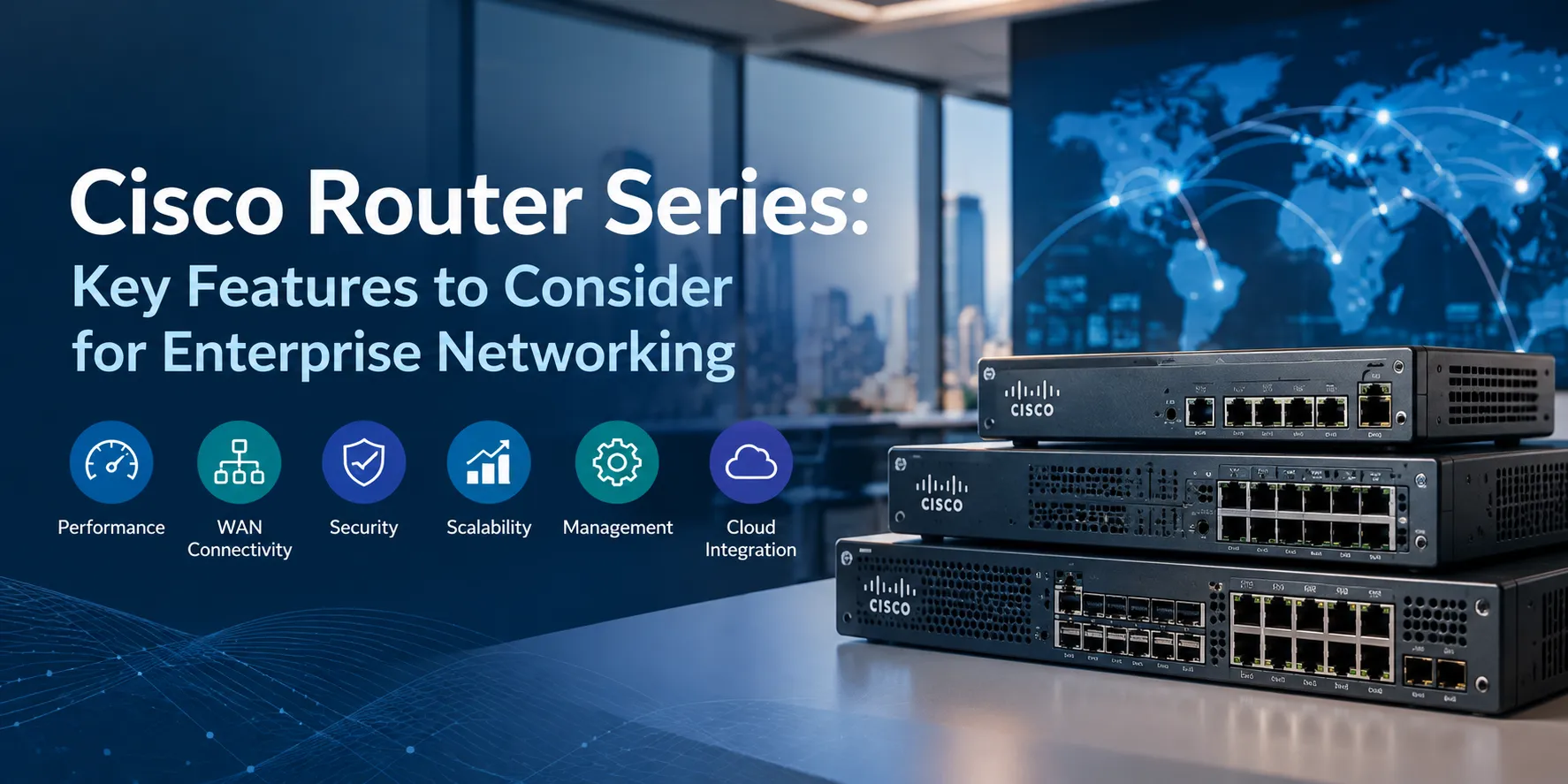

Enterprise networks are becoming increasingly distributed. Employees work from different locations, applications are hosted in the cloud, and organizations depend on real-time services such as video conferencing and collaboration platforms.
In this environment, the router is more than a device that forwards packets. It can become an important part of connectivity, security, traffic management, and branch networking. Understanding the Cisco router series can therefore help organizations plan network infrastructure around their operational requirements.
The Role of Routers in Enterprise Networks
A router connects different networks and determines how traffic should move between them.
In an enterprise environment, this may involve communication between branch offices, headquarters, data centers, cloud platforms, remote users, and external services.
The router needs to handle these connections efficiently while supporting the organization's security and management policies.
1. Routing Performance
The first consideration is the amount and type of traffic the router needs to handle.
A network supporting cloud applications, video meetings, VoIP, large file transfers, and business-critical applications may have significantly different requirements from a small office.
When comparing a Cisco Router Series, organizations should consider expected throughput and the impact of additional features on performance.
2. WAN Connectivity
Enterprise organizations often rely on multiple WAN connections.
Depending on the architecture, a router may need to support different connectivity methods and provide reliable communication between locations.
Organizations should evaluate current WAN requirements while also considering future connectivity plans.
3. Network Security
Security is increasingly integrated into modern networking.
Routers may participate in VPN connectivity, traffic controls, access policies, and broader security architectures.
The security requirements of the organization should therefore be evaluated before selecting a router series.
4. High Availability
Network downtime can interrupt business applications and communication.
Organizations with critical connectivity requirements may need redundancy and high-availability strategies. Router selection should therefore consider how the device will fit into the organization's overall resilience architecture.
5. Centralized Management
Managing routers individually can become difficult as the number of locations increases.
Centralized management and monitoring can help IT teams maintain visibility across distributed infrastructure, identify problems, and apply consistent policies.
This becomes particularly valuable for organizations with many branch offices.
6. Cloud and Hybrid Connectivity
Many businesses now operate across on-premises infrastructure, private environments, and public cloud services.
Routers need to fit into this broader architecture and provide reliable connectivity between different environments.
When evaluating a Cisco Router Series, organizations should consider how the router will integrate with their existing cloud and network architecture.
7. Future Expansion
Network infrastructure should not only address current requirements.
Organizations should estimate potential increases in:
- Users
- Devices
- Locations
- Cloud applications
- Internet traffic
- Video collaboration
- IoT deployments
Planning for future requirements can reduce the likelihood of replacing infrastructure prematurely.
A Practical Cisco Router Selection Checklist
Before selecting a router, IT teams should ask:
- How much traffic does the network currently generate?
- What bandwidth will be required in the future?
- How many WAN connections are needed?
- Which security capabilities are required?
- Is redundancy necessary?
- How many locations need to be connected?
- Is centralized management required?
- Which cloud services need to be accessed?
- What interfaces are required?
- How will the network scale over the next few years?
Answering these questions can significantly simplify the process of comparing different router solutions.
Conclusion
Enterprise routing is not simply about moving data from one network to another. Performance, WAN connectivity, security, availability, management, and scalability all influence how effectively a network can support business operations. Evaluating these elements together makes it easier to select a Cisco Router Series that fits both current workloads and future requirements.
With experience across Cisco networking solutions, Inexa Technology works with businesses that need reliable routing and enterprise network infrastructure. Its expertise can support organizations through product evaluation and solution planning based on their specific technical environment.
Get in touch with Inexa Technology for Cisco router guidance and enterprise networking requirements.
Frequently Asked Questions
Why are there different Cisco Router Series?
Different series are designed to address different networking environments, performance levels, connectivity requirements, and deployment scenarios.
What should enterprises look for in a Cisco router?
Enterprises should consider performance, WAN connectivity, security, scalability, redundancy, management, interfaces, and compatibility with the existing network architecture.
Can Cisco routers support multi-location businesses?
Yes. Cisco routing solutions can be deployed across branch and distributed network environments, with the appropriate model and architecture depending on business requirements.
Is scalability important when choosing a router?
Yes. Network traffic and connectivity requirements can grow as an organization adds users, devices, locations, and applications. Scalability should therefore be considered during initial selection.
Can a Cisco router be integrated into an existing network?
Cisco routers can be deployed within existing network architectures, but compatibility, interfaces, routing protocols, configuration, and security requirements should be evaluated before deployment.





















Sign in to leave a comment.